AI Weekly: Top Coding Model Returns, Google's New Flash Checkpoint, and the Video Generation Race

Anthropic's top coding model is back, Google quietly tests a new Flash checkpoint, and Figure AI robots hit the factory floor.
This week saw Anthropic's flagship coding model return to global availability alongside new cybersecurity classifiers, while Google quietly benchmarked a new Gemini Flash checkpoint on LM Arena. The video generation race intensified with a head-to-head comparison of Omni Flash, SeaDance, Happy Horse, and Veo 3.1. Meanwhile, Figure AI's robots reportedly began real deployments in BMW factories — a milestone for embodied AI moving from demo to production.
This week was packed with AI updates — from the global redeployment of a top-tier coding model, to a leaked Google Flash model test, to fierce competition in video generation. Here's a breakdown of the key developments and what they mean for the industry.
Note: This article is based on content analysis from the YouTube channel World of AI. Some product codenames (e.g., Fable 5, Mythos 5) refer to models in the Anthropic Claude family — context should make their meaning clear.
Top Coding Model Returns Globally, With Enhanced Safety Mechanisms
After nearly three weeks offline, Anthropic's flagship coding model (referred to as "Cloud Fable 5" in the source material) is back on the global market. It had been pulled due to a temporary U.S. government export control order. Now that the restriction has been officially lifted, the model is available again across Cloud AI, the Cloud API, Cloud Code, and Cloud Cowork.
The Geopolitical Context of Export Controls: U.S. government controls on AI model exports reflect the broader tech geopolitics of recent years. Since 2023, the Commerce Department's Bureau of Industry and Security (BIS) has brought certain advanced AI models under export control frameworks, citing concerns about their potential use in military applications or weapons of mass destruction development. This pairs with chip export restrictions (such as limits on selling H100 GPUs to China) to form a strategic U.S. apparatus for controlling the spread of AI technology. For companies like Anthropic, restricted global access isn't just a commercial loss — it's also forcing them to build out compliance frameworks faster, including pre-release testing mechanisms and jailbreak information-sharing agreements with the government. This "regulation in exchange for market access" dynamic is reshaping how top AI labs relate to government.
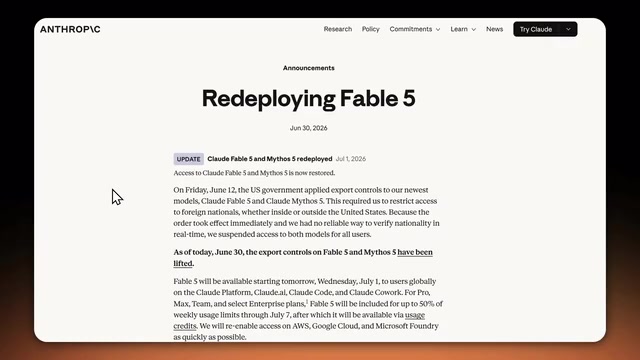
This return isn't a simple rollback to the status quo. Anthropic has introduced a new suite of cybersecurity classifiers designed to detect and block dangerous requests.
How Cybersecurity Classifiers Work: These classifiers are essentially specialized text classification models trained to determine in real time whether a user's input involves dangerous intent — such as synthesizing biological or chemical weapons, or generating cyberattack code. The technical approach typically involves: binary classifiers fine-tuned on large sets of harmful and benign examples; preference models derived from reinforcement learning from human feedback (RLHF); and hybrid architectures combining rule engines with neural networks. The core challenge is balancing precision and recall — being too sensitive leads to false positives that block legitimate security research or penetration testing, while being too permissive lets genuinely dangerous queries through. Anthropic has acknowledged that false positive rates are elevated during the tuning phase, causing some normal coding tasks to be downgraded — a real-world engineering reality.
Because the classifiers are still being tuned, some normal coding and debugging tasks may temporarily fall back to a lower-tier model (Cloud Opus 4.8) until false positive rates are reduced.
Deployment strategy has also shifted: for Pro, Max, Team, and some Enterprise users, this model will consume up to 50% of weekly usage allowances until July 7, after which it transitions to a usage credit system. Anthropic also announced plans to build a shared industry framework with partners like Amazon and Microsoft to assess AI jailbreak risks, and to deepen cooperation with the U.S. government on pre-release model testing, jailbreak information sharing, and AI safety research.
Benchmarks: Leading Quality, But Cost Is the Biggest Barrier
Real-world tests confirm that the model's coding capabilities haven't diminished. In HTML5 physics engine tests, it outperformed GLM 5.2, GPT 5.5, and Opus 4.8 across multiple scenarios — at a steep price, roughly six times the cost of Opus 4.8.
Specific comparisons: building three independent canvas physics demos, this model used approximately 62,000 tokens at a cost of about $3; GPT 5.5 used 37,000 tokens at about $1; Opus 4.8 used only 22,000 tokens at $0.50; and GLM 5.2 used 36,000 tokens at just $0.08.
Understanding Token Economics and Cost Structure: A token is the basic unit of text that large language models process — roughly 0.75 English words or 1–2 Chinese characters. Models are typically priced separately for input and output tokens, with output token prices often several times higher than input. The cost gap above (the top model at ~$3 vs. GLM 5.2 at just $0.08) reflects the current market's layered structure: top U.S. labs trade massive compute for peak performance, while Chinese teams achieve extreme cost efficiency through architectural optimization and scale. For enterprise users, token costs directly affect AI application ROI, which is why "price-performance ratio" is becoming just as important a selection criterion as raw capability.
The model scored above 8 in all scenarios, including realistic collisions, accurate object physics, and clean destruction effects — no floating or clipping artifacts. GPT 5.5 was the closest competitor and even edged ahead in the "monster truck" test. GLM 5.2 didn't win any individual category, but delivered solid output quality at an extraordinarily low cost.

The most impressive demo involved someone challenging the model to "rebuild GTA 6." The entire demo was generated from a single prompt — the model wrote all the game code and procedurally generated every 3D asset, with no external models or prefab resources. This ability to produce a complete interactive scene from a single prompt showcases the remarkable potential of today's top coding models.
Google's New Gemini Flash Checkpoint Quietly Under Testing
Google is testing a new Gemini Flash checkpoint on LM Arena, with early feedback suggesting it performs noticeably better than the current version. This comes amid a streak of controversy around Gemini — disappointing checkpoints, researchers leaving the platform — making the new version look like a strong response.
How LM Arena Works: LM Arena (formerly Chatbot Arena), developed by a UC Berkeley team, is an open AI model evaluation platform that uses a "blind matchup" system: users interact with two models without knowing their identities and then vote, with results used to compute Elo-based rankings. This methodology's strength is that it reflects real user experience, avoiding the "benchmark gaming" that plagues traditional evaluations like MMLU or HumanEval. It has become standard practice for tech companies to submit models anonymously to Arena before official release — both to gather genuine user feedback and as a low-key market warm-up.
The naming is still unclear. Testers have spotted both "Gemini 4 Flash Preview" and "Gemini 3.6 Flash Preview" in model identifiers; it may ultimately launch as Gemini 3.6 Flash, Gemini 4 Flash, or something else entirely. The consensus among testers is that this isn't a generational leap — it's a solid incremental upgrade with a perceptible improvement in output quality.

On SVG generation — a traditional Gemini strength — the new checkpoint continues to impress: whether generating a "pelican riding a bicycle" (detailed down to tire smoke) or SVG renderings of a PS5 or Xbox controller, the quality far exceeds what you'd expect from a Flash-tier model. Voxel art performance is middle-of-the-road, reasonable for a Flash variant.
Google DeepMind also quietly released two additional models: Nanobanana 2 Lite (billed as the fastest and cheapest Gemini image model, suited for large-scale everyday image generation) and Gemini Omni Flash (a video generation and editing model for developers, now available via the Gemini API and Google AI Studio).
GPT-5.6 Codex Context Window Raises Eyebrows
A new report on GPT-5.6's behavior in Codex suggests its context window may be 372,000 tokens. This comes from model configuration details discovered in an openclause commit and has not been officially confirmed by OpenAI.
The Technical Significance and Engineering Challenges of Context Windows: A context window determines how much information a model can "remember" and process in a single inference pass. Technically, window size is constrained by the computational complexity of the attention mechanism in Transformer architectures — standard self-attention scales at O(n²) with sequence length, meaning million-token context requires enormous memory and compute. The industry has developed several optimization approaches: sparse attention, sliding window attention (like the GQA used by Mistral), and alternative state-space architectures (like Mamba). A 372,000-token window is roughly equivalent to 300 pages of A4 text — far below Gemini 1.5 Pro's 1 million tokens, but sufficient for the vast majority of codebase analysis tasks. The gap between user expectations and what actually shipped reflects the real-world tension between performance, cost, and latency constraints in commercial deployment.
The figure has generated some concern — the industry widely expected a 1 million-token context window, and 372,000 tokens falls noticeably short. It's still a very usable scale, but the specifics will need clarification from OpenAI.
Video Generation: The Speed vs. Quality Tradeoff
Competition in video generation is intensifying. In a head-to-head benchmark, Google Gemini Omni Flash was directly compared against SeaDance 2.0, Happy Horse 1.1, and Veo 3.1.
The Architectural Evolution of Video Generation Models: Most leading video generation models today are built on the Diffusion Transformer (DiT) architecture, extending image diffusion's denoising generation paradigm into the temporal dimension, applying consistency constraints along the time axis to achieve smooth frame-to-frame transitions. Models like Veo, SeaDance, and Happy Horse build on this with optical flow estimation, physics-prior constraints, and multi-modal conditioning to improve scene logic consistency. Omni Flash's failure in the "drone hitting a utility pole" scenario reveals a fundamental weakness in lightweight Flash models when it comes to physical common-sense reasoning — this capability requires large numbers of parameters to store an implicit model of the physical world, and is fundamentally at odds with the speed and low-cost goals of the Flash positioning.
The results confirmed the "Flash" positioning: Omni Flash generated a 10-second video in just 31 seconds at a cost of approximately $1.32, making it the fastest and cheapest option. But quality is also the weakest — in a scene of a "drone flying through a train heading into New York," the drone would just crash straight into a utility pole, with clearly inadequate scene logic. By contrast, SeaDance 2.0 had the cleanest visuals, Happy Horse showed strong prompt comprehension, and Veo 3.1 was the most natural overall.
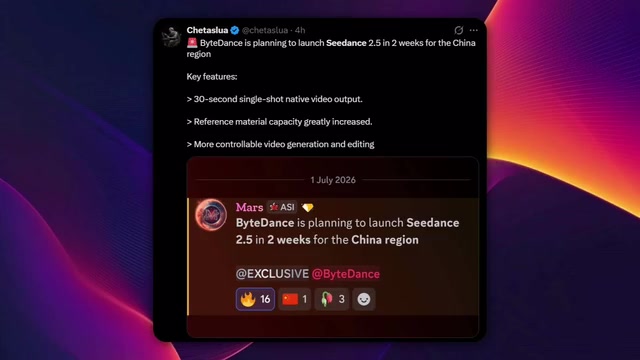
On the SeaDance front, ByteDance reportedly plans to launch SeaDance 2.5 in the Chinese market within two weeks. It's expected to bring native 30-second single-shot video generation, higher reference material capacity, and more controllable video generation and editing. Native 30-second single-shot generation is one of the current technical bottlenecks — longer sequences require the model to maintain global consistency over a larger time span, placing higher demands on both architecture and training strategy. Longer single-shot output and stronger controllability are exactly the directions that video generation models need to break through, and if accurate, this would be a major leap for SeaDance.
Other Notable AI Developments
Beyond the major updates above, a few other items are worth noting this week:
- ZAI (the team behind the GLM series) launched a new IDE tool supporting long-running autonomous coding workflows and verifiable programming tasks, available on Linux, Windows, and macOS.
- Musk's xAI released Voice Agent Builder, a no-code voice agent creation platform powered by Grok Voice, priced at $0.05 per minute, allowing developers and businesses to build human-like voice agents without writing code from scratch.
- Figure AI robots may be the week's most industrially significant signal. Figure 03 is reportedly being deployed in BMW factories for real logistics and manufacturing tasks — meaning Figure is no longer just demoing capabilities, but actually entering production environments to handle repetitive physical labor.
The Path to Commercializing Embodied AI: Embodied AI refers to intelligent systems capable of perceiving, reasoning, and acting in the physical world — the key leap from AI in the "digital world" to AI in the "physical world." Companies like Figure AI typically operate across three technical layers: low-level motion control (RL-based gait and grasping policies), mid-level task planning (vision-language model-driven scene understanding and instruction decomposition), and high-level human-machine interaction (natural language instruction intake and feedback). The real-world BMW factory deployment is highly significant: factory environments are relatively structured with high task repetitiveness, making them an ideal entry point for embodied AI. This contrasts with the path taken by predecessors like Boston Dynamics, which long remained in the demo phase. Figure's approach of "limited scenarios, real deployment" to gain commercial validation has driven its valuation from $500 million to $39 billion in 28 months — a clear signal of how much capital markets appreciate this strategy.
Wrap-Up
This week's dense wave of updates once again underscores the speed at which the AI industry iterates. From the return of a top coding model with upgraded safety mechanisms, to Google's low-key Flash checkpoint testing, to the speed-vs.-quality tradeoffs playing out in video generation — every direction is evolving rapidly. The news of Figure AI entering a real factory signals that embodied AI is moving from demos to deployment. With more new models on the horizon, the next stretch promises to stay exciting.
Key Takeaways
Related articles

The Truth Behind Codex 'Build a Website in 5 Minutes': AI Isn't Creating Sites—It's Helping You Copy Them
Exposing the truth behind viral Codex 5-minute website videos: creators aren't building original sites with AI—they're copying shared prompts or scraping others' work. Learn AI coding tools' real limits.

Getting Started with AI Agent Development: A Complete Guide from Concept to Practice
A comprehensive guide to AI Agent architecture and development, covering automated marketing, intelligent customer service, and investment analysis scenarios with single and multi-agent collaboration.

The Truth Behind Codex 'Build a Website in 5 Minutes': AI Isn't Creating Sites — It's Helping You Copy Them
Exposing the truth behind viral Codex 5-minute website videos: creators aren't building original sites with AI — they're copying shared prompts or scraping others' work.