AI Writes 90% of the Code—Who Reviews It? Breaking Down Anthropic's Code Review Practices

Claude Code team writes 90% of code with AI and cuts rollbacks by over 40%, rebuilding the entire software trust chain.
The article breaks down the engineering practices of Anthropic's Claude Code team: about 90% of the product's code is written by AI, merged PRs more than doubled from June to September 2026, yet the rollback rate dropped by over 40%. The core isn't having AI write code and then a human glance at it, but stringing verification, review, risk tiering, approval, release, and post-hoc feedback into a complete trust chain. Before submission, AI runs tests and builds, compares screenshots, and is rechecked by an independent sub-agent; after submission, multiple review agents search for problems in parallel, another group verifies and filters false positives, and bug/security reviews and CI jointly gatekeep; human approval is risk-tiered—low risk can be exempt, medium risk requires one person, high risk requires two, and sensitive paths always require human intervention. The team also found that too many review rounds are inefficient, so they remind authors to change approach after three rounds, focus on newly added changes afterward, and use feature flags, merge queue re-runs, and incident retrospectives to distill test cases and close the loop.
Claude Code team has about 90% of its code written by AI, with merged PRs doubling while the rollback rate drops by over 40%. This article breaks down their code review practices: AI self-verification, parallel review with independent verification, risk-tiered approval, feature flags, and incident retrospectives—revealing how to build a trust chain in the age of AI programming.
AI is writing code faster and faster, but a sharp question follows: after it's written, who checks it? In a video, Bilibili creator CCLucky breaks down the engineering practices of Anthropic's Claude Code team, offering a set of answers worth emulating—they don't just let AI write code and then have someone glance at it. Instead, they string together verification, review, risk tiering, approval, release, and post-hoc feedback into a complete trust chain.
90% of Code Written by AI, Yet Rollback Rate Declined
The Claude Code team revealed that about 90% of this product's code is written by Claude itself. What's more noteworthy is the outcome data: between June and September 2026, the number of merged PRs more than doubled, while the proportion requiring rollback dropped by over 40%. These numbers break the intuitive judgment that "more AI-written code inevitably means worse quality."
The key is that the team didn't separate "writing code" from "reviewing code." After AI output accelerated, they focused on engineering the review process, letting machines handle high-frequency checks while people focus on high-risk decisions.
Before Submitting, Let AI Prove Itself
The first problem the team solved: when AI says "done," how do you know it actually did it right?
Their approach is to have Claude run tests and builds before submitting a PR. If interface changes are involved, they also compare screenshots against design mockups. Then, a sub-agent that didn't participate in writing reviews the changes again. This way, what people see isn't just the code itself, but the complete check results—whether tests passed, whether the build succeeded, whether the interface matches the design.
The essence of this step is to let AI prove itself first, turning the subjective claim "I'm done" into verifiable evidence.
Parallel Review Plus Independent Verification to Filter False Positives
After the PR is submitted, multiple review agents search for problems in parallel. But agents can also produce false positives—what then? The team has another group of agents independently verify and filter out unreliable findings. The remaining review comments have only two paths: either fix them or explain why and close them.
Whether code can be merged doesn't depend solely on AI reviewers. Bug review, security review, and CI all play a role. Test types, checks, and builds must pass, and bug or security reviews must have no unresolved findings—otherwise the PR can't get through. Each layer of checks has a different focus, collectively reducing the chance of omissions.

PR (Pull Request) is a core mechanism in modern code collaboration platforms (such as GitHub, GitLab): after a developer completes changes on a separate branch, they initiate a PR request to merge it into the main branch. The PR page centrally displays the diff, commit history, CI check results, and review comments, so it naturally becomes the vehicle for "review." In AI programming scenarios, the significance of PR is further amplified—it's no longer just a review entry point between people, but the convergence point for all automated checks, multi-agent reviews, risk tiering, and approval rules. Routing AI output uniformly through the PR process allows every change to leave a traceable evidence chain and makes it easy to attach verification and rollback mechanisms before and after merging.
CI (Continuous Integration) refers to the automated pipeline executing builds, tests, static checks, and other tasks in a unified environment after each code change is submitted, and feeding the results back to the PR. Its value lies in turning "whether it runs" from manual verification into a threshold automatically executed on every commit. The article mentions "test types, checks, and builds must pass, otherwise the PR can't get through," which sets CI results as a hard condition for merging. The division of labor between CI and AI review is also clear: CI handles objective, repeatable factual judgments (whether compilation succeeds, whether tests pass), while AI reviewers handle pattern-recognition-level problem discovery. Only by combining both can you ensure basic quality while covering semantic-level hidden risks.
Human Approval Still Exists, but Intensity Depends on Risk
So do humans still need to approve? Yes, but the intensity depends on the risk level. According to the video, low-risk changes that meet conditions such as trusted authors and pass automated checks may not require human approval; medium-risk changes require one person's approval; high-risk changes require two. Some sensitive paths always require human intervention—where someone should approve, AI cannot take over.
The brilliance of this tiered mechanism is that it doesn't treat "human approval" as a one-size-fits-all process. Instead, it treats human attention as a scarce resource, prioritizing it for places that truly require judgment.
More Review Rounds Doesn't Mean More Efficient
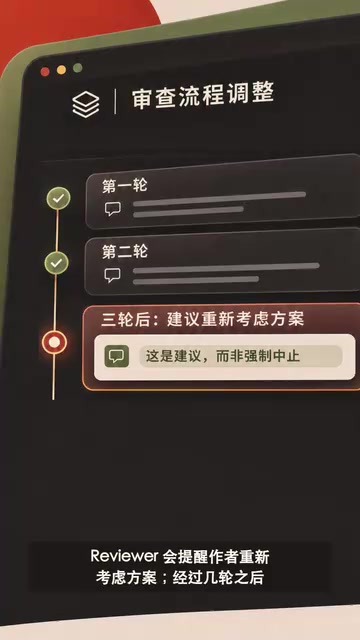
The team also shared a counterintuitive finding: more review rounds don't necessarily mean higher efficiency. There was once a PR that went through over 50 rounds of repeated review and revision overnight, falling into an inefficient loop.
So they adjusted the process: after three rounds, the reviewer reminds the author to reconsider the approach. After several rounds, the review focus shifts to newly added changes—because even if the overall change passed review, newly added modifications might slip through.
After Release: Re-running Checks, Feature Flags, and Incident Retrospectives
The merge queue re-runs checks on top of the latest main branch to avoid missing conflicts or regressions due to a lagging branch. New features are usually placed behind feature flags first, used internally, and then gradually released. If problems occur after launch, you can turn off the feature flag and then roll back as soon as possible to control the impact.
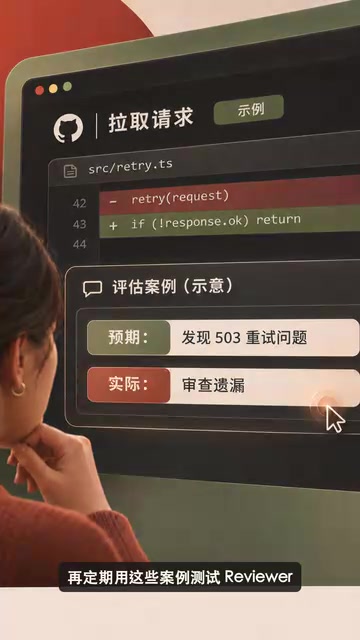
Furthermore, the team compiles incidents that occurred, related PRs, and fixes into evaluation cases, has engineers familiar with the code confirm them, and then periodically uses these cases to test reviewers. This way, every incident has a chance to help the team discover what's still missing in review.
Feature Flag is an engineering technique that decouples "code deployment" from "feature release": new code can be merged and deployed to production first, but is disabled by default through flag configuration and invisible to the outside. The team can enable it only for internal employees or a small percentage of users, observe metrics and error rates, and then gradually ramp up. Once an anomaly occurs online, turning off the flag can stop the new logic from taking effect within seconds, without urgently rolling back the entire version. This complements the article's mention of "turn off the feature flag, then roll back as soon as possible": flags are for quick止血 (stopping the bleeding), while rollback is for thoroughly undoing problematic code. In an environment of high-frequency AI output, feature flags can minimize the blast radius of failures and are an important safety valve in the trust chain.
What's Rebuilt Is the Entire Trust Chain, Not Just the Review Step
The Claude Code team's approach isn't as simple as finding an AI to look over the code once. It connects verification, review, risk, approval, release, protection, and post-hoc feedback. AI handles high-frequency checks and organizes evidence; humans decide direction, focus on high-risk changes, and are accountable for delivery results.
AI changes more than the speed of writing code—it changes the trust chain by which teams build software. Humans set the direction, and systems fortify the defenses—this may be the most pragmatic engineering paradigm in the age of AI programming.
Related articles

How Does Chemotherapy Damage Ovarian and Bone Health?
Alkylating agents like cyclophosphamide in chemotherapy can cause ovarian toxicity, affecting bone health in breast cancer patients. Learn about baseline DEXA scans, biennial follow-up, and monitoring for aromatase inhibitor, tamoxifen, and GnRH agonist users.

USMLE Radiology 12-Question Challenge: Core Imaging Diagnosis Points Explained
Using a 12-question USMLE radiology quiz, this article explains key imaging points for pneumothorax, pleural effusion, intussusception, bowel obstruction, Salter-Harris classification, gout, SAH, and ischemic stroke, plus MRI in pregnancy and multiple myeloma.

Hot Flashes and Menopausal Symptoms After Cancer: A Guide to Non-Hormonal Management
How to manage menopausal symptoms after cancer? This article reviews guideline-recommended non-hormonal options: water-based lubricants, SNRIs/SSRIs, gabapentin, plus psychological support and environmental adjustments.