Ai2 at COLM 2026: From Open Models to Scientific Agents

Ai2 presents open models and a scientific agent framework at COLM 2026, staying true to its transparency-first research philosophy.
At COLM 2026, the Allen Institute for AI (Ai2) spotlighted three projects: Olmo Hybrid, which explores hybrid model architectures; Asta, an agent system designed for scientific tasks; and Bolmo, a new addition to its open model family. Together, these map out a clear trajectory from foundational model development to domain-specific agent applications. Ai2's hallmark is its thoroughgoing openness — releasing not just model weights but also training data, code, and evaluation pipelines. At a time when many top AI labs are moving toward closed development, Ai2's approach offers the research community an auditable, reproducible reference and a sustained demonstration that open collaboration can drive meaningful progress.
Ai2's Open Research Presence at COLM 2026
The Allen Institute for AI (Ai2) took center stage at COLM 2026 (Conference on Language Modeling), showcasing a series of advances in open language models, training infrastructure, and AI systems designed for scientific research. As an organization with a long-standing commitment to open research, Ai2 presented a comprehensive portfolio spanning from foundational models to high-level agent applications — and used the conference as an opportunity to engage with the broader research community.
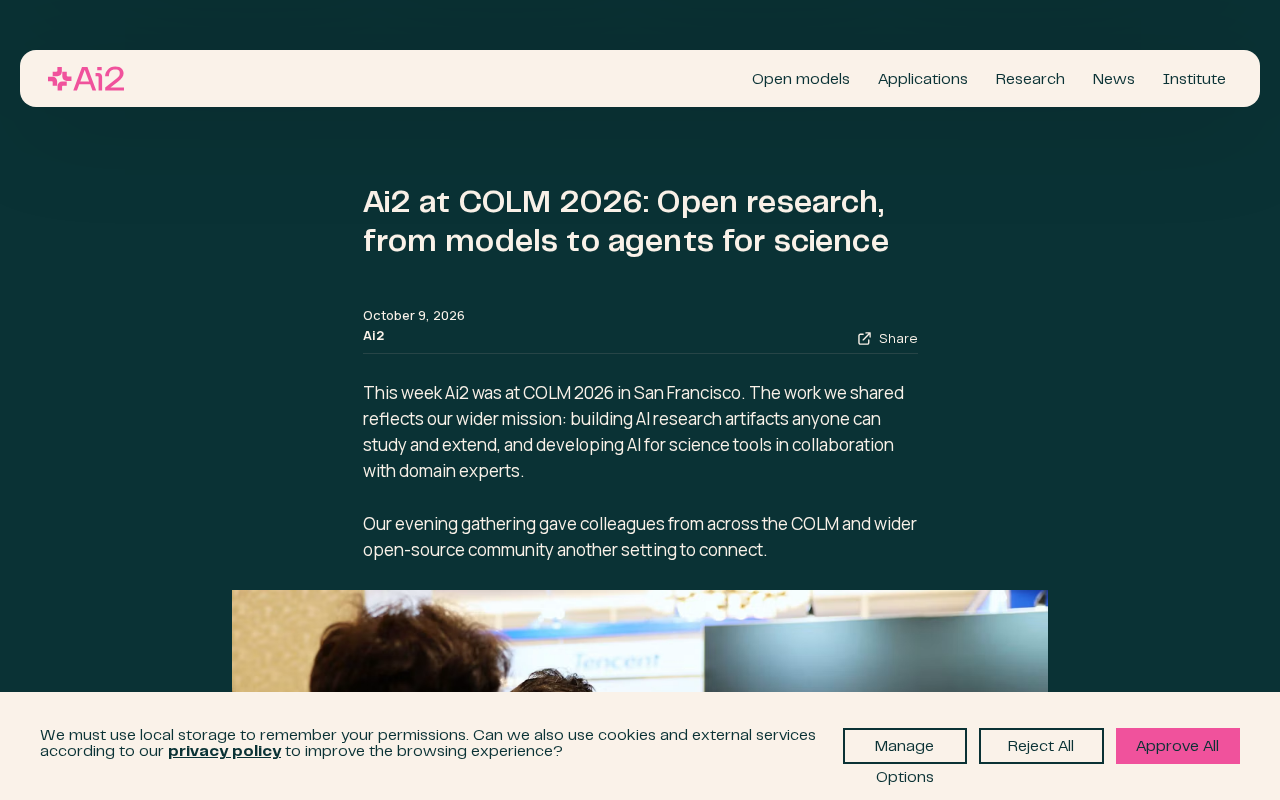
The central theme of this showcase can be distilled into a single question: how do you advance language models from systems that "can talk" to systems that "can do science" — all while maintaining openness and transparency? This aligns closely with the industry-wide trend of moving AI applications from general-purpose conversation toward specialized, domain-specific use cases.
Three Product Lines: Olmo Hybrid, Asta, and Bolmo
Based on publicly available information, Ai2 highlighted three distinct projects at the conference, each representing a different technical direction.
Olmo Hybrid: Advancing Training Infrastructure
The Olmo series has long been the flagship of Ai2's open model strategy — notable not just for open-sourcing model weights, but for releasing training data, code, and complete training pipelines. The name "Olmo Hybrid" suggests an exploration of hybrid architectures or hybrid training strategies, approaches typically aimed at balancing model performance with computational efficiency — a hot area in large model research today. For researchers looking to reproduce and improve upon open models, this kind of work delivers its value through a fully auditable and traceable technical stack.
"Hybrid architecture" in recent large model research typically refers to designs that combine the Transformer's attention mechanism with state space models (SSMs, such as Mamba). Pure Transformers scale quadratically in computational complexity with sequence length, while SSMs offer linear complexity but can fall short on fine-grained local reasoning. Hybrid architectures aim to get the best of both worlds: using attention in layers that require precise matching, and SSMs in layers focused on efficient sequence modeling — achieving a better tradeoff between inference speed and model capability. Ai2's previously released OLMo 2 demonstrated competitive performance under constrained compute budgets. Olmo Hybrid continues in that spirit, exploring whether architectural innovation can further close the gap with closed-source frontier models — without sacrificing full openness.
Asta: An Agent Built for Science
Asta represents Ai2's concrete attempt to realize its "AI for science" vision — transforming language models from content generation tools into agents capable of assisting with, or autonomously executing, scientific research tasks. Scientific settings place much higher demands on AI systems: accuracy is paramount, but so is interpretability and rigorous command of domain knowledge. Elevating a model to an agent means the system must be capable of planning, invoking tools, and iterating through multi-step reasoning.
The core challenge for a scientific agent lies in integrating the natural language understanding of large language models with domain-specific tool chains. Typical implementation paths include enabling the model to invoke code execution environments, retrieve literature databases, operate experimental simulators, and dynamically adjust its action strategy based on intermediate results across multi-step reasoning. The key distinction from general-purpose conversational assistants is "closed-loop verification" — scientific tasks require a system not only to formulate hypotheses, but to design validation approaches and interpret results. Ai2's prior work in this space — including Semantic Scholar and S2ORC academic data resources — provides a natural knowledge foundation for Asta. Another critical benchmark for scientific agents is reproducibility: researchers must be able to audit every step in the agent's reasoning chain, rather than treating it as a black box. This aligns closely with Ai2's overall open research philosophy.
Bolmo: A New Addition to the Open Model Family
Bolmo is another model project featured in the showcase, further expanding Ai2's open model portfolio. While public materials offer limited technical detail, Ai2's consistent track record of openness strongly suggests that Bolmo will follow the same fully open release model as its predecessors.
The Significance of Open Research in Today's Landscape
At a time when many leading AI labs are moving toward closed development — offering capabilities exclusively through APIs — Ai2's open research approach carries particular weight. Openness here means more than downloadable model weights; the transparency of training data, methodology, and evaluation pipelines is what enables independent academic verification, safety audits, and downstream innovation.
COLM, as a conference dedicated to language modeling, provides an ideal venue for this kind of open research. Ai2's stated goal of "connecting with the broader research community" reflects a belief that open collaboration is a core driver of progress in the field — not merely a strategy for releasing technology.
The Evolution from Models to Agents
The overall arc of this showcase — from foundational models like Olmo Hybrid and Bolmo, to a scientific agent like Asta — clearly traces a path of technical evolution: from models to agents. This mirrors a broader paradigm shift underway across the AI field: the model itself is no longer the endpoint, but rather a component in building more complex, more autonomous task-execution systems.
For practitioners and researchers interested in AI applications in science, Ai2's work offers a valuable open reference worth following closely. It charts a clear technical direction while also offering a preliminary answer to the question of how AI can genuinely serve scientific discovery.
Related articles

Gemini 4 Argon Hands-On: AI Builds Board Games, Constructs Temples, and Trains Robots Autonomously
Gemini 4 Argon hands-on roundup: AI autonomously builds a desk racetrack and temple in Blender, writes a ray tracing engine, trains a humanoid robot to sink 7 shots, plus API pricing and developer access.

The Magic Octagonal Coin: Why Only 9% of People Can Predict Its Flip?
Only 9% of people can correctly predict the Magic Octagon coin flip. This article explains its spatial rotation mechanism, common cognitive pitfalls, and a new hypothesis based on Relevance Theory, exploring the limits of human spatial reasoning.

Sam Altman: AI Is Entering the Era of Scientific Discovery — Math Breakthroughs Will Replicate in Biology and Energy
Sam Altman says AI is entering the era of scientific discovery — math breakthroughs will replicate in biology, materials science, and energy to help develop new drugs and energy sources.