Airbnb Officially Announces AI Travel Agent, Launching in the First Half of 2027

Airbnb plans to launch an AI travel agent in the first half of 2027, covering the full process from itinerary planning to in-stay assistance.
Airbnb announced that it will launch an AI agent for travelers in the first half of 2027, positioned as a full-process assistant covering itinerary planning, option comparison, order management, and in-stay assistance. The article notes that the agent aims to flip the booking interaction from "people finding information" to "information finding people," replacing filter operations with natural-language needs. Pushing the launch to 2027 reflects the low error tolerance required of transactional agents in payments, inventory, and cancellation/change policies, as well as the difficulty of governing unstructured host-side data. If the agent takes on recommendation responsibilities, hosts' exposure logic may shift from photos and review rankings to the degree to which listing descriptions are structured. The official announcement did not disclose details such as technical architecture, model source, or cross-language support, and the agent's actual quality still depends on progress in listing data governance.
Airbnb is pushing AI from the backend recommendation algorithm to the front-end service layer. According to its official statement, an AI agent for travelers will launch in the first half of 2027. It is positioned not as a simple chatbot, but as a full-process assistant covering itinerary planning, option comparison, order management, and assistance during the stay.
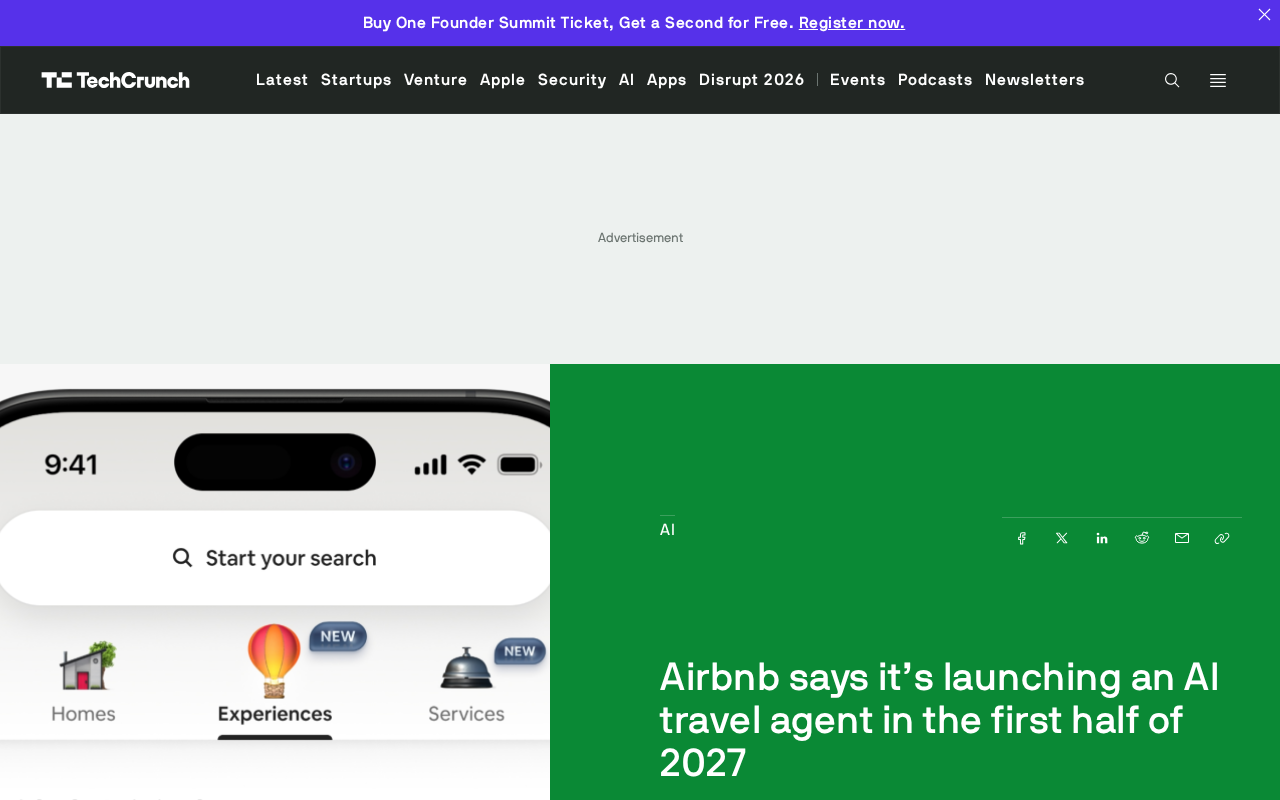
From Search Box to Agent: What Airbnb Wants to Change
In the past, when booking a stay on Airbnb, the user's core actions were to enter the destination, dates, and number of guests, then repeatedly adjust price and room type in the filters. This process is essentially "people finding information."
The AI agent aims to flip this interaction into "information finding people." Users can describe their needs in natural language—traveling with pets, needing quiet, limited budget, wanting to be near a certain neighborhood—and the agent is responsible for translating these vague conditions into executable searches and comparisons, and then giving recommendations.
The difference between "people finding information" and "information finding people" corresponds to two different system architectures in technical implementation. Traditional search relies on users actively constructing queries, and the system returns matching results; the core is retrieval and ranking. Agent-based interaction introduces an intermediate layer: the agent first understands the user's natural-language intent, decomposes it into multiple subtasks (such as determining the budget range, filtering pet-friendly listings, and comparing transportation convenience), and then calls tools such as search, price comparison, and booking one by one to complete them. This paradigm is known in the industry as a "tool-use agent," whose key capability is not generating text, but reliably orchestrating external APIs and interpreting the returned results. For Airbnb, this means the agent must operate on real inventory, dynamic prices, and cancellation/change rules, and any misunderstanding at any step may translate into a wrong decision.
Four Things the Agent Can Do
According to the official description, the capability boundaries of this AI agent are roughly divided into four parts:
- Itinerary planning: Generate accommodation plans based on travel purpose and preferences, rather than only returning a list of listings.
- Option comparison: Make horizontal comparisons across multiple listings and prices to help users make trade-offs.
- Order management: Handle booking-related operations and inquiries.
- Assistance during the stay: Provide support during the accommodation process, covering everything from check-in to check-out.
Connecting these four parts actually pushes Airbnb one step further from a "booking entry point" toward a "travel service entry point." Booking is only one node in a journey, with a large number of fragmented decisions before and after it. The value of the agent lies in connecting these nodes.
Why 2027, Not Now
The official timeline is the first half of 2027. This pace indicates two things.
First, transactional AI agents have an extremely low tolerance for error. Booking involves payments, inventory, and cancellation/change policies. The loss caused by a wrong recommendation or wrong operation is real, unlike content generation, which can be "rewritten." For the agent to run stably on real inventory and pricing systems, the engineering complexity is far higher than building a demo.
Second, Airbnb's supply side consists of dispersed individual hosts, and the standardization of listing descriptions, rules, and availability data varies widely. For the agent to accurately understand this unstructured information, a large amount of data governance work is required.
The core difference between transactional AI agents and content-generation AI lies in the cost of errors. Content generation can be rewritten repeatedly, while booking operations involve irreversible cash flows and inventory locking. A mistaken booking may result in cancellation fees, overbooking conflicts, or refund disputes. The industry usually measures the maturity of such systems by "error tolerance" and "rollbackability": the agent needs to set up confirmation steps before executing payment, correctly understand tiered cancellation/change policies in rebooking scenarios, and promptly update recommendations when inventory changes. In addition, the agent's recommendations also face explainability requirements—when users ask "why do you recommend this one," the system needs to provide verifiable reasons rather than black-box output. These engineering constraints together explain why the launch time has been pushed to 2027 rather than an earlier demo stage.
What It Means for Hosts and the Platform
If the agent truly takes on comparison and recommendation responsibilities, the logic of traffic allocation will change. In the past, hosts competed for exposure through photos, titles, and review rankings. In the future, they may have to face a new question: "How does the agent understand my listing?" Whether the description is structured and whether the rules are clear will directly affect the probability of being recommended.
For the platform, the agent may also become a new service fee point or a differentiation moat. But all of this depends on whether the agent's recommendations are credible enough. Once users feel that recommendations favor the platform's interests rather than their own needs, trust will quickly erode.
The degree to which listing data is structured directly determines whether the agent can accurately understand and recommend it. Currently, Airbnb listing descriptions rely heavily on text and photos freely written by hosts, and rule terms (such as whether pets are allowed, cleaning fees, and check-in times) are scattered across different fields in inconsistent formats. So-called data governance means extracting this unstructured information into machine-readable attribute tags, for example translating "quiet neighborhood" and "walking distance to the subway" into computable geographic and noise dimensions. The recommendation quality of the agent depends heavily on the completeness of this underlying data layer: listings with missing fields or vague descriptions are likely to be downranked or even ignored in the agent's comparison logic. Therefore, structured reform on the host side is not optional; it is a prerequisite for being recommended.
A Hypothesis Yet to Be Tested
Airbnb's official announcement provides direction and a capability list, but does not disclose the agent's technical architecture, model source, whether it supports multi-round rebooking, or how it handles cross-language scenarios. These details determine whether it is "a better search" or "a true agent."
The first half of 2027 is a clear time anchor. Before then, what the industry can observe is Airbnb's actions in structuring listing data and automating the transaction chain—these say more about the agent's real quality than the capability list at a launch event.
Related articles

AI Detection False Positive Controversy: Writer Accused of Using AI, Who Should Bear the Burden of Proof?
A 2026 Commonwealth Short Story Prize regional winner was flagged by Pangram as 100% AI-generated but cleared after drafts were reviewed. The case exposes AI detection false positives and the burden-of-proof dilemma facing creators.

How Stanford Teaches AI-Native Engineering: Inside CS146S
Stanford's CS146S course confronts AI one-click assignment generation, exploring AI-native engineering education. Mihail Eric shares how to treat AI as an engineering partner and build system design and code review skills, offering a new model for engineering education.

Stanford's AI-Native Engineering Course: How to Teach Programming in the Age of Agents
Stanford CS146S course reform: Mihail Eric brings open-source maintainers into the classroom, having students propose changes in unfamiliar real codebases, exploring AI-native engineering teaching in the age of agents, shifting from writing code to cultivating engineering decision-making skills.