AirJelly: A Proactive Second Brain and a New Choice for Desktop AI Agents

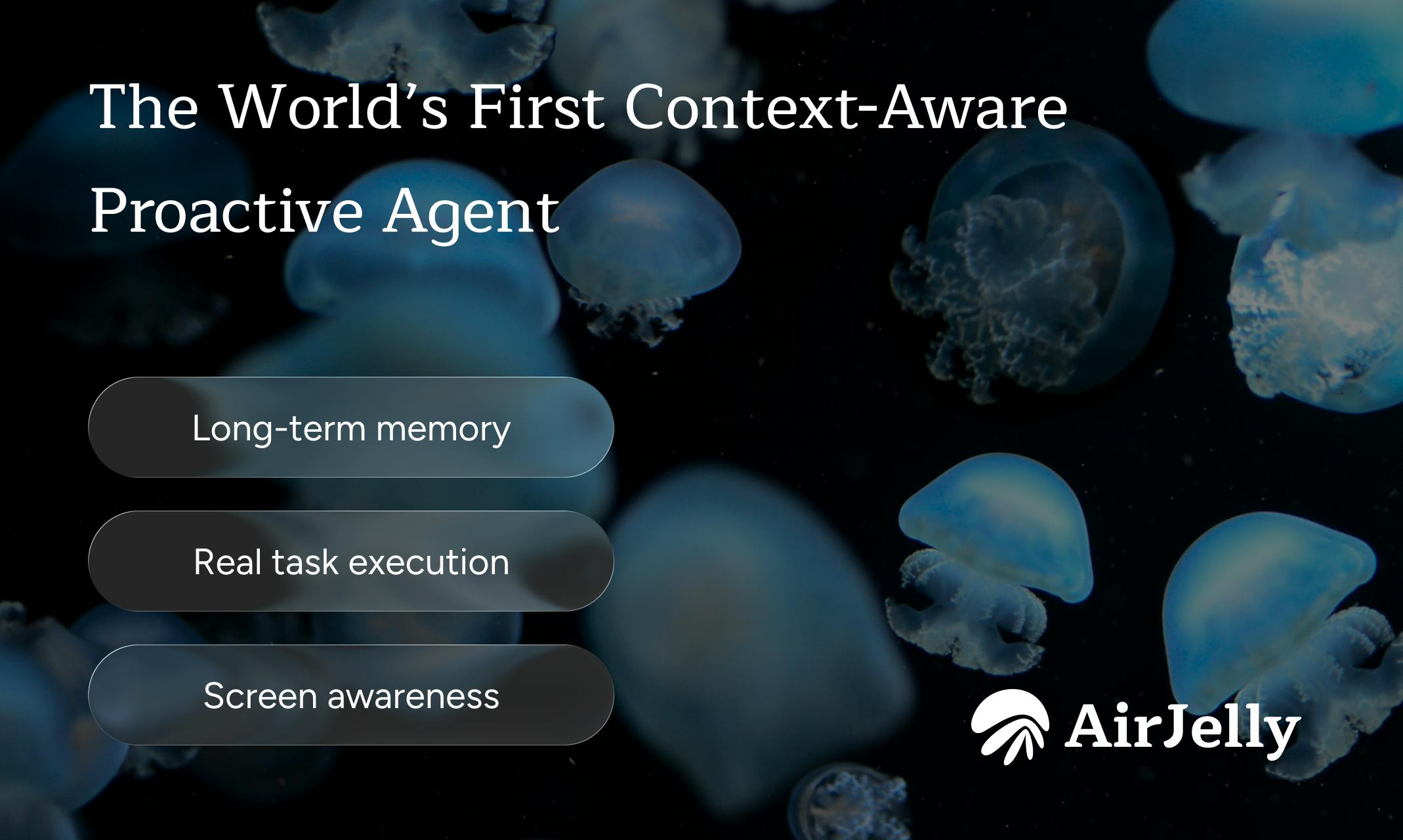
AirJelly is an always-on desktop AI agent that proactively captures intent by observing your screen and auto-organizing tasks—marking AI's shift from passive response to proactive anticipation.
AirJelly debuted at #9 on Product Hunt as an "always-on desktop AI agent" that observes screen activity to understand work context, capture intent, organize tasks, and track follow-ups—no manual entry needed. Its three layers—intent capture, task organization, and relationship tracking—set it apart from recording tools like Rewind AI and Microsoft Recall. However, it faces privacy risks and accuracy challenges, with data handling still unexplained.
Article Content
In an increasingly crowded field of AI agents, most tools remain stuck in a passive "you ask, I answer" mode. AirJelly, ranked #9 on Product Hunt, proposes a different approach: letting AI proactively observe your screen activity and anticipate your next move.
What Problem Does It Actually Solve?
AirJelly positions itself as an "always-on desktop AI agent." By observing your screen activity, it understands what you're working on and who you're interacting with, then proactively captures intent and organizes tasks.
This represents a fundamental departure from traditional task management tools. Tools like Todoist and Notion require you to manually enter to-dos, with AI merely assisting with categorization and reminders. AirJelly's logic is: you don't need to enter anything at all—it can figure it out just by watching you work.
One line from the official description stands out—"It doesn't just spot your to-dos — it foresees what's next and acts." This suggests the product team is attempting to bridge the gap from "recognition" to "action," not just telling you what to do, but actually doing it for you.
The so-called "always-on agent" refers to an AI program that runs continuously in the background on a user's device, capable of perceiving context without needing to be awakened or engaged in conversation each time. Its key difference from traditional chat-based assistants lies in the trigger mechanism: chat assistants are driven by user input, following a "request-response" model; always-on agents are driven by environmental changes—screen switches, window focus changes, and input behavior can all serve as trigger signals. This requires the agent to maintain a continuously updated context state locally and proactively surface suggestions or execute actions at the right moment. Technically, this typically demands coordination among screen capture, visual understanding, short-term state caching, and decision modules, with high requirements for latency and resource consumption. The design challenge of always-on agents isn't the accuracy of any single judgment, but how to avoid disruption, misjudgment, and privacy leakage during long-term operation.
Breaking Down Three Core Capabilities
Based on the product description, AirJelly's capabilities can be divided into three layers:
Intent capture layer: Continuously observes on-screen activity, extracting your work context—what document you're writing, who you're communicating with, and what stage your project is at.
Task organization layer: Based on captured intent, automatically organizes task lists and priorities. You don't need to tell it "note this down for me"—it decides on its own what's worth recording.
Relationship tracking layer: This is a more unique aspect. AirJelly tracks your interpersonal interactions to ensure you never miss a follow-up or forget a promise—"never miss a follow-up or forget a promise." This essentially brings CRM thinking into personal productivity scenarios.
The key technologies behind intent capture typically include screen content understanding (OCR, layout analysis, UI element recognition) and behavioral sequence modeling. The system needs to not only understand "what's on screen" but also infer "what task stage the user is in": whether they're writing an email, switching documents, or comparing spreadsheet data. A common approach is to encode consecutive operation frames into state sequences, then combine user input text fragments and window titles to assign semantic labels to current activity. Task organization then aggregates and prioritizes on this basis, with common strategies including merging operations belonging to the same project or conversation into a single to-do, and ranking by time urgency, involved parties, and other signals. If done well, users feel the agent "knows without asking," but the gap between training data and actual work scenarios often leads to recognition biases—this is also the core experience threshold for such products.
Industry Trends in Proactive AI Agents
AirJelly is not an isolated case. Rewind AI and Microsoft Recall are attempting similar things—letting AI continuously record and understand users' digital lives. But AirJelly's differentiation lies in its "self-organizing" nature: information isn't just recorded; it's structurally organized and transformed into executable actions.
The biggest skepticism facing such always-on agents has always been privacy. Continuous screen capture or monitoring of screen activity means AI needs access to all your digital behavior, including passwords, private messages, and sensitive files. AirJelly currently doesn't detail its data processing methods on its Product Hunt page, which may be the biggest concern for potential users.
Another challenge is accuracy. Predicting intent sounds great, but if judgments are frequently wrong, users will quickly turn it off. Based on early feedback of 77 votes and 6 comments, community interest is moderate, but the sample size is insufficient to judge the actual experience.
Microsoft Recall is a system-level feature Microsoft launched with Copilot+ PCs in 2024. It takes snapshots of the screen every few seconds and stores screenshots locally, allowing users to search historical activity records through natural language. Rewind AI entered earlier with a similar approach, marketed as a "digital memory" tool that allows users to look back at everything they've seen and heard on their computer. What both have in common is "recording first": indiscriminately saving everything first, then restoring context through retrieval. AirJelly's approach is closer to "understanding first"—it doesn't aim to replay history, but rather distills tasks, priorities, and interpersonal commitments from continuous observation, directly converting perception into action. This difference reflects two technological forks in proactive agents: one is memory-enhancement focused, emphasizing traceability and retrieval; the other is intent-driven, emphasizing breakpoint judgment and automatic execution. The former relies more on storage and privacy protection engineering, while the latter relies more on intent understanding and decision accuracy—and their failure modes are entirely different.
Who Should Try It
AirJelly's target user profile: knowledge workers with fast work rhythms, scattered task sources (switching between email, chat, and documents), and frequent need for interpersonal follow-ups (salespeople, project managers, entrepreneurs).
If your work is primarily completed within a single fixed tool, or if you have strong privacy concerns about screen monitoring, this product may not be for you. But if you've been looking for a second brain that "organizes automatically without manual entry," AirJelly represents a direction worth watching.
The team states that AirJelly's ultimate goal is to manage everything in your life, freeing up time for "things AI can't do, or simply for you to enjoy life." Whether this vision can be realized depends on the balance it strikes between proactivity and controllability.
One-line Summary
AirJelly is an always-on desktop AI agent that proactively captures intent by observing your screen and automatically organizes tasks, representing the shift from passive response to proactive anticipation.
Paragraph Summary
AirJelly debuted at #9 on Product Hunt as an "always-on desktop AI agent," understanding users' work context through continuous screen observation, proactively capturing intent, organizing tasks, and tracking interpersonal interactions—eliminating the need for manual to-do entry. Its capabilities span three layers: intent capture, task organization, and relationship tracking. Unlike recording-focused tools like Rewind AI and Microsoft Recall, AirJelly emphasizes "self-organization," structuring information into executable actions. However, it faces two major challenges: privacy risks from continuous screen monitoring and intent prediction accuracy. The product page has yet to explain its data processing mechanisms, and early feedback samples are small. It's best suited for knowledge workers with scattered task sources and frequent interpersonal follow-ups.
Related articles

Why Does the Tesla Roadster Need to Fly? A Deep Dive into Musk's Wild Demo
Tesla's Roadster launch showed wall-climbing, upside-down driving, and flying stunts—but The Vergecast notes the demo car may lack a battery, the Rocket version is invite-only and not street-legal, and the website terms don't guarantee delivery. After nine years of delays, why does this car still need to exist?

AI Is Not a Replacement: Human-AI Collaboration Through the Lens of Factory Root Cause Analysis
Starting from factory root cause analysis, this article explains how AI accelerates evidence chain construction rather than replacing human experts, exploring the pragmatic implementation logic and business value of 'AI supporting people rather than replacing them.'

AI Agent Decision Auditing: Building an Evidence Chain in Regulated Workflows
Starting from a Reddit discussion, this article analyzes three core issues in AI agent decision auditing within regulated workflows: what fields audit records should contain, how to handle feedback latency for erroneous decisions, and how to continuously calibrate LLM judge consistency with human judgment.