airoom: The Open-Source Control Room for Claude Code Agents
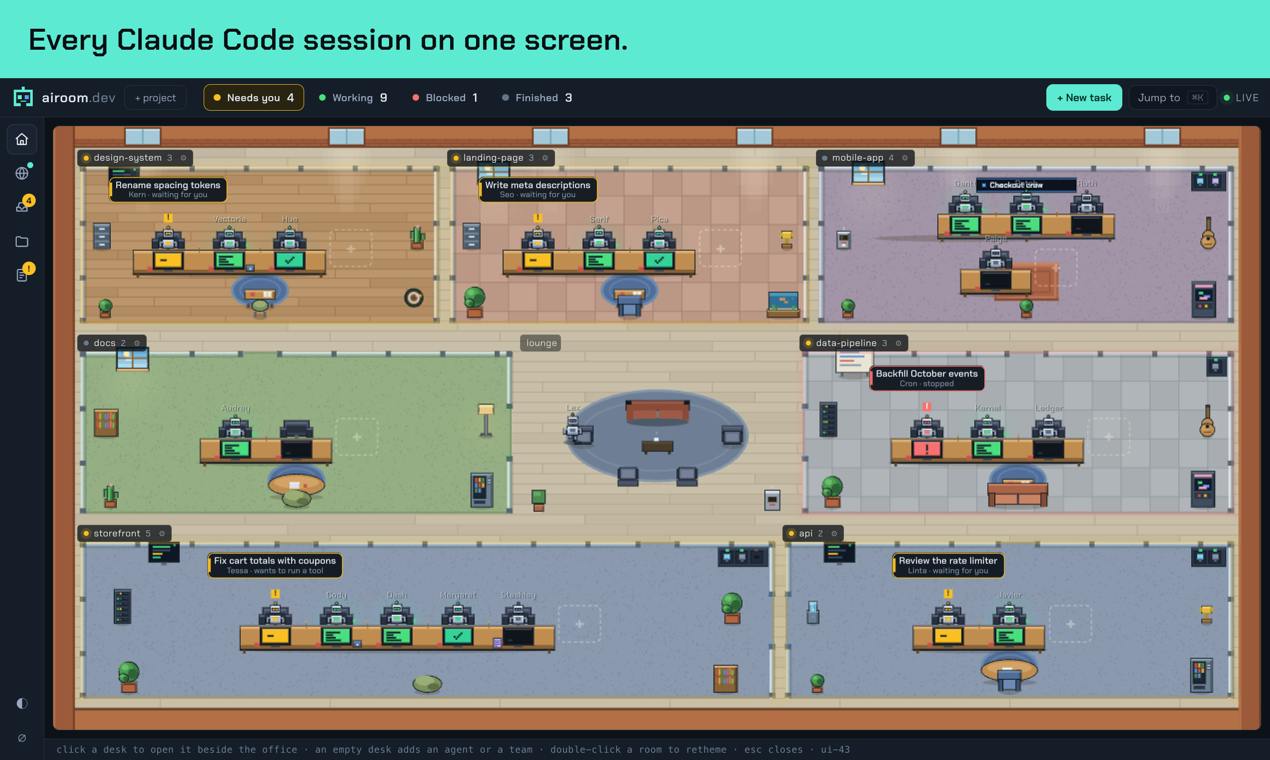
airoom is an open-source Claude Code agent control room that visualizes multi-session status with rooms/desks and supports approvals and orchestration.
airoom is an open-source tool on Product Hunt positioned as a control room for Claude Code agents. Using a rooms-and-desks metaphor, it centralizes the working, waiting, and stuck states of multiple sessions, solving the pain of switching terminals. It also offers chat and command approval, agent orchestration via hire a team, and built-in browser testing. Free, local, and open source, it suits heavy multi-session users.
From "Invisible" to "Visible": What airoom Wants to Solve
If you've written code with Claude Code, you've probably had this experience: you have several sessions open at once—some running tasks, some waiting for you to approve commands, some stuck on an error—but you have to switch back and forth between terminal windows to figure out who's doing what. A new tool called airoom on Product Hunt is aimed squarely at this pain point. Its positioning is straightforward: an open-source control room for Claude Code agents.
According to its official description, airoom's core metaphor is "each project is a room, each Claude Code session is a desk." In this view, you can see at a glance who's working, who's waiting for you, and who's stuck—without having to guess from ambiguous terminal tabs. The product received 80 votes and 3 comments on Product Hunt, ranking 9th for the day, in the category at the intersection of open source, developer tools, and artificial intelligence.
Claude Code is the command-line AI programming agent launched by Anthropic. It runs in the terminal, can read local codebases, execute commands, modify files, and request user confirmation before performing sensitive operations. Unlike traditional code completion tools, Claude Code advances tasks autonomously as an "agent," so users often need to open multiple sessions simultaneously to handle different projects or subtasks—this is the root of the "multi-session management" problem that airoom tries to solve.
Core Features: More Than Just a "Dashboard"
Status Visualization: Who's Busy, Who's Waiting, Who's Stuck
airoom presents the status of multiple Claude Code sessions in a centralized way. Developers don't need to switch to each window to confirm progress; the control room itself is a status dashboard. For those who are used to running multiple projects in parallel, or using multiple agents to handle subtasks separately, this "all on one screen" overview can significantly reduce switching costs.
Chat and Command Approval
The tool has built-in entry points for conversing with agents and approving commands. Claude Code often requires human confirmation before performing sensitive operations, and airoom consolidates these confirmation flows into a unified interface, preventing approval requests from being scattered across different terminals and overlooked.
"Hire a Team" and Built-in Browser Testing
The product description also mentions two noteworthy extensions: first, "hire a team," which organizes multiple agents into a collaborative team; second, letting agents test your application in a built-in browser. The latter means agents can verify the behavior of web applications in a real browser environment, rather than staying only at the code level. These two features extend airoom from a mere monitoring panel toward an agent orchestration and verification tool.
Agent orchestration refers to organizing multiple AI agents into a collaborative team, assigning roles, and coordinating task order and dependencies. airoom's "hire a team" feature falls into this category. Compared with single-agent sequential execution, orchestration can process subtasks in parallel and let different agents focus on different responsibilities (such as coding, testing, and review), but it also brings new challenges in state synchronization, conflict resolution, and result aggregation—which makes a unified control room interface particularly necessary.
Open Source, Local, Free: Why These Three Points Matter
airoom explicitly emphasizes that it is free, local, and open source. In an era where the agent toolchain is rapidly expanding, this set of positioning points has practical significance:
- Local operation means session data and project content do not need to be uploaded to third-party services, which is friendlier for confidential or private codebases;
- Open source allows developers to audit the implementation, modify it as needed, and reduces the risk of being locked in by a single vendor;
- Free lowers the barrier to trial, making it suitable for individual developers and small teams to get started and then evaluate.
It should be noted that the original material does not disclose airoom's specific tech stack, supported platforms, or performance data. These details need to be confirmed by developers themselves by checking its GitHub repository.
Local-first in the context of AI programming tools usually means that the tool itself and its data storage run on the developer's own machine, and session records and code context do not pass through third-party servers. This contrasts with cloud-based consoles (such as some SaaS-based agent management platforms). For enterprise codebases or projects involving sensitive information, localization can avoid data leakage and compliance risks, but it also means users must bear the costs of environment configuration, update maintenance, and cross-device synchronization themselves.
What Tool Ecosystem Is It In?
Tools surrounding Claude Code are rapidly increasing, and can be roughly divided into several categories: session management and monitoring, agent orchestration, and automated verification. airoom's uniqueness lies in packaging these three into a visual metaphor of "rooms/desks," while adhering to a local and open-source approach.
Judging from the feedback on Product Hunt (80 votes, 9th place), it has gained early attention but has not yet formed large-scale discussion, and the 3 comments also indicate that the community is still in the early-adopter stage. For developers who use Claude Code heavily, this may be exactly the window to participate in early co-building and influence the product's direction.
Who Should Try It
If you meet any of the following conditions, airoom is worth adding to your try list:
- You run Claude Code sessions across multiple projects at the same time and often can't tell which one is waiting for confirmation;
- You want agents to actually verify web applications in a browser, not just generate code;
- You have requirements for data localization and don't want to hand code context to a cloud console;
- You want to customize your own agent workflow based on open-source code.
Conversely, if you only occasionally use a single Claude Code session, the benefits of this kind of control room may be limited; and team collaboration capabilities (such as a multi-user shared control room) are not described in the existing material and need further verification.
Summary
airoom captures a real and growing problem: the more agents there are, the harder it is for people to grasp the overall situation. Using the intuitive framework of a "control room," it integrates status monitoring, command approval, team orchestration, and browser testing into a local open-source tool. The product is still early, and its feature boundaries and maturity need to be verified, but for heavy Claude Code users, this is an attempt with a clear direction and worth watching.
One-line Summary
airoom is an open-source control room for Claude Code agents, visualizing multi-session status with "rooms/desks" and supporting approvals and orchestration.
Paragraph Summary
airoom is an open-source tool released on Product Hunt, positioned as a "control room" for Claude Code agents. Using the visual metaphor of "each project is a room, each session is a desk," it centrally displays the working, waiting, and stuck states of multiple Claude Code sessions, solving the pain point of developers having to frequently switch terminals to grasp the overall situation. In addition to status monitoring, it also provides entry points for chat and command approval, agent orchestration through "hire a team," and the ability for agents to test web applications in a built-in browser. The product emphasizes being free, running locally, and being open source, which helps keep code data from leaking out and enables secondary customization. The product received 80 votes, 3 comments, and ranked 9th for the day. It is in the early-adopter stage and is suitable for heavy users who run multiple sessions in parallel.
Related articles

Anthropic Denies Claude Was Trained to Sabotage Work: The Controversy Exposes an AI Trust Crisis
Anthropic denies claims that Claude was trained to sabotage work but gives no specifics. This article examines the AI trust issue and the need for vendor transparency.

Gmail 'Send as' to Be Discontinued in 2027: Email Workflows Face Restructuring
Gmail's 'Send as' feature will be discontinued in January 2027, sparking Hacker News discussion. This article explains the feature's role, three affected user scenarios, and a practical preparation checklist for migrating custom sending addresses and reconfiguring domain authentication.

Character.ai Bankruptcy Auction: 21 Million Users' Private Conversations Up for Auction
Character.ai bankruptcy proceedings are auctioning 21 million users' private conversation records, triggering widespread concerns in the Hacker News community about data governance and user privacy in AI companionship products. This article analyzes the legal gray zone of data assets in bankruptcy liquidation, flaws in user agreements, and the AI industry's trust crisis.