Akai MPC Sample Key Leaked: A New Play for Open-Source Hardware

Akai teases the MPC Sample Key and plans to open-source its software to attract the modding community.
Akai teased the new MPC Sample Key on Instagram and announced plans to open-source its software, allowing the modding community to customize functionality. The Verge obtained exclusive images showing it may be a compact sampling device, but price and release date remain unknown. Open-sourcing is rare among hardware manufacturers and could boost user stickiness and differentiation, though it also poses security and stability challenges. The community has high expectations for the scope of open source and third-party firmware support, and ultimate success depends on execution and community response.
Akai teased the new MPC Sample Key on Instagram and announced plans to open-source its software, giving the modding community free rein to get creative. Although the company has yet to reveal a release date or price, The Verge obtained exclusive images and details about the device. The product appears to continue Akai's exploration of combining hardware and software while using an open-source strategy to attract developers and enthusiasts.
Open-Source Strategy: A Field Day for the Modding Community
Akai has made it clear that it will open-source the MPC Sample Key's software—a decision that is uncommon among hardware manufacturers. Open source means users can modify the underlying code, customize functionality, and even develop entirely new use cases. For the modding community, this is undoubtedly a major draw. Akai's MPC series has already built a large base of loyal users who are passionate about personalizing their devices. This open-source move is expected to further lower the barrier to creation and spark more innovative uses.
According to The Verge, Akai emphasized the importance of being community-driven on social media but did not disclose the specific scope of the open-source release (for example, whether all code or only some modules will be opened). This openness could also bring security and stability challenges, requiring the manufacturer to strike a balance between community freedom and official support.
Open-source software licenses are key to understanding this strategy. Common licenses such as GPL, MIT, and Apache 2.0 differ significantly in modification rights, distribution conditions, and patent grants. If Akai adopts a copyleft license like the GPL, derivative works must also be open-sourced; if it uses a permissive license like MIT, the manufacturer can more flexibly retain proprietary modules. The choice of license will directly affect whether the modding community can legally distribute modified firmware and whether third-party developers are willing to invest.
Design Details: What the Leaked Images Say About Product Positioning
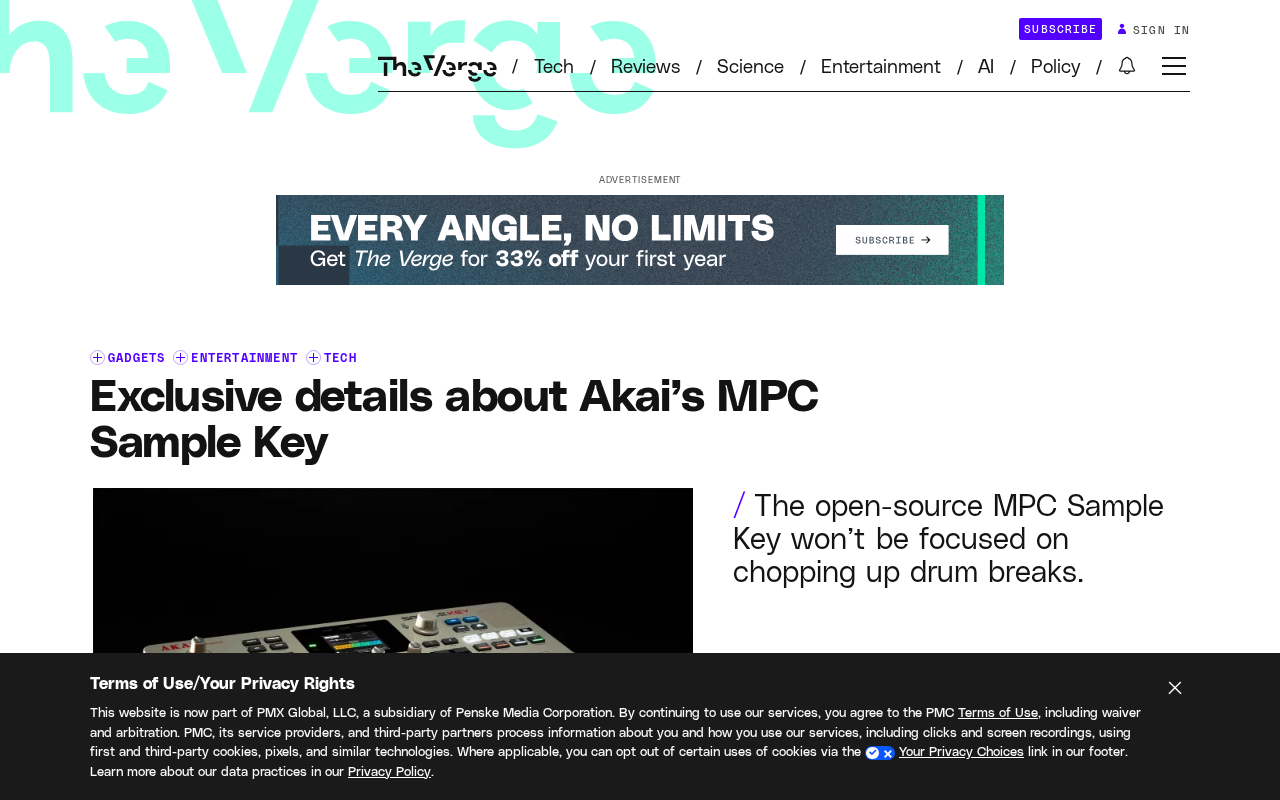
Judging from the exclusive images obtained by The Verge, the MPC Sample Key appears to be a compact device that continues the classic elements of the MPC series, though specific specs and features have not yet been made public. The images show the device with buttons and knobs, possibly focused on sampling and sequence editing. Due to the lack of official information, we cannot confirm its connectivity, storage capacity, or compatibility.
The product's name suggests that its core functionality may revolve around sampling. Combined with open-source software, users may be able to import custom sample libraries or write scripts to extend functionality. Akai has not yet announced hardware specifications, but it is reasonable to expect continued support for MIDI and USB connectivity to fit modern music production environments.
Samplers and sequencers are two core concepts in music production. A sampler records, edits, and plays back audio fragments (samples), while a sequencer is used to arrange notes, rhythms, and automation events on a timeline. The MPC series has historically combined the two into a "sample + sequence" workflow. The MPC Sample Key's name suggests it may focus more on sampling, while the depth of sequence editing may depend on the extensibility of the open-source software.
Market Impact: Opportunities and Risks of Open-Source Hardware
Akai's move aligns with the open-source hardware trend. In recent years, more and more music device manufacturers have begun embracing open source—for example, some Elektron products allow users to modify firmware. Open source can accelerate feature iteration, attract developer contributions, and increase user stickiness. However, risks exist as well: fragmented modifications can lead to device compatibility issues, and manufacturers need to provide clear documentation and community management.
For Akai, the MPC Sample Key's open-source strategy could be key to differentiated competition. In a market where hardware is highly homogenized, community ecosystems often form a moat. But whether it ultimately succeeds depends on the actual execution of the open-source plan and community response. At present, price and release date remain unknown, adding uncertainty to market performance.
Firmware is the low-level software that runs on a hardware device, responsible for controlling hardware resources and supporting higher-level functionality. Open-source firmware means the community can modify the device's basic behavior—for example, adding new audio processing algorithms or changing control mappings. This differs from open-source applications, which typically run on top of an operating system. Open-source firmware can bring deeper customization freedom, but it also requires developers to have embedded systems knowledge and may affect device stability and security.
Community Reaction and Future Outlook
Despite limited details, the modding community has already shown strong interest. Discussions on Reddit and forums focus on the possible scope of the open-source release and whether the device supports third-party firmware. Some users look forward to using the open-source software to implement custom sample processing or MIDI mapping. Since Akai has not responded to specific questions, these expectations remain speculative.
In the long run, if the MPC Sample Key can strike a balance between openness and ease of use, it could appeal to a broad audience ranging from beginners to veteran producers. But the manufacturer needs to clarify the open-source license, update and maintenance plans, and community support channels. For now, we can only wait for Akai to reveal more information.
MIDI mapping refers to establishing correspondences between physical controls on a hardware controller—such as knobs and buttons—and software parameters (e.g., volume, filter cutoff). In an open-source environment, users may customize MIDI mapping rules or even create scripts that combine multiple controls into macro commands. For the MPC Sample Key, if the open-source software supports flexible MIDI mapping, it would significantly enhance its usefulness as a live performance and studio controller.
Related articles

Tencent WorkBuddy Hands-On: How AI Agents Crush Traditional Chat Assistants
WorkBuddy vs Doubao tested: how AI Agents directly operate computers to convert PPT to PDF, archive files and more. Analysis of WorkBuddy's low barrier, domestic ecosystem, pricing and plugin marketplace, plus AI Agent selection advice.

Azure Cross-Tenant Attack Chain: Root Cause Analysis of Five Paths
Binary Security analyzes five full cross-tenant compromise paths in Azure, trending 271 points on HN. This article interprets their shared root cause perspective and offers defense recommendations for cloud tenant isolation and reflections on responsibility boundaries.

Recreating a Real Bubble Tea Station in Isaac Sim: Script-Driven Unitree G1 Brews Tea
Developers recreated a real self-service tea station in NVIDIA Isaac Sim, using scripts to drive a Unitree G1 through a five-step tea-brewing process, exploring whether physics simulation can be a source of synthetic robot demonstration data and discussing contact stability and imitation learning.