Albert Gu Declares "It works.": Mamba Architecture Gets Key Validation
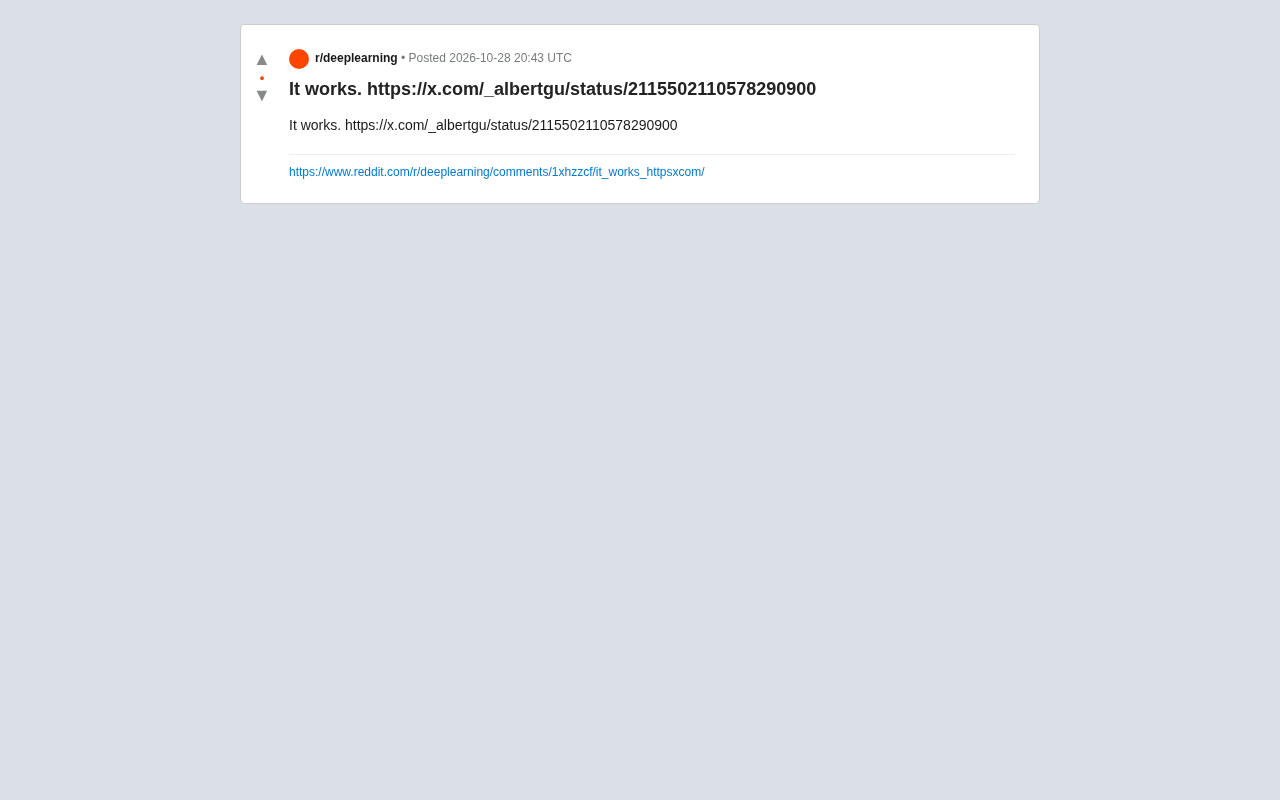
Albert Gu's "It works." tweet is seen as a signal that Mamba is engineering-feasible, but technical details are still lacking.
A minimalist Reddit post cited Mamba core author Albert Gu's tweet "It works.", drawing community attention. Mamba replaces Transformer self-attention with a selective state space model, reducing sequence modeling complexity from quadratic to linear and theoretically lowering long-context costs. Yet obstacles remain between paper and engineering usability, and a single tweet is not a technical conclusion; Transformer's mature toolchain remains the key variable.
Why a single tweet deserves serious attention
A minimalist post circulating on Reddit has only one line of body text: "It works." — accompanied by a link to a tweet from Albert Gu on X (formerly Twitter). The information content looks close to zero, but in the current technical context, this sentence carries no small weight.
Albert Gu is one of the core authors of the Mamba line of work. Mamba attempts to replace the self-attention mechanism in Transformers with a selective state space model, reducing the complexity of sequence modeling from quadratic growth with length to linear. For some time, this architecture has shown competitiveness on tasks such as language modeling, but the question of whether it can truly run at scale and whether its results hold up has remained a focus of outside scrutiny. The phrase "It works." points precisely to this kind of leap from "feasible in a paper" to "valid in engineering."
Since the original post does not elaborate on any technical details, this article does not make inferences beyond the source material and only discusses, around this signal itself, the current situation of the Mamba route and the impact it may bring.
What problem is Mamba trying to solve?
The cost of self-attention
The core of the Transformer is self-attention: every position in the sequence must compute association weights with every other position. This gives the model powerful global modeling capability, at the cost that computation and memory overhead grow quadratically with sequence length. The longer the context window, the harder this cost is to bear.
The industry has invested a great deal of engineering effort in this — sparse attention, chunked computation, various approximation methods — essentially all seeking a balance between "preserving the benefits of attention" and "reducing the cost of long sequences."
The idea of state space models
Mamba takes another path. It borrows the state space model from control theory, using a hidden state that recurs over time steps so that each new token only needs to interact with a compressed state rather than looking back over the entire history. In this way, complexity is linear in sequence length.
The difficulty lies in "selectivity": the model needs to learn to judge which information should be written into the state and which should be forgotten. Mamba's key contribution is to make these parameters vary dynamically with the input, thereby possessing a certain degree of content-awareness while maintaining linear complexity.
State space models (SSMs) originate from control theory. The classical form uses a set of first-order differential equations to describe how the system state evolves over time, and maps the hidden state to the output through an observation equation. In sequence modeling, it is discretized into a recurrent form: at each time step, the hidden state is updated according to the current input, and then the output is read out. This recurrent structure is naturally suited to processing long sequences because the amount of computation grows linearly with length and the state can remain constant in size during inference. Early SSMs performed limitedly on language tasks, mainly because the state update method was independent of the input, making it difficult to selectively focus on information as flexibly as attention. Mamba compensates for this deficiency by making the state transition parameters depend on the input, enabling SSMs to gain content-awareness while maintaining linear complexity.
The signal value behind "It works"
There is a gap between a paper and something usable
Architectural innovation in academic papers and being able to train stably, reproduce, and not collapse under real workloads are two different things. Many model structures that look elegant ultimately fail on training stability, parallel efficiency, or degradation of long-range dependencies.
A short tweet from a core author with a firm tone usually means that some previously doubtful link has been cleared — perhaps the stability of large-scale training, perhaps inference efficiency, or perhaps performance on downstream tasks. The source material does not specify which one, so a more prudent understanding is: this is an external release of an internally validated result.
In the evolution of deep learning architectures, "scalability" usually refers to whether a model can maintain stable training, predictably improve performance, and efficiently utilize existing hardware in engineering implementation when parameters, data, and computation are increased. Many theoretically elegant architectures encounter problems such as gradient explosion, difficulty converging, or a sharp drop in parallel efficiency after being scaled up. For recurrent-based models like Mamba, large-scale training also involves how to parallel scan along the time dimension to fully utilize GPUs, and how to design efficient kernels. These engineering details often determine whether an architecture can move from a paper to actual deployment, and they are also the possible validation content behind signals like "It works."
Why the community is paying so much attention
Since it was proposed, Mamba has been regarded as one of the few routes that could potentially compete head-on with Transformers in general sequence modeling. Discussion around it has long focused on two points: first, whether the theoretical efficiency advantage can be translated into actual throughput; second, whether information will be lost in long-context tasks due to state compression.
Any signal of progress from the authors' side will be amplified and interpreted by the community, because if this route is proven scalable, it means the cost structure of long-context applications may be rewritten.
Possible impact on developers and industry
Cost imagination for long-context applications
If linear complexity can truly be delivered in engineering, the direct beneficiaries are scenarios stuck on the cost of long sequences: long-document understanding, codebase-level retrieval, long-term conversational memory, audio and gene sequence processing, and so on. The common pain point in these scenarios is not that the model is not smart enough, but that "once the context gets long, it becomes outrageously expensive."
It should be noted that the source material does not provide any performance numbers, and this article does not make quantitative speculations. Directionally, this is a route that may change the cost curve.
Ecosystem and toolchain remain variables
Whether an architecture can truly land does not depend only on the model itself. Around Transformers, an extremely mature set of inference frameworks, operator libraries, hardware adaptations, and tuning experience has already accumulated. For a new architecture to gain the same level of engineering support will take time.
Therefore, even if validation passes, what is more likely in the short term is hybrid solutions — introducing state space layers at specific points rather than replacing everything. This gradual path has been more common historically.
The maturity of inference frameworks and operator libraries directly determines the deployment cost of a new architecture. Taking Transformers as an example, their self-attention mechanism has been deeply optimized into efficient operators such as FlashAttention and widely integrated into mainstream frameworks such as PyTorch, TensorRT-LLM, and vLLM, and hardware vendors have also made specialized optimizations for attention computation. If a new architecture wants the same level of support, framework developers need to implement custom operators, hardware vendors need to provide adaptations, and extensive tuning on real workloads is required. This process usually takes years and requires the community to form a sufficiently large user base. Therefore, there is an obvious time lag between architectural innovation and the engineering ecosystem, which is also why gradual hybrid solutions are more realistic.
Stay cautious: one sentence is not the whole conclusion
It is important to place this signal in a reasonable position. A tweet is not a paper, not a benchmark report, and not a reproducible experimental record. It cannot prove that the architecture is superior to Transformers on all tasks, nor can it indicate a deployment timeline.
A more reasonable attitude is to treat it as a node worth tracking and wait for subsequent technical disclosures and third-party reproduction. Previous times Mamba drew attention were accompanied by the publication of actual evaluation data; this time, too, we need to wait for the data to speak.
For developers concerned with the direction of sequence modeling, what can be done now is to follow official subsequent releases, watch for updates to open-source implementations, and verify feasibility on a small scale in their own long-sequence scenarios, rather than immediately adjusting their tech stack based on this.
FAQ
Will Mamba replace Transformers? The source material does not provide any such conclusion. Judging from the maturity of the engineering ecosystem, the short-term prospect is more likely coexistence and hybridization rather than replacement.
What exactly did this tweet validate? The original post contains only the sentence "It works." and does not specify what was validated. Any specific conclusion lacks support from the source material.
What should ordinary developers do now? Just stay informed. Wait until there are public technical details and reproducible results before evaluating whether to try it in your own scenarios.
One-line Summary
Albert Gu's "It works." tweet is seen as a signal that the Mamba route is engineering-feasible, but technical details are still lacking.
Paragraph Summary
A minimalist post on Reddit cited a tweet from Mamba core author Albert Gu, "It works.", drawing community attention. Mamba replaces Transformer self-attention with a selective state space model, reducing sequence modeling complexity from quadratic to linear and theoretically greatly lowering the cost of long-context applications. However, between a paper and engineering usability there are obstacles such as training stability and parallel efficiency, and this tweet is interpreted as meaning that some key link has passed internal validation. The article points out that this signal is significant for scenarios such as long-document understanding and code retrieval, but Transformer's mature toolchain remains the main variable for the deployment of new architectures, and hybrid solutions are more likely in the short term. A single tweet does not constitute a technical conclusion, and public details and third-party reproduction are still needed.
Related articles
Ollama+RAG Local Knowledge Base Setup: A Step-by-Step AnythingLLM Tutorial
Based on a Bilibili tutorial, this guide details building a local RAG knowledge base with Ollama + AnythingLLM: from general LLM knowledge limits and RAG principles to document upload, vector storage, and verification.
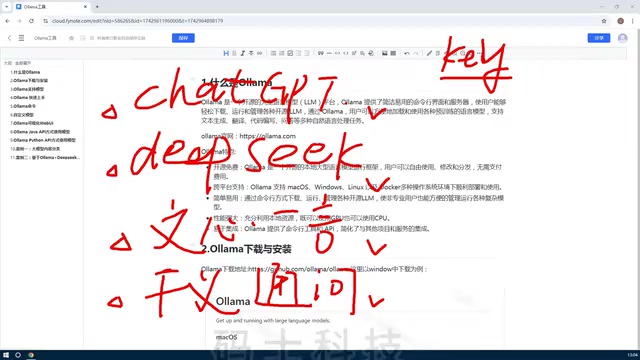
The Ultimate Ollama Tutorial: A Beginner's Guide to Running Large Models Locally for Free
Ollama is an open-source local large model management tool supporting free download and deployment of models like DeepSeek, with command-line and Web UI, cross-platform, automatic GPU/CPU scheduling — ideal for AI beginners and private deployment.
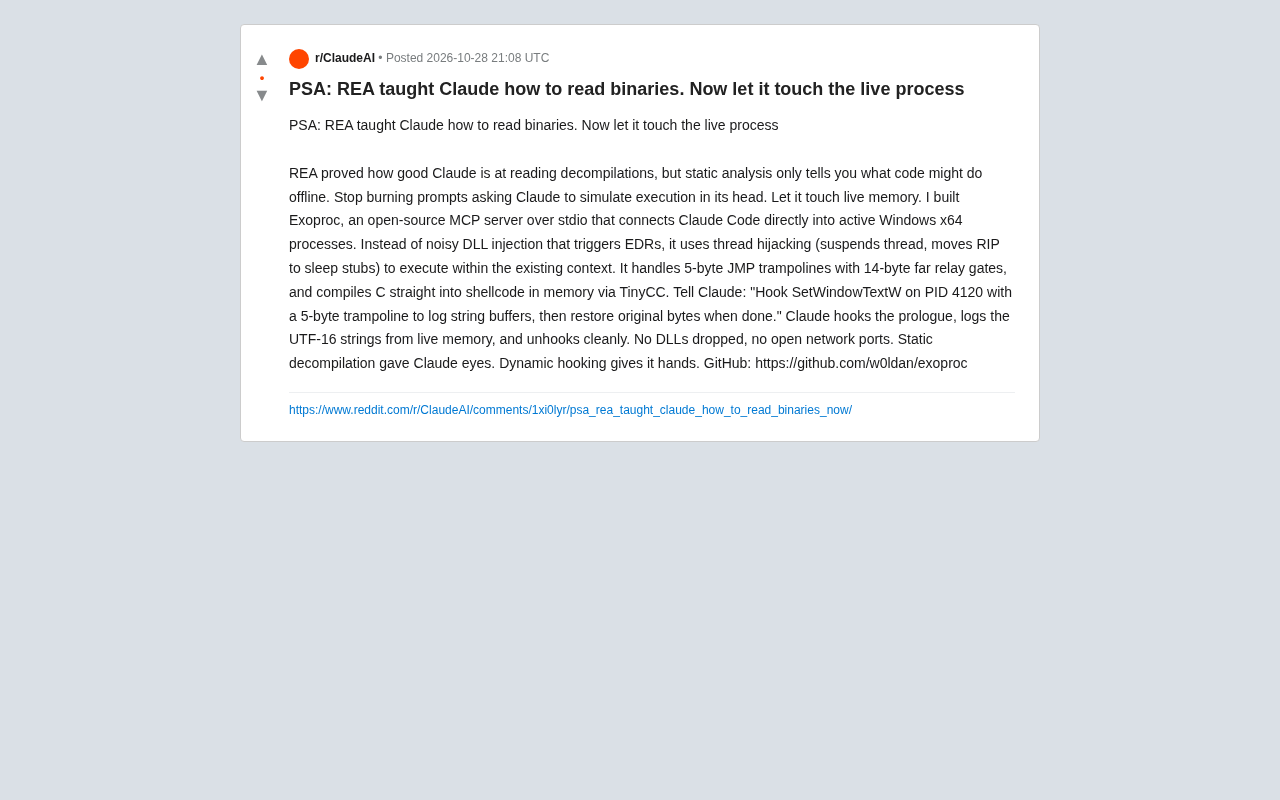
Giving Claude "Hands": Exoproc Open-Source MCP Server Enables Live Process Hooking
Exoproc is an open-source MCP server enabling Claude Code to hook live Windows x64 processes via thread hijacking, bypassing EDR for dynamic analysis. Static decompilation gave Claude eyes; dynamic hooking gives it hands.