Algebruh: Cross-Validating AI Arithmetic Claims with Formal Verification Tools

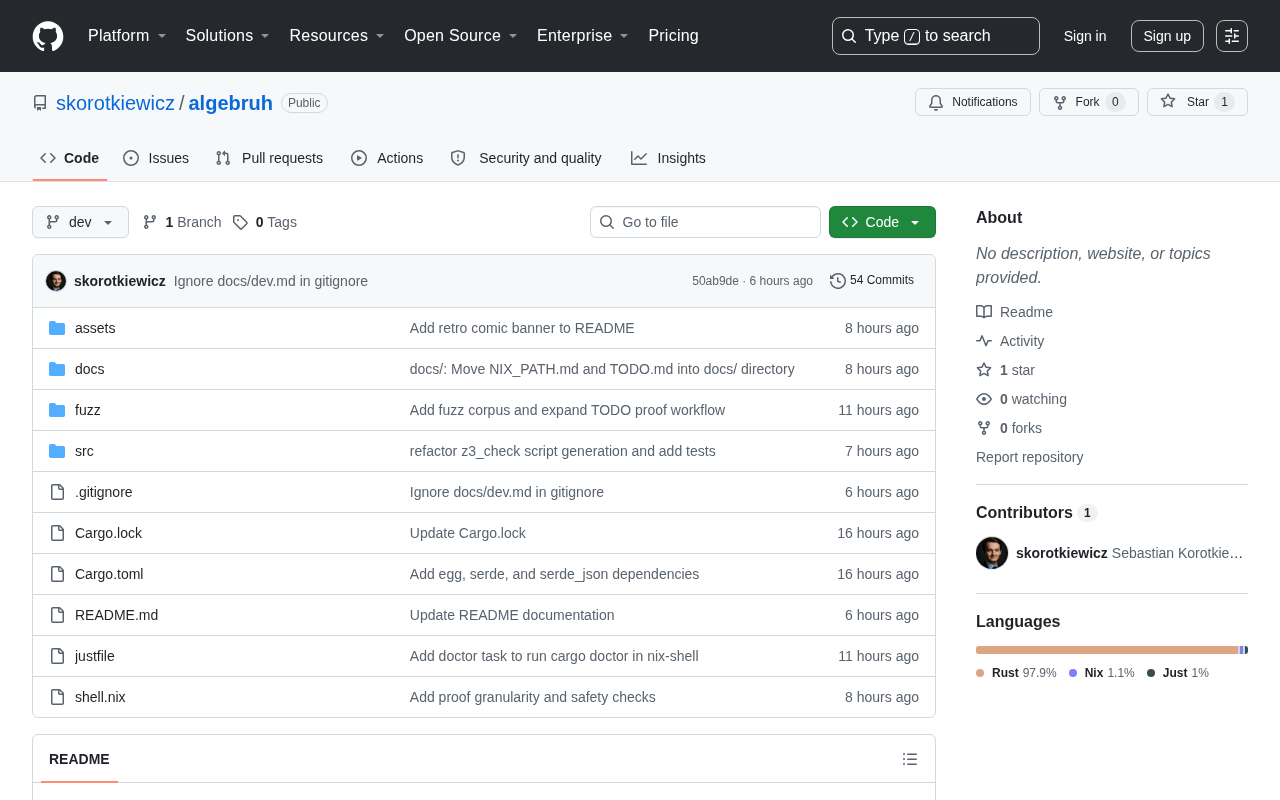
Algebruh uses Z3, cvc5, and Lean to formally verify arithmetic claims made by AI language models.
Algebruh is an early-stage open-source project that integrates three formal verification engines—Z3, cvc5, and Lean—to cross-validate arithmetic assertions produced by large language models. By leveraging redundant verification across independent tools with different algorithmic foundations, it aims to provide deterministic correctness guarantees for AI-generated mathematical claims, addressing the fundamental limitation that LLMs perform pattern matching rather than actual computation.
When AI Says "1+1=3," Who Catches the Error?
As large language models (LLMs) are widely adopted for mathematical reasoning, code generation, and logical analysis, a growing concern has emerged: Are the arithmetic conclusions produced by these models truly reliable? LLMs frequently "hallucinate" when handling numerical calculations, producing seemingly plausible but secretly flawed chains of reasoning. Recently, an open-source project called Algebruh debuted on Hacker News as a "Show HN" post, attempting to tackle this problem from the perspective of formal verification.
The root cause of these "mathematical hallucinations" lies in the fundamental architecture of LLMs. Built on the Transformer architecture, their "computation" process is essentially pattern matching at the token level through attention mechanisms, rather than actual numerical operations. When a model processes something like "17×24," it doesn't execute a multiplication instruction like a calculator would—instead, it makes probabilistic predictions based on similar patterns seen in training data. This explains why LLMs perform reasonably well on simple arithmetic but see error rates spike dramatically as digit counts increase or computational complexity rises. Research shows that GPT-4's error rate on multi-digit multiplication can reach tens of percentage points, and it's even more prone to producing plausible-yet-incorrect result chains in sequential operations involving carrying and borrowing.
Algebruh's core idea is simple yet powerful: Use rigorous automated theorem provers and SMT solvers to cross-validate the truth or falsity of any arithmetic claim. Rather than relying on probabilistic statistical inference, it leverages mathematically provable formal engines to deliver deterministic "correct" or "incorrect" verdicts.
Three Verification Engines: How Z3, cvc5, and Lean Work Together
Algebruh's most notable design choice is its simultaneous integration of three industry-recognized formal verification tools, using multi-engine cross-validation to boost confidence in conclusions.
Z3 and cvc5: Industrial-Grade SMT Solvers
Z3 is a Satisfiability Modulo Theories (SMT) solver developed by Microsoft Research, widely used in software verification, program analysis, and automated reasoning. It handles complex logical problems including linear arithmetic, nonlinear constraints, and bit-vectors, making it one of the de facto standards in both academia and industry.
From a technical standpoint, SMT solvers extend Boolean Satisfiability (SAT) solvers with support for specific mathematical theories, including integer arithmetic, real arithmetic, array theory, and bit-vectors. They work by converting assertions to be verified into logical formulas, then determining whether those formulas are satisfiable under the given theory. For example, to verify "for all integers x, x+0=x," an SMT solver attempts to find a counterexample—whether there exists some x such that x+0≠x. If it proves no counterexample exists, the original proposition holds. Z3 is used millions of times daily for program verification, including AWS's s2n TLS implementation verification and Windows driver verification, among other critical industrial scenarios.
cvc5 is another open-source SMT solver maintained by Stanford University and other institutions, succeeding CVC4. It has complementary strengths with Z3 in certain theory solving—for example, cvc5 has unique advantages in string theory and finite model finding, while Z3 excels in nonlinear arithmetic and bit-vector theory. By connecting to both solvers simultaneously, Algebruh means that when both produce consistent conclusions, confidence in the verification result significantly increases; when disagreements arise, potential edge cases are promptly exposed.
Lean: A Theorem Prover for Formal Mathematics
The third engine, Lean, represents an entirely different verification paradigm. As an interactive theorem prover that has gained tremendous traction in the mathematics community in recent years, Lean has a rigorous type-theoretic foundation and an extensive mathematical library (mathlib). It can not only verify arithmetic but also handle mathematical propositions requiring rigorous proof chains. Including Lean in the verification pipeline gives Algebruh broader coverage spanning from "numerical computation correctness" to "mathematical proof rigor."
Lean was created by Leonardo de Moura at Microsoft Research in 2013 and has now evolved to Lean 4. It's based on the type theory of the Calculus of Inductive Constructions, using the Curry-Howard isomorphism to equate mathematical proofs with program constructions—a type-correct program itself constitutes a proof of the corresponding proposition. Lean's most impactful achievement is mathlib—a community-driven formalized mathematics library that, as of 2024, contains over 150,000 theorems and definitions covering a broad range of mathematics from basic algebra to advanced topology. In 2023, mathematician Terence Tao used Lean to formally verify the proof of the Polynomial Freiman-Ruzsa conjecture, marking a milestone for formal methods in cutting-edge mathematical research. Unlike SMT solvers, Lean requires constructing complete proof paths, giving its verification results higher credibility at the cost of relatively lower automation.
The Design Philosophy of Multi-Engine Cross-Validation
Why use three tools simultaneously? This is the essence of Algebruh's design philosophy.
Any single verification tool may have implementation-level bugs or blind spots for specific problems. By having Z3, cvc5, and Lean independently verify the same assertion, Algebruh constructs a redundancy verification mechanism:
- When multiple independent engines reach the same conclusion, that conclusion can be considered virtually certain;
- When engines disagree, it precisely reveals suspicious areas worthy of deeper human investigation.
This approach shares DNA with "multiple verification" in software engineering and "consensus mechanisms" in distributed systems, using engineering methods to compensate for the uncertainty of single-point verification. In fact, this strategy has deep theoretical and practical roots in engineering practice. The "Triple Modular Redundancy" (TMR) systems in aerospace use three independent computing units to process the same input, determining the final output through majority voting—this is the core design principle of the Airbus A320 flight control system. In distributed computing, Byzantine fault tolerance algorithms require systems to reach correct consensus even when some nodes fail. Algebruh brings this thinking to formal verification: Z3, cvc5, and Lean are based on completely different algorithmic implementations and theoretical frameworks, making the probability of all three producing the same error extremely low. This "N-Version Programming" methodology elevates the reliability of individual tools from the 99.x% level to near-certainty.
Potential Application Scenarios for Algebruh
The value of formal verification tools like Algebruh becomes particularly pronounced in an era where AI is deeply involved in technical work.
Fact-Checking LLM Output
This is the most direct application. When an AI assistant produces arithmetic conclusions while generating reports, code, or mathematical derivations, Algebruh can serve as a "post-hoc auditor," automatically flagging assertions that don't withstand formal scrutiny. This is critically important for finance, scientific research, engineering design, and other scenarios demanding extreme precision.
Education and Learning Support
Students learning mathematical proofs can use such tools to instantly verify whether their reasoning is rigorous, without waiting for manual grading. The instant feedback capability of formal verification has the potential to dramatically improve mathematics learning efficiency.
Quality Gates in Automated Pipelines
In software systems involving numerically intensive computations, embedding formal verification of arithmetic assertions into CI/CD pipelines can catch logic errors early and prevent bugs from reaching production. This is similar to the role of static analysis tools in code quality management, but with verification rigor far exceeding traditional unit tests—formal verification provides mathematical correctness guarantees, not just coverage from a finite set of test cases.
A Realistic Perspective: Limitations of an Early-Stage Project
It's worth noting that, based on Hacker News feedback, Algebruh is still at a very early stage—at the time of posting, it had received only 5 upvotes and zero comments, with limited community attention. This reminds us that despite the novel concept, the tool's maturity, usability, and actual verification capabilities remain to be proven over time.
Furthermore, while formal verification tools are impeccable in mathematical rigor, they typically face a trade-off between expressiveness and scalability: the types of assertions that can be verified are constrained by the tool's theoretical support, and "translating" vague mathematical expressions in natural language into formal language is itself a challenging engineering problem.
This "semantic gap" is one of the most active research directions in formal verification today. The process of converting natural language mathematical statements into formal language is commonly called "autoformalization." Research from Google DeepMind has shown that LLMs themselves can serve as "translators," converting informal mathematical statements into formal expressions in Lean or Isabelle, but accuracy is still far from deployment-ready. The challenge lies in the ambiguity of natural language—"x divided by y" might refer to integer division or real division depending on context, and "greater than" might mean strict or non-strict inequality. Additionally, implicit premises (such as "assuming x is positive") are often omitted. Current solutions include designing restricted natural language interfaces, using LLM-assisted translation with human confirmation, and developing domain-specific languages (DSLs) to bridge this gap. How elegantly Algebruh handles this problem will be key to determining its practical value.
Formal Methods Meets AI: A Pragmatic Path Toward Trustworthy AI
Although small, Algebruh reflects an increasingly important technological trend: combining deterministic formal methods with probabilistic AI systems. LLMs excel at generation and association but lack inherent correctness guarantees; tools like Z3 and Lean provide exactly the provable rigor that's missing. Their combination may well be a pragmatic path toward "trustworthy AI."
This trend has already gained wide recognition in both academia and industry. Meta's research team demonstrated in 2024 a pipeline that uses LLMs to generate Lean proof candidates, which are then confirmed by Lean's verifier, successfully proving competition-level mathematics problems. Google's AlphaProof similarly employs a dual-track architecture of "AI generation + formal verification." These practices suggest that future trustworthy AI systems likely won't be single-model "end-to-end" outputs, but rather "generate-verify" loop architectures composed of generative models and verification models, where formal verification tools play an irreplaceable "gatekeeper" role.
For developers interested in AI reliability, formal verification, and mathematical automation, Algebruh is an open-source experiment worth keeping an eye on. It's small in scale, but pointed in the right direction.
Key Takeaways
Related articles

Chain of Thought Isn't Just for AI: How Humans Can Use CoT to Improve Thinking Quality
Chain of Thought isn't just a prompt trick for large models. Starting from a Hacker News discussion, this article analyzes why CoT works for human thinking too, breaks down actionable ways to transfer it, and highlights the key differences between human CoT and machine CoT.
Cloudflare Teams Up with OpenAI: Closi…
Cloudflare Teams Up with OpenAI: Closing the Loop from Vulnerability Discovery to Defense with AI
Cloudflare uses OpenAI Daybreak to investigate security vulnerabilities and generate reviewable remediation plans, while developers use Codex to boost coding efficiency and quality.

Orca Multi-Agent Orchestration in Practice: A Guide to Parallel Collaboration with Claude and Codex
Orca is Stable AI's free open-source agent workbench supporting 34 agents like Claude Code and Codex in parallel. Learn its Git worktree isolation, multi-model orchestration, and mobile management.