Alibaba's Qwen3-Omni-Flash: A Powerful New Omni-Modal Model for Audio and Video AI

Alibaba releases Qwen3-Omni-Flash, an omni-modal API model with full audio-video I/O that outperforms Gemini Flash on cost-efficiency.
Alibaba's Qwen team has launched Qwen3-Omni-Flash, an omni-modal large model available via API. It supports audio, image, and video input alongside text and speech output, elevating audio to a first-class modality. The model excels in two areas: long audio-video understanding (meeting summaries, real-time translation, transcription) and native agent tool-calling (selectively listening or watching to orchestrate complex tasks). It also handles automated video editing, one-prompt MV generation, and short drama translation, with support for 74 languages and 39 Chinese dialects. Official benchmarks show its audio capabilities surpass Gemini Flash at the same tier, at a significantly lower price. An open-source real-time voice interaction Harness is also released to lower the developer onboarding barrier.
The Alibaba Qwen team has recently launched a brand-new omni-modal large model: Qwen3-Omni-Flash. Unlike previous models in the Omni series, this one is not open-source — it is made available through an API. Building on the foundation of existing multimodal capabilities, it places particular emphasis on audio input and output, targeting agentic application scenarios centered on audio and video.
Omni-Modal Architecture: Audio and Video as First-Class Citizens
Qwen3-Omni-Flash is a truly omni-modal model. On the input side, it simultaneously supports audio, images, and video. On the output side, it can generate both text and speech. This means the model is no longer limited to "understanding images and reading text" — it can fully listen, see, and speak.
Compared to the previously open-sourced Qwen3-Omni Flash (a 30B-parameter, 3B-activation MoE model), this new version is built on a stronger backbone and inherits Qwen's advantages in long-context token processing. The core breakthrough lies in elevating audio from a "secondary modality" to a first-class citizen that can serve as both input and output — opening the door for voice interaction, real-time translation, and similar use cases.
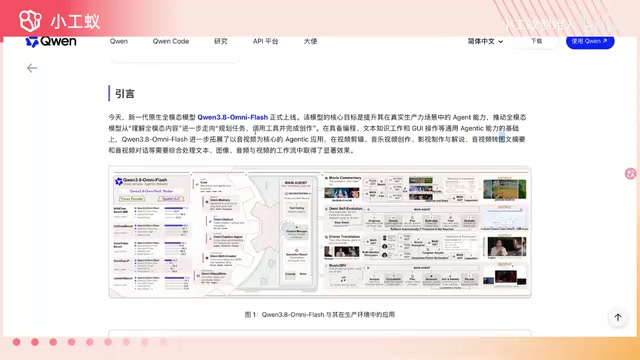
According to official benchmark data, Qwen3-Omni-Flash's overall audio capabilities surpass those of Gemini Flash at the same tier, and show a marked improvement over the previous generation Qwen Omni Plus. More importantly, the cost-efficiency is compelling — performance has improved significantly while API pricing has dropped considerably, making it attractive for developers who need to process audio and video at scale.
What is MoE? MoE (Mixture of Experts) is a sparse architecture widely used in modern large models. Unlike traditional dense models, MoE splits model parameters into multiple "expert" sub-networks, activating only a few of them per inference pass. This allows the model to maintain a large total parameter count while keeping actual compute costs low. Qwen3-Omni Flash's design — 30B total parameters with only 3B activated — embodies this principle: the model carries the knowledge capacity of a large model while running at the cost of roughly a 3B model. This is one of the key technical reasons why Flash/Mini-tier API models can offer significantly lower pricing.
Two Core Capabilities: Long Audio-Video Understanding and Native Agent Support
The model's capability roadmap can be summarized along two directions.
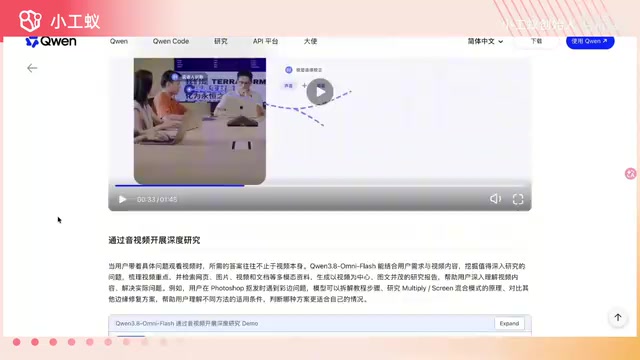
The first is long audio-video understanding. It supports ingesting lengthy audio or video streams, converting them to text, and performing semantic comprehension. A typical application is meeting minutes: the model can combine visual and audio signals to identify speakers, understand meeting content, and generate structured summaries. It also supports real-time audio translation and transcription, making it highly practical for multilingual meetings and live-streaming scenarios.
The second is native agent capability. The model can autonomously invoke tools, deciding after understanding a question whether it should "listen or look" — without needing to process all content frame by frame. This selective attention mechanism improves efficiency and more closely mirrors how humans process information. Combined with external knowledge base integration, it can handle complex task orchestration.
What is a Native Agent? Native agent capability means the model can autonomously plan steps and invoke external tools (such as search, code execution, or database queries) during inference, rather than simply returning a text answer. For an omni-modal model, "tool calling" extends further into the perception layer — the model can actively choose to "listen to an audio clip" or "extract a video frame" to answer a question, rather than processing all inputs uniformly. This selective attention reduces unnecessary computation and makes complex task orchestration more closely resemble how humans work. Paired with external knowledge base integration (RAG, Retrieval-Augmented Generation), the model also delivers practical value in private data scenarios.
Built for Content Creation: From Video Editing to One-Sentence MV Generation
Qwen3-Omni-Flash is officially positioned as a backbone model for audio-video editing applications. It can handle automated editing tasks similar to those in CapCut — automatically trimming footage to match music, generating MVs from a single prompt, translating short dramas (e.g., Chinese to English), and producing narration for long-form films.
The model's multilingual support is impressive: it officially covers 74 global languages, recognizes 39 Chinese dialects on the input side, and supports speech generation in 29 languages and 7 dialects. This broad coverage makes it well-suited for international content production at scale.
Real-Time Interaction and the Open-Source Harness
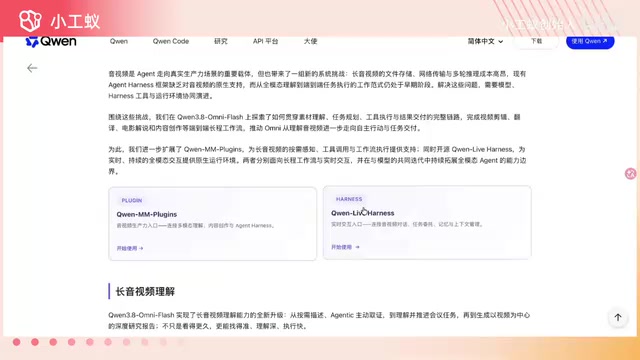
Alongside the model itself, Alibaba has also released companion plugins and a Harness. One Harness is specifically designed to support Qwen's real-time interaction capability (Qwen Live), and the complete agent framework has been open-sourced. With this toolkit, developers can build real-time voice interaction applications that enable natural conversation with AI.
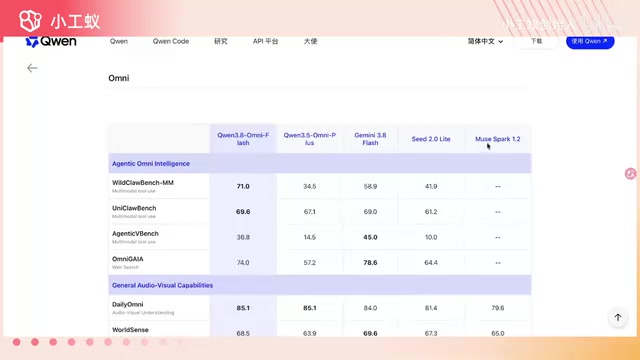
In head-to-head comparisons, the official team benchmarked Qwen3-Omni-Flash against the previous generation Gemini series and open-source models like Manta's U-Spark. The overall conclusion: Qwen3-Omni-Flash performs on par with or better than competing models, while offering a lower price point and stronger overall cost-efficiency.
What is a Harness? In AI engineering contexts, a "harness" typically refers to a framework built around a model that handles input/output wrapping, tool call scheduling logic, and interfaces with external systems — used for either evaluation or deployment. The Harness open-sourced by Alibaba is specifically designed for real-time voice interaction scenarios, allowing developers to build voice assistants, real-time translation tools, and similar applications directly on top of it, without having to build low-level API communication infrastructure from scratch. Open-sourcing this layer of engineering tooling is a common strategy vendors use to attract developer ecosystems and drive API adoption, while also enabling the community to customize and optimize for specific use cases.
Closing Thoughts: Omni-Modal Models Reach Maturity
As large model technology continues to evolve, omni-modal models capable of "understanding human conversation and responding in kind" are maturing rapidly. Qwen3-Omni-Flash brings audio input and output to a production-ready level, and its combination of API access and an open-source Harness lowers the barrier to integration — providing new infrastructure for audio-video agents, real-time translation, automated content creation, and more. For developers and enterprises focused on multimodal AI, this is a tool-oriented model well worth keeping an eye on.
Related articles

OpenAI Partners with Shield: How the Astra Agent Revolutionizes IT Troubleshooting
OpenAI and Shield launch the Astra agent, which autonomously logs into computers and legacy systems to fix IT issues in real time, 35-40% faster than traditional models, with humans involved only when judgment is needed.

iPhone Duo Battery Life Tested: One Charge a Day Is Unavoidable, and the Large Screen Is the Culprit
iPhone Duo battery test: heavy use needs at least one charge a day, and about 30% remains after 6.5 hours of screen-on time. How often the large screen is unfolded is key; a MagSafe battery pack helps, and long-term degradation is also worth watching.

Kimi K3.1 Pro Open-Sourced: 2.8 Trillion Parameters Close In on Opus
Moonshot releases the open-source MoE model Kimi K3.1 Pro, with 2.8T total parameters and 104B activated, trailing Opus 5.5 by under 1 point on Terminal Bench 4.0.