Alibaba's QwQ-32B Open-Sourced: How 32B Parameters Rival DeepSeek R1's 671B

Alibaba's QwQ-32B matches 671B-parameter models using only 32B parameters via two-stage reinforcement learning.
Alibaba's open-source reasoning model QwQ-32B rivals and even surpasses the 671B-parameter DeepSeek R1 across multiple benchmarks with only 32B parameters. The key lies in a two-stage reinforcement learning training strategy: first building reasoning foundations on precisely verifiable math and programming tasks, then extending to general domains. RL also demonstrates the advantage of avoiding catastrophic forgetting while synergistically improving multiple capabilities. The model can be locally deployed on consumer-grade GPUs, dramatically lowering the barrier to high-performance reasoning models.
Alibaba recently released QwQ-32B, a new open-source reasoning model that achieves — and in some cases surpasses — the performance of DeepSeek R1's full version using roughly one-twentieth of its parameter count. While the training strategy behind this achievement was described in a mere 227-word blog post, the technical approach it reveals deserves a deeper look.
QwQ-32B Performance Comparison: 32B vs 671B — David vs Goliath
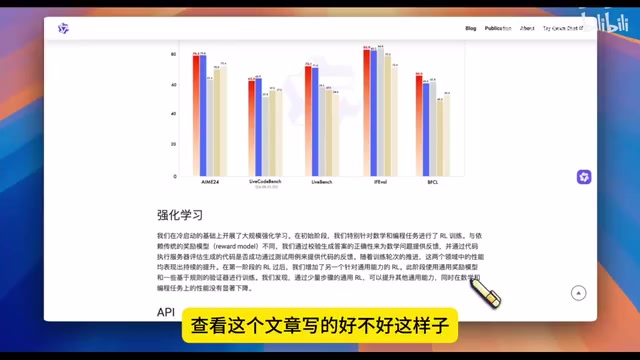
The most striking aspect of QwQ-32B is its parameter efficiency. DeepSeekAd R1's full version has 671B parameters, while QwQ-32B has only 32B — less than 5% of the former. Yet across major benchmark tests, the two perform nearly on par, with QwQ-32B even pulling ahead on certain tasks.
In the large language model domain, parameter count is the core metric for measuring model scale. Parameters are essentially the learnable weight values in a neural network — the more parameters, the more language patterns and knowledge a model can theoretically capture. 671B means 671 billion parameters; 32B means 32 billion. Conventional wisdom holds that there's a roughly linear positive correlation between parameter count and model capability — this is the "Scaling Law" proposed by OpenAI in 2020. However, QwQ-32B challenges this assumption, demonstrating that with sufficiently advanced training methods, the boundaries of scaling laws can be dramatically pushed. It's worth noting that DeepSeek R1 uses a MoE (Mixture of Experts) architecture — while its total parameter count is 671B, the actual parameters activated during each inference pass are far fewer, approximately 37B. Even so, QwQ-32B achieving comparable performance with an even smaller total parameter count remains a significant efficiency breakthrough.
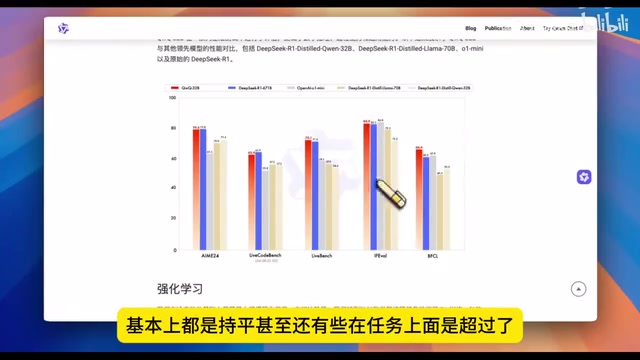
According to the official performance report, QwQ-32B outperforms DeepSeek R1 by approximately two percentage points on code-related tasks like LiveBench. LiveBench is a relatively new LLM evaluation benchmark whose core feature is the use of continuously updated test questions that haven't been contaminated by model training data. Traditional benchmarks (such as MMLU, HumanEval, etc.) carry the risk of models "memorizing" answers since their questions are fixed and public — this is known as the Data Contamination problem. LiveBench addresses this by regularly drawing questions from the latest math competitions, programming challenges, and academic papers, ensuring evaluation results reflect genuine reasoning ability rather than memorization. QwQ-32B's strong performance on such "anti-cheating" benchmarks is a more convincing demonstration of its true reasoning capability and generalization.
Compared to OpenAI's O1 model, QwQ-32B also demonstrates extremely strong competitiveness. This means a model that can be locally deployed on consumer-grade GPUs already has the capability to go toe-to-toe with top-tier closed-source models.
This "punching above its weight" ability stems from breakthroughs in data quality and training strategy, not simply parameter stacking.
Training Strategy Breakdown: Two-Stage Reinforcement Learning is Key
Although Alibaba didn't publish a formal paper, a clear two-stage training roadmap can be extracted from the blog.
Reinforcement Learning (RL) is one of the three major paradigms of machine learning, alongside supervised learning and unsupervised learning. In the traditional LLM training pipeline, there are typically two stages — Pre-training and Supervised Fine-Tuning (SFT) — potentially followed by RLHF (Reinforcement Learning from Human Feedback) for alignment with human preferences. QwQ-32B's approach goes further, elevating reinforcement learning from a mere alignment tool to a core training methodology. Specifically, the core mechanism of RL works as follows: an agent (the model) takes actions in an environment and continuously adjusts its strategy based on reward signals. In reasoning model training, the model attempts to solve problems — correct answers yield positive rewards, incorrect ones yield negative rewards, and the reasoning strategy is optimized through extensive trial and error. This aligns with DeepSeek R1's training philosophy, which also extensively uses RL algorithms like GRPO (Group Relative Policy Optimization).
Stage One: Reinforcement Learning on Math and Programming Tasks
QwQ-32B's training begins with large-scale reinforcement learning focused on mathematics and programming. These two domains were chosen for a critical reason: their answers can be precisely and quantitatively verified.

In math tasks, 1 plus 1 equals 2, never 3 — the answer is deterministic, and the model can be trained through reverse reasoning against known answers. Programming tasks work the same way — whether code passes test cases can be determined simply by running it. This inherent verifiability means no additional reward model or human annotation is needed to efficiently determine whether the model's reasoning is correct.
In reinforcement learning training, the quality of the Reward Signal directly determines training effectiveness. Math and programming tasks are prioritized precisely because they belong to the category of "formally verifiable" tasks. Math problems can be verified through symbolic computation or numerical comparison; programming tasks can be validated through automated Test Suites — what software engineering calls "unit tests." This automated verification mechanism allows the training process to completely eliminate dependence on human annotation, achieving so-called "self-play" style learning. In contrast, applying reinforcement learning directly to open-ended tasks like writing or conversation requires relying on another model (a reward model) to provide scores, and the reward model's own biases introduce the "Reward Hacking" problem — where the model learns to please the judge rather than genuinely improving its capabilities. Therefore, first establishing a solid reasoning foundation on verifiable tasks is a very clever curriculum design strategy.
Through extensive reinforcement learning training on these two types of tasks, the model's logical reasoning ability is fundamentally enhanced. This is the core reason QwQ-32B can demonstrate powerful reasoning capabilities with a small parameter count.
Stage Two: Reinforcement Learning Extension to General Capabilities
After building a solid reasoning foundation in Stage One, training moves to Stage Two — introducing reinforcement learning for general domains. This stage uses two verification mechanisms:
General Reward Model: For tasks that are difficult to quantify, such as writing and conversation, Alibaba trained dedicated reward models to judge output quality. For example, when the model writes an article, it's hard to judge quality using rules alone — this is where another model serves as the "judge." Reward models are typically trained on human preference data — annotators rank multiple model outputs, and the reward model learns these preference rankings to score new outputs. While less precise than mathematical verification, this approach provides a viable optimization direction for RL training on open-ended tasks.
Rule-based Verifiers: Used to check the format compliance of model outputs. Reasoning models typically need to output in two stages — the thinking process within thinking tags and the final answer in the solution. Additionally, when the model is asked to output in specific formats like JSON, rule-based verifiers can directly determine whether the format is compliant. This structured output capability is critical for model reliability in real-world applications, especially in scenarios requiring data exchange with other systems.
The "Emergence" Advantage of Reinforcement Learning: Capabilities Improve Rather Than Decline
During training, the Alibaba team discovered a highly valuable phenomenon: reinforcement learning doesn't cause other capabilities to decline — instead, it leads to comprehensive improvement.

This stands in stark contrast to traditional model fine-tuning. Practitioners who have done fine-tuning know that when you fine-tune a model with domain-specific data, the model's performance on original tasks typically drops by several percentage points — a well-known "catastrophic forgetting" problem.
Catastrophic Forgetting is a classic, long-standing problem in neural networks, first identified by McCloskey and Cohen in 1989. When a neural network is trained on new tasks, weight updates overwrite previously learned knowledge, causing performance on old tasks to plummet. This is particularly pronounced in LLM fine-tuning scenarios: for instance, after fine-tuning a general model with extensive medical data, its medical Q&A ability improves significantly, but its coding or math capabilities may noticeably degrade. The field has developed various mitigation strategies, including LoRA (Low-Rank Adaptation), Elastic Weight Consolidation (EWC), and multi-task joint training.
However, under the reinforcement learning framework, when the team incorporated general domain training data, the model's other capabilities not only didn't decline but showed synergistic improvement. For example, improvements in writing ability might simultaneously boost conversational capabilities. This is likely because reinforcement learning optimizes decision-making at the strategy level rather than simply fitting specific data distributions, thus causing less damage to the model's existing knowledge. This finding has significant implications for the direction of future model training — reinforcement learning may be a superior capability expansion path compared to supervised fine-tuning.
Technical Insights: A Big Future for Small Models
From QwQ-32B's success, we can extract several core insights:
First, parameter count is not the determining factor. A 32B-parameter model rivaling a 671B-parameter model demonstrates that with the right training strategy, small models can unleash enormous potential. This has major implications for local deployment and edge computing scenarios.
Second, data quality matters far more than data quantity. QwQ-32B's success is largely attributable to carefully curated high-quality training data and scientifically designed training processes, not simple data accumulation.
Third, reinforcement learning is becoming the core training paradigm for reasoning models. From DeepSeek R1 to QwQ-32B, reinforcement learning has demonstrated unique advantages in enhancing model reasoning capabilities, with particularly high self-supervised training efficiency on verifiable tasks.
From a practical deployment perspective, a 32B-parameter model after Quantization can typically be compressed to approximately 16-20GB of VRAM usage. This means a single NVIDIA RTX 4090 (24GB VRAM) can run this model, while a 671B-parameter model — even with MoE architecture — requires multiple professional-grade GPUs (such as A100 or H100) for full deployment, with hardware costs easily reaching hundreds of thousands of dollars. Quantization is a model compression technique that reduces memory usage and computational requirements by lowering model weights from 32-bit floating point to 8-bit or even 4-bit integers while preserving model performance as much as possible. For enterprise users, local deployment means data doesn't need to be sent to cloud APIs, fundamentally resolving data privacy and security compliance concerns. For developers and researchers, this dramatically reduces the cost of experimentation and iteration. QwQ-32B's open-source license (Apache 2.0) further eliminates legal barriers to commercial use.
Alibaba also mentioned at the end of the blog that they will continue integrating reinforcement learning capabilities, moving toward artificial general intelligence. The open-sourcing of QwQ-32B not only provides the community with a powerful locally-deployable reasoning model but also validates an efficient small-model training approach — one that may profoundly influence the direction of open-source AI model development going forward.
Key Takeaways
- Alibaba's QwQ-32B rivals and even surpasses DeepSeek R1's full 671B-parameter version across multiple benchmarks using only 32B parameters
- Training employs a staged reinforcement learning strategy: first building foundations with precisely verifiable math and programming tasks, then expanding to general domains
- RL's key advantage over traditional fine-tuning is that it doesn't cause capability degradation — instead enabling synergistic improvement across abilities
- The model's success once again proves that data quality and training strategy matter more than sheer parameter scale
- As an open-source model, QwQ-32B can be locally deployed on consumer-grade GPUs, dramatically lowering the barrier to high-performance reasoning models
Related articles
Deep Dive into AI Agent Skill Design: …
Deep Dive into AI Agent Skill Design: Engineering Practices from Anthropic and Perplexity
A deep dive into Skill design philosophy from Anthropic's Claude Code team and Perplexity's Agent team, covering the Tax Test, Gotchas Flywheel, progressive disclosure, and Eval-First practices for building high-quality AI Agent skill systems.
Deep Dive into OpenAI's Official GPT-5…
Deep Dive into OpenAI's Official GPT-5.6 Prompting Guide: The Shift from Manual to Automatic
A deep dive into OpenAI's official GPT-5.6 Sol prompting guide: conciseness-first, outcome-oriented design, autonomy boundaries, tool routing, and reasoning intensity tuning.
 Deep Dives
Deep Dive into How OpenClaw (Open-Source Crayfish) AI Agent Works
Deep analysis of OpenClaw AI Agent internals: System Prompt, tool calling, SubAgents, Skill system, memory, and Context Engineering explained.