Altman Says RAM Is Better Off in Data Centers Than in Personal Computers

Altman says leaving memory in PCs rather than data centers is terrible resource misallocation, reflecting AI and consumer electronics competing for capacity.
Sam Altman said bluntly on a podcast that leaving memory in personal computers rather than data centers is "terrible" resource allocation. The article analyzes that behind this statement is the structural demand for memory from AI training and inference competing with consumer electronics for limited capacity. The economic output per unit of memory in data centers is far higher than in personal devices, so Altman's position has its commercial logic. But this remark also reflects the tension between AI infrastructure players and the PC industry during a shortage cycle, and it creates the impression of "tech giants competing with the public for profits." The article points out that the memory shortage is only the surface; the core issue is the allocation priorities of scarce resources such as compute, memory, and power in the AI era, and how to balance infrastructure efficiency with end-user accessibility.
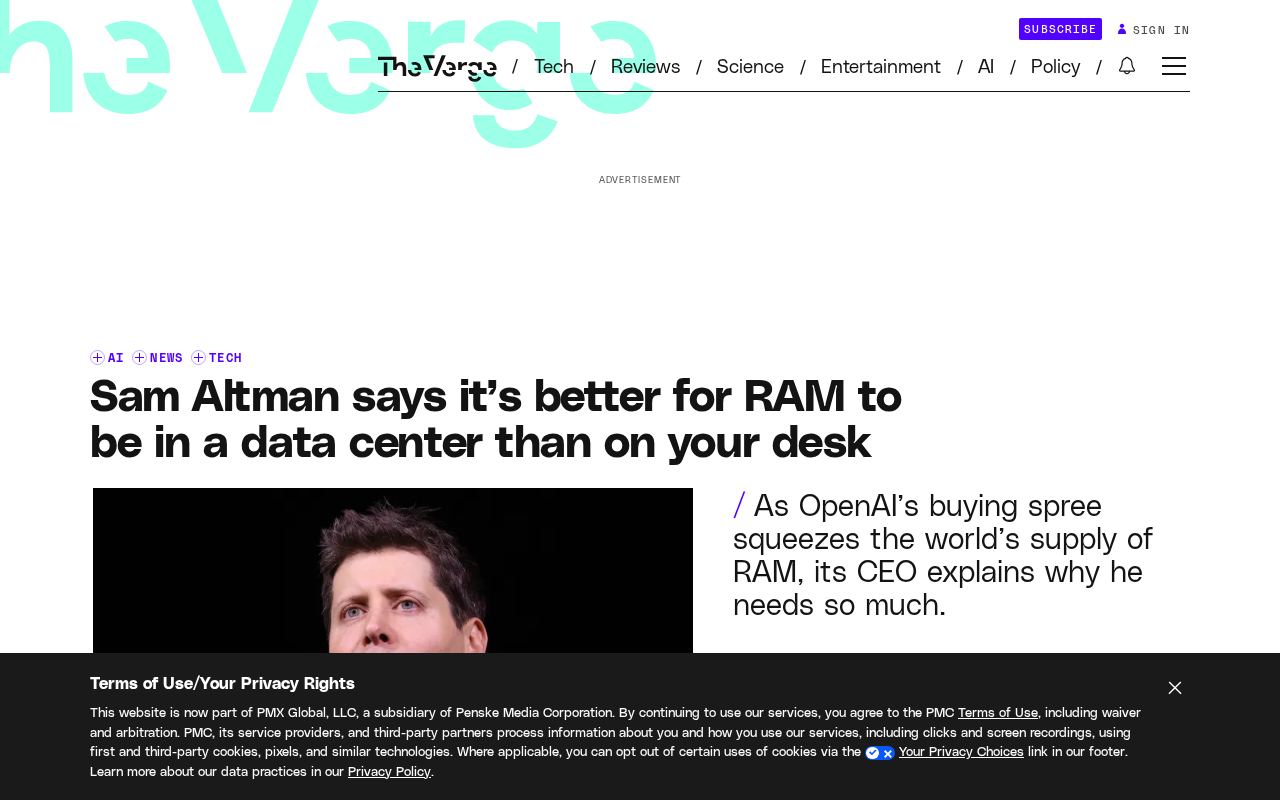
OpenAI CEO Sam Altman, appearing on the Cheeky Pint podcast, was asked about supply chain shortages—specifically the ongoing RAM shortage. His answer was quite blunt: leaving memory in personal computers instead of data centers is a "terrible" thing.
The Resource Allocation Logic Behind One Sentence
Altman's exact words were, "A lot of people want..." (the content is cut off in the source material), but he clearly expressed a negative view of memory flowing to consumer devices rather than data centers. This statement seems abrupt, but it actually points to an emerging reality: the demand for memory from AI training and inference is competing with consumer electronics for the same limited production capacity.
The memory sticks in personal computers serve the daily use of a single user, while memory in data centers supports thousands of model inference and training tasks. Judging by the economic value produced per unit of memory, the latter is clearly higher. Altman's word "terrible" essentially means that when supply is constrained, allocating scarce resources to low-output scenarios is a waste.
Why the Memory Shortage Alarms OpenAI
Large models' consumption of memory is structural. Training requires massive amounts of high-bandwidth memory to work with GPU clusters, and inference likewise depends on sufficient memory capacity to carry context and batch requests. When consumer-grade memory demand squeezes production capacity, the procurement costs and delivery cycles for cloud providers and AI companies are directly affected.
This is not a problem for OpenAI alone. The entire AI infrastructure layer is paying the price for tight memory supply, and Altman chose to say it plainly in public—which is, to some extent, also building momentum for "data center first" resource allocation.
High Bandwidth Memory (HBM) is key to understanding AI memory demand. Unlike consumer-grade DDR memory, HBM stacks multiple layers of DRAM chips vertically and packages them together with the GPU, providing several times the bandwidth of traditional memory. When training large models, the GPU needs to throughput parameters and gradients at extremely high speeds, and HBM bandwidth directly determines compute utilization. The problem is that HBM shares front-end wafer capacity with consumer-grade DRAM, and HBM has lower yields and longer production cycles. When AI data centers buy large amounts of HBM, fabs shift capacity toward higher-margin HBM, indirectly squeezing consumer memory supply. This is precisely the industry mechanism behind Altman's statement that "leaving memory in PCs is terrible"—the shortage is not an absolute shortage of total volume, but a structural shift in capacity allocation between AI and consumer electronics.
Memory demand during inference is often underestimated. Training is a one-time high investment, while inference is ongoing operational expenditure. When a large model serves thousands of concurrent requests, each request needs to retain a context window (KV Cache) in memory; the longer the context and the higher the concurrency, the greater the memory usage. Although batching can improve GPU utilization, it also linearly increases memory consumption. Therefore, for companies like OpenAI that provide API services, memory capacity directly determines how many users a single card can serve and how low the per-request cost can be pushed. Tight memory supply not only drives up procurement costs but also limits the speed of service expansion, which explains why Altman is so sensitive to consumer memory squeezing capacity.
Data Center First Does Not Mean Users Don't Matter
What needs to be distinguished is that Altman is criticizing resource misallocation, not denying the value of personal computing. Judging from his previous statements about AI lowering compute costs and making it more accessible, he does not oppose ordinary people having compute power. The problem is how to prioritize when total memory is limited.
This statement also reflects the potential tension between AI companies and the consumer electronics industry. PC makers want stable memory supply to maintain shipments, while AI infrastructure players want priority access to high-capacity, high-bandwidth memory supply. Both sides' demands are reasonable, but friction is inevitable during a shortage cycle.
What Consumers Actually Feel
For ordinary users, the most direct manifestation of the memory shortage is higher upgrade costs and lower cost-effectiveness for DIY PC builds. Altman's remarks are likely to create the impression of "tech giants competing with the public for profits," but from an industrial efficiency perspective, his judgment is not without basis—the same memory placed in a data center indeed serves far more requests and generates far higher economic returns than a personal computer.
There is an easily overlooked transmission chain between AI accessibility and compute costs. Altman has repeatedly argued that AI inference costs should fall sharply year by year so that more people can afford AI. But this vision depends on economies of scale: only if data centers continue to expand and per-unit compute costs fall can end users obtain AI services at lower prices. Conversely, if key components such as memory rise in price due to consumer electronics demand and data center expansion slows, the curve of declining inference costs will flatten. Therefore, in Altman's logic, "data center first" is not opposed to users but is a precondition he believes is necessary for achieving accessibility. The controversy is whether this top-down efficiency path can truly benefit end consumers, or merely give infrastructure players more bargaining power.
What This Debate Really Points To
The memory shortage is only the surface; the core issue is the resource allocation priorities of infrastructure in the AI era. When compute, memory, and power all become scarce goods, who defines "more worthwhile" uses will increasingly become a topic of public discussion. Altman's position is clear: data centers have a higher return on investment and therefore should come first.
This logic holds commercially, but it may not satisfy everyone at the social level. Personal computers are the entry point through which many people encounter AI, and if hardware costs continue to rise, the narrative of AI accessibility will be undermined. How to balance infrastructure efficiency with end-user accessibility is a question companies like OpenAI will sooner or later have to answer head-on.
According to the podcast content, Altman also discussed AI's impact on mathematics, but the source material does not elaborate on specific views, so no extension is made here.
One-line Summary
Altman says leaving memory in PCs rather than data centers is a terrible resource misallocation, reflecting AI and consumer electronics competing for capacity.
Paragraph Summary
Sam Altman said bluntly on a podcast that leaving memory in personal computers rather than data centers is "terrible" resource allocation. The article analyzes that behind this statement is the structural demand for memory from AI training and inference competing with consumer electronics for limited capacity. The economic output per unit of memory in data centers is far higher than in personal devices, so Altman's position has its commercial logic. But this remark also reflects the tension between AI infrastructure players and the PC industry during a shortage cycle, and it creates the impression of "tech giants competing with the public for profits." The article points out that the memory shortage is only the surface; the core issue is the allocation priorities of scarce resources such as compute, memory, and power in the AI era, and how to balance infrastructure efficiency with end-user accessibility.
Related articles

VERS: Editing Activation Explanations to Halve Reasoning Model Tokens
VERS guides reasoning models by editing activation explanations, cutting 45.8% of tokens on GSM8K with only a 0.82 pp accuracy drop and transferring to larger models, but losing accuracy on competition problems.

Finding Errors Is Not Enough: Selective Model Escalation for Entity-Targeted Sentiment Analysis
This study explores selective model escalation for entity-targeted sentiment analysis, comparing data collection ordering, uncertainty-driven re-examination, and model routing—finding that minority-class priority only helps at very small data volumes, the oracle upper bound far exceeds actual gains, and escalation must be tailored to each dataset.
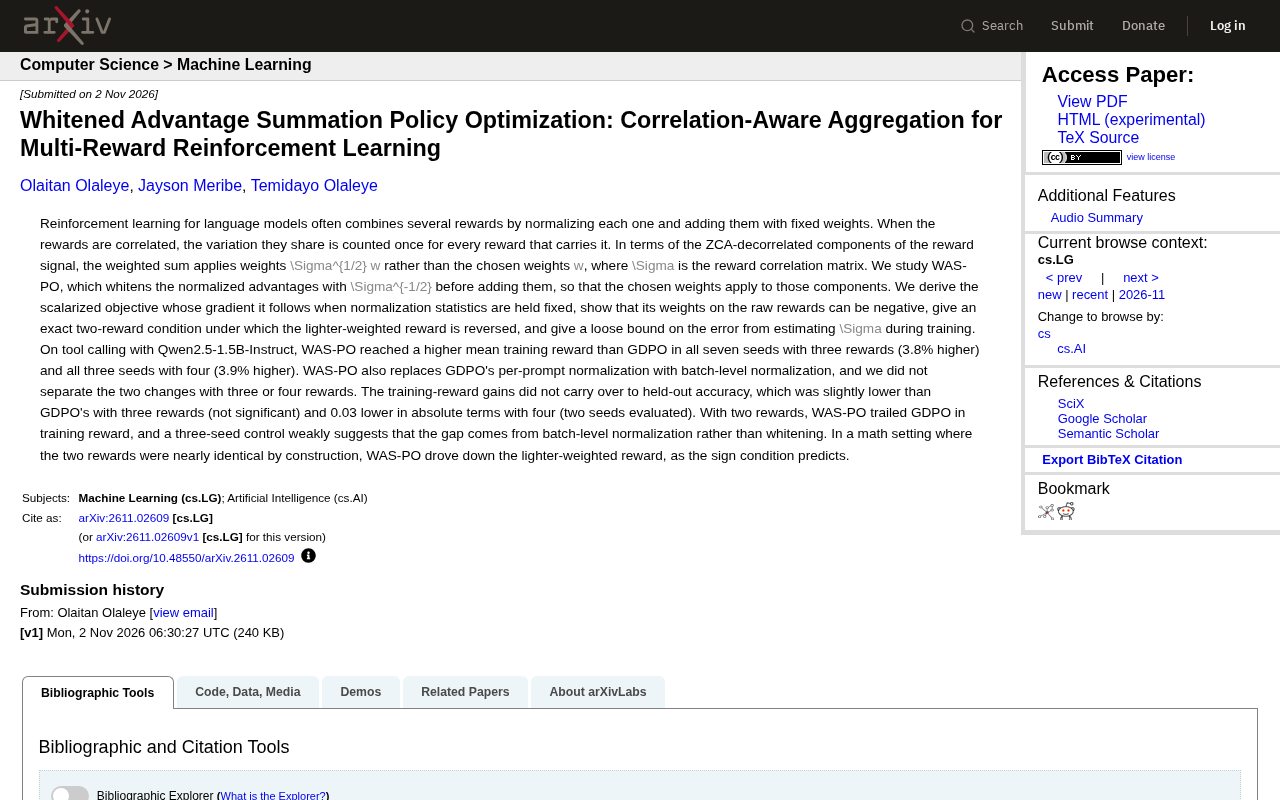
WAS-PO: Using Whitened Advantages to Solve the Correlation Trap in Multi-Reward Reinforcement Learning
WAS-PO paper proposes whitening advantages to correct correlation bias in multi-reward RL: when rewards are correlated, naive weighted summation effectively applies Σ^{1/2}w instead of w. Experiments show training reward improves steadily, but held-out accuracy does not improve in sync, and under two rewards it actually falls behind.