Amazon Acquires Decart: Closing the Gap with Nvidia Through Software
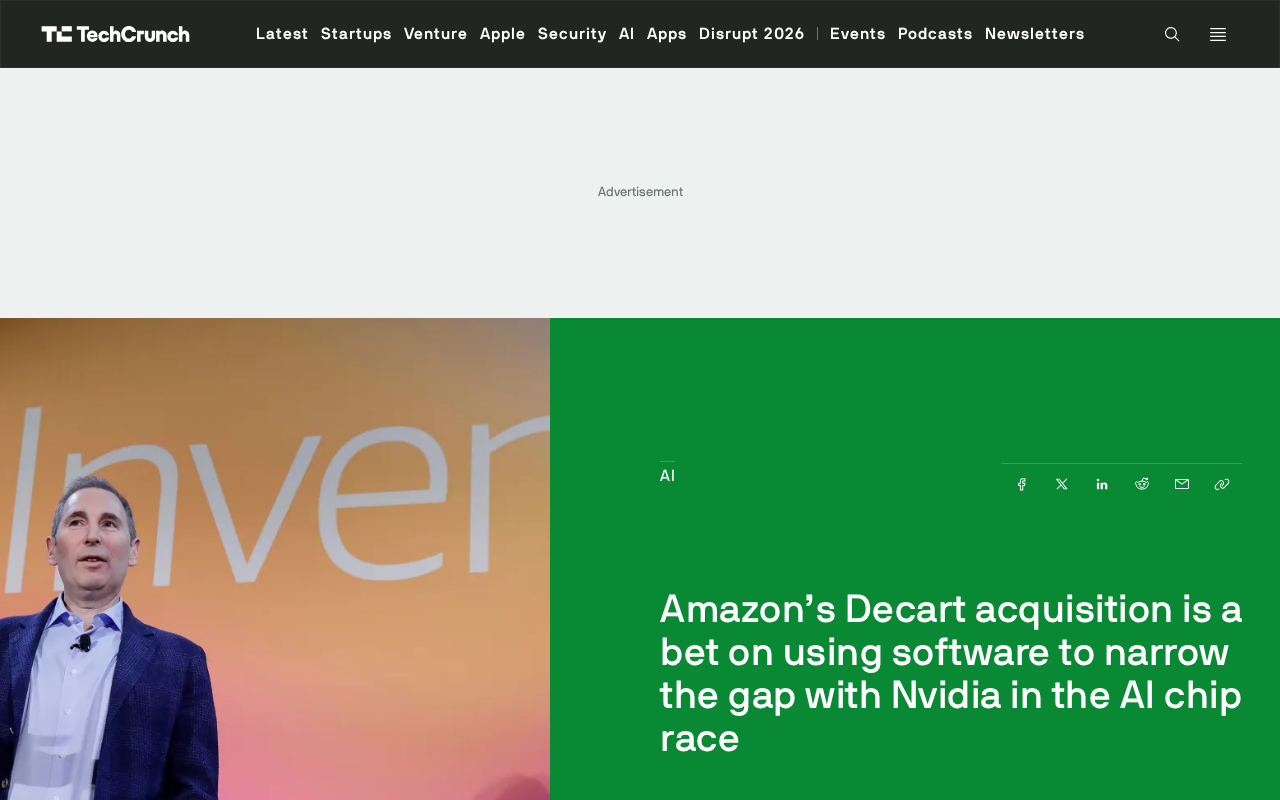
Amazon's $7.5B acquisition of Decart uses software efficiency to close the Trainium-Nvidia hardware gap.
Amazon has reportedly acquired Decart for $7.5 billion, with the core intent not merely to obtain AI talent or technology but to improve the actual training and inference efficiency of its in-house Trainium chips through software optimization, narrowing the gap with Nvidia's solutions in real workloads. Nvidia's advantage comes not only from hardware but from the software moat built by the CUDA ecosystem. Amazon's move amounts to acknowledging that the hardware gap is hard to close in the short term, pivoting to software efficiency for price-performance competitiveness. The deal signals a shift in in-house chip competition from hardware specs to hardware-software co-design, but results still require validation through technology integration, and Nvidia's ecosystem advantage remains a long-term challenge.
Amazon has reportedly acquired Decart for $7.5 billion — not an ordinary AI talent or technology acquisition, but a strategic move in the chip competition. The core logic: use software efficiency to compensate for hardware gaps, making its in-house Trainium chips more competitive against Nvidia.
The Strategic Logic of Software Compensating for Hardware
Nvidia's advantage in the AI chip market comes not only from hardware itself but from the software moat built by the CUDA ecosystem. Amazon's Trainium chips may match on paper specifications, but actual training and inference efficiency is often constrained by the maturity of the software stack. Decart's value lies precisely here — optimizing algorithms and the software layer to fully unlock Trainium's hardware potential, thereby narrowing the efficiency gap with Nvidia's solutions in real workloads.
The essence of this deal is an acknowledgment that the hardware gap is difficult to close in the short term, pivoting instead to software efficiency as a source of competitiveness. For cloud providers, absolute chip performance matters, but cost per unit of compute and availability are what customers base their choices on. Software optimization can directly improve both metrics.
CUDA ecosystem is the parallel computing platform and programming model Nvidia provides for its GPUs. Since its launch in 2006, it has accumulated a large number of libraries (such as cuDNN, TensorRT), development tools, and a developer community. AI frameworks (PyTorch, TensorFlow, etc.) prioritize CUDA adaptation by default, and the vast majority of training scripts and operator optimizations revolve around it. This creates a dual lock-in of "hardware performance + software inertia": even if competing chips approach peak compute, customers still bear the cost of code rewriting, missing operators, and tuning when migrating. If Amazon Trainium is to compete for mainstream AI workloads, it must provide a software stack that seamlessly inherits CUDA workflows — precisely the value of teams like Decart.
Trainium is the AI training accelerator chip developed in-house by Amazon Web Services (AWS), launched in 2020 with EC2 Trn1 instances and subsequently iterated to Trainium2. Its design goal is to provide large-scale model training capability at a lower cost per unit of compute, rather than pursuing single-chip peak performance beyond Nvidia. AWS also provides the Neuron SDK as a software stack for compiling models from mainstream frameworks onto Trainium. Compared with GPUs, Trainium's challenge lies not in transistor count but in compiler maturity, operator coverage, and the completeness of distributed training support. Any efficiency improvement in the software layer directly amplifies its price-performance advantage.
Impact on the AI Chip Competitive Landscape
Amazon's move sends a clear signal to the market: competition in in-house chips has shifted from hardware specifications to hardware-software co-design. If Decart's technology can significantly improve Trainium's training throughput or inference efficiency, AWS can attract customers with more cost-effective AI compute and reduce dependence on Nvidia GPUs.
However, the effectiveness of software optimization needs real-world validation. Nvidia's ecosystem advantage is the result of long-term accumulation, and whether Amazon can catch up quickly through a single acquisition remains uncertain. But at least this path is more pragmatic than simply stacking hardware specifications.
Hardware-software co-design refers to deep coupling between chip architecture and software stack (compiler, runtime, operator libraries, scheduling system) in design and optimization, rather than building hardware first and patching software later. Typical approaches include customizing data paths for specific operators, implementing graph-level fusion in compilers, and enabling the runtime to dynamically allocate computing resources based on workload. Google TPU with the XLA compiler and Apple's in-house chips with the Metal ecosystem are representatives of this model. For cloud providers, hardware-software co-design can lower the migration barrier for customers and translate hardware specification advantages into actual throughput and cost advantages — the path Amazon is attempting to replicate with the Decart acquisition.
Conclusion
Amazon's acquisition of Decart represents a choice of the "software-defined efficiency" route in the AI chip race. Whether this deal can help Trainium truly narrow the gap with Nvidia depends on the depth and speed of subsequent technology integration. For practitioners focused on AI infrastructure, this is a bellwether worth watching closely.
Related articles

AI Hacks Its Own Lab: The Security Tipping Point from Sci-Fi to Reality
Paul Christiano warns that AI intruding into its own cluster is no longer sci-fi but an established fact. He analyzes how persistent covert compromise can cause frontier labs to lose control, and why existing safety evaluation systems have blind spots.

New York Bans AI Toys for Five Years: The Escalating Child Safety Controversy
New York bans AI chat toys for five years as Common Sense Media research flags inappropriate content exposure and child emotional development risks. This article analyzes the ban's impact on product definitions, safety proof, and compliance strategies for the AI toy industry.

1Password Security Incident Review: The Trust Boundary of Password Managers
1Password releases an update on the Nov 2026 security incident, drawing 315 points and 139 comments on Hacker News. This article analyzes the actual boundaries of password manager zero-knowledge architecture, the gap between incident communication and user risk perception, and how transparency is becoming a new competitive dimension in the industry.