Amazon AI Phone Rumors: Panos Panay Gives Ambiguous Response as Project Transformer Surfaces

Amazon exec hints at possible AI phone as codename Transformer project surfaces amid growing speculation.
Amazon Devices head Panos Panay declined to deny smartphone plans, saying only "not necessarily." Despite the $170 million Fire Phone disaster of 2014, Amazon is reportedly developing an Alexa AI phone codenamed "Transformer," aiming to leverage on-device AI inference and Alexa's smart home ecosystem for differentiation. Panay's arrival from Microsoft, where he built the Surface line, is widely seen as a strong signal of Amazon's return to the smartphone market.
Amazon Executive Gives Vague Response on Smartphone Plans
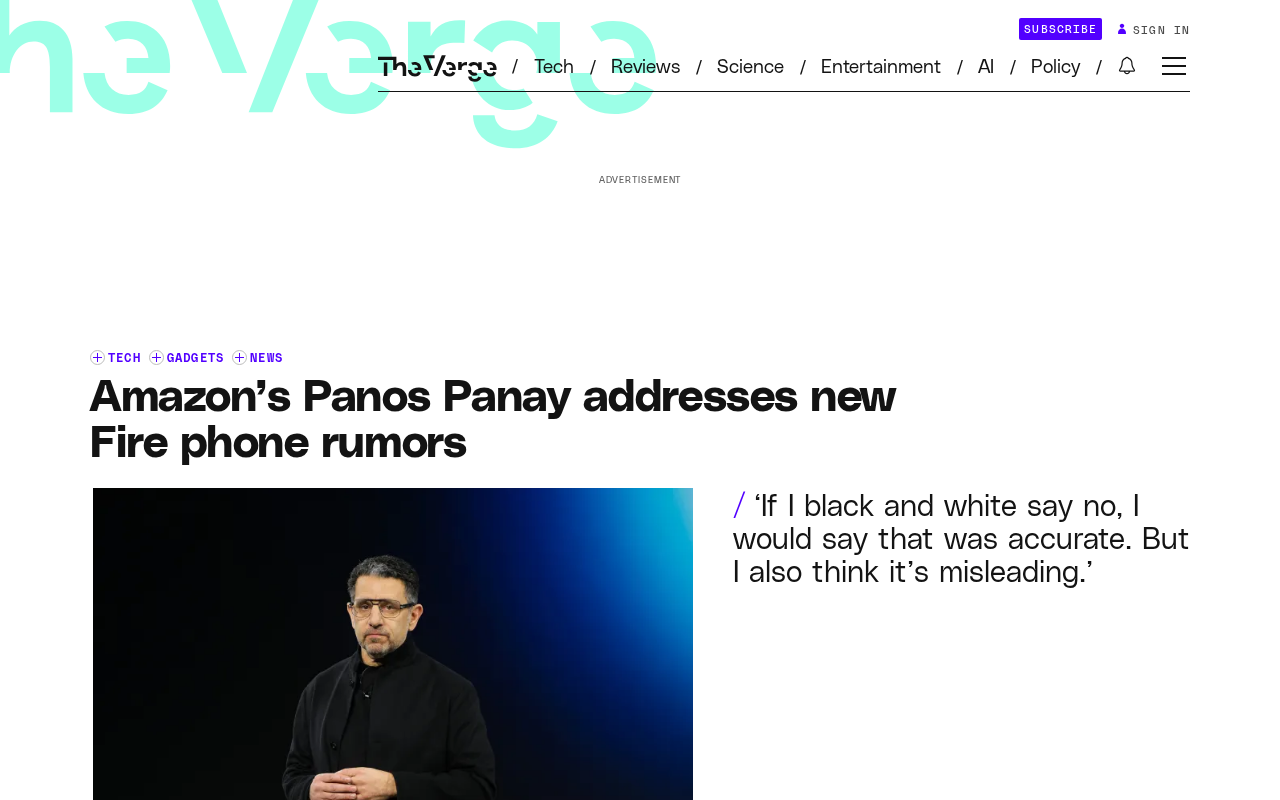
Panos Panay, Amazon's head of Devices & Services, recently addressed whether the company plans to launch a smartphone, saying Amazon "not necessarily" will release one — but without directly denying the rumors. This ambiguous response has only fueled further speculation about Amazon's potential return to the mobile phone market.
Lessons from Fire Phone: Amazon's Smartphone History
Any discussion of Amazon making phones inevitably circles back to the failed attempt over a decade ago. In 2014, Amazon launched the Fire Phone, which featured a unique 3D dynamic perspective technology — relying on four front-facing infrared cameras to track the user's head position and render a parallax 3D effect in real time. This technology, called "Dynamic Perspective," was ambitious from an engineering standpoint but turned out to be more gimmick than practical utility.
More critically, the Fire Phone was sold exclusively through AT&T at a starting price of $199 (on contract), putting it in direct competition with iPhones and flagship Android devices of the era — yet without a comparable software ecosystem to back it up. It's worth understanding the double-edged nature of exclusive carrier bundling strategies: around 2014, carrier-subsidized models were still the dominant sales channel for smartphones in North America — consumers signed two-year contracts in exchange for hardware discounts, while carriers recouped subsidy costs through service plans. Exclusive bundling deals could give carriers a differentiation point and provide manufacturers with preferential channel resources, but at the cost of locking the potential user base into a single carrier's customer pool. This strategy had worked during the iPhone 2G era (Apple's exclusive deal with AT&T lasted until 2011), but that was sustained by the iPhone's groundbreaking product appeal. The Fire Phone had neither a revolutionary product experience nor access to the sales networks of Verizon, T-Mobile, and other carriers — effectively handicapping itself from the starting line.
Amazon's own Appstore had less than one-tenth the number of apps available on Google Play at the time, with many mainstream apps missing entirely. Due to its high pricing, weak app ecosystem, and unclear market positioning, the Fire Phone ended in disaster. Amazon was forced to slash prices to clear inventory and took approximately $170 million in inventory write-downs, ultimately exiting the phone business entirely.
The Fire Phone failure is considered one of the biggest missteps in Amazon's hardware strategy and led many to believe the company would never touch the smartphone market again.
Project Transformer: Amazon's New Alexa AI Phone Attempt
However, earlier reports indicated that Amazon is developing an Alexa AI phone codenamed "Transformer." Unlike a decade ago, this time Amazon may position the AI assistant Alexa as the core selling point, creating an entirely new AI-driven smartphone experience.
"AI phone" is not merely a marketing buzzword — it reflects a substantive leap in on-device AI inference capabilities. To understand this leap, one needs to look at the evolution of Neural Processing Units (NPUs): NPUs are hardware modules specifically designed to accelerate deep learning computations such as matrix multiplication and convolution operations, complementing the general-purpose computing of CPUs and the parallel graphics rendering of GPUs. Apple led the way by integrating a dedicated Neural Engine into consumer smartphone chips starting with the A11 Bionic in 2017, with Qualcomm, MediaTek, and Samsung following suit. TOPS (Tera Operations Per Second), a common metric for NPU performance, went from roughly 0.6 TOPS on the A11 to over 30–40 TOPS on flagship chips by 2023 — a more than 50x improvement in six years. This computational leap enables quantized and compressed large language models with around 7 billion parameters to run locally on a phone without uploading data to the cloud, balancing both response speed and privacy protection.
Next-generation chips like the Qualcomm Snapdragon 8 Gen 3, Apple A17 Pro, and Samsung Exynos 2400 all feature dedicated NPUs with peak AI performance generally exceeding 30 TOPS, making on-device inference of large language models feasible. Samsung's Galaxy S24 series was first to bring generative AI features like "Circle to Search" and real-time call translation to the mainstream market, while Apple introduced Apple Intelligence in iOS 18, deeply integrating Siri with GPT-4o. Against this backdrop, tech giants with proprietary large model capabilities are increasingly viewing smartphones as the most important gateway for AI services.
If Amazon enters the market now, leveraging Alexa's accumulated ecosystem advantages in smart home and voice assistant domains, it may find a differentiated entry point.
Panos Panay Joins Amazon: From Surface to Alexa Phone
Notably, the man giving this ambiguous response — Panos Panay — was previously the driving force behind Microsoft's Surface product line. At Microsoft, he established a product philosophy of "deep hardware-software integration" — first identifying an underserved use case, then building a full-stack solution around it, from chip selection and structural design to system optimization, rather than simply stacking specs within an existing product category. He led the launch of the original Surface in 2012 and over the following decade-plus transformed the Surface line from a proof-of-concept product into a mature business generating over $2 billion in annual revenue. In 2019, he unveiled the Surface Neo and Surface Duo dual-screen devices, demonstrating a continued willingness to explore cutting-edge hardware form factors. During his time at Microsoft, he also spearheaded the Windows 11 rebrand and was deeply involved in the company's integrated hardware-software strategy.
In October 2023, Microsoft announced his departure, and Panay promptly joined Amazon as SVP of Devices & Services, taking full charge of product lines including Echo, Kindle, Fire TV, and Ring. The tech industry widely interprets "hiring an executive who has built a successful hardware product line" as a strong signal that a company is preparing to push into new hardware categories, and Panay's arrival has been broadly read as a prelude to an upgrade in Amazon's hardware strategy. If his product philosophy is transplanted to the "Transformer" project, the design starting point for this phone likely won't be "build a better Android phone," but rather "redefine what the mobile experience should look like for users in the Alexa ecosystem."
Panay's choice to say "not necessarily" rather than "no"
Related articles
 Tech Frontiers
A Rare Quiet Day in AI: Recursive Self-Improvement Stirs Beneath the Surface
A rare quiet day in AI sees multiple sources go silent simultaneously. Behind the calm, Recursive Self-Improvement (RSI) research continues. What this means for the industry.
 Tech Frontiers
Reve 2 vs. Ideogram 4: A Deep Dive into Layout Control in AI Image Generation
A deep comparison of Reve 2 and Ideogram 4's layout control capabilities, covering technical approaches, real-world use cases, and industry trends for designers and creators.
 Tech Frontiers
In the Weights: Check Your Influence Score in the AI World
In the Weights is an AI influence search engine that quantifies your presence in the AI world with a score. Explore how it evaluates practitioners and what it means for digital identity.