Amazon and Google to Jointly Hold Nearly 30% of Anthropic

After Anthropic's IPO, Amazon and Google together hold nearly 30%, reflecting AI giants' capital positioning and governance challenges.
After Anthropic's IPO, Amazon holds just under 15% with an option to increase its stake, while Google holds nearly 14%, giving the two a combined nearly 30% stake. This dual-giant capital structure is rare in tech investment history and reflects the cloud giants' battle for position in generative AI infrastructure: Amazon is deeply tied to Anthropic through AWS, and Google through Google Cloud and the TPU system, while each retains its own in-house large models, forming "competitive cooperation." Although the nearly 30% stake does not reach an absolute controlling line, it is enough to form joint influence on major matters and brings governance challenges such as related-party transactions and computing power procurement pricing. This case has become a key sample for observing the "dual bet" trend in the AI industry and public market acceptance.
One IPO, Two Giants' Capital Convergence
According to newly disclosed information, after AI startup Anthropic completes its IPO, its shareholding structure will show a high degree of concentration: Amazon will hold just under 15% of the shares and retain the option to increase its stake further; Google follows closely with a stake of nearly 14%. Together, the two tech giants will control close to 30% of Anthropic's equity. This figure means that behind one of the most watched unicorns in generative AI, the influence of these two cloud and advertising giants goes far beyond that of ordinary financial investors.
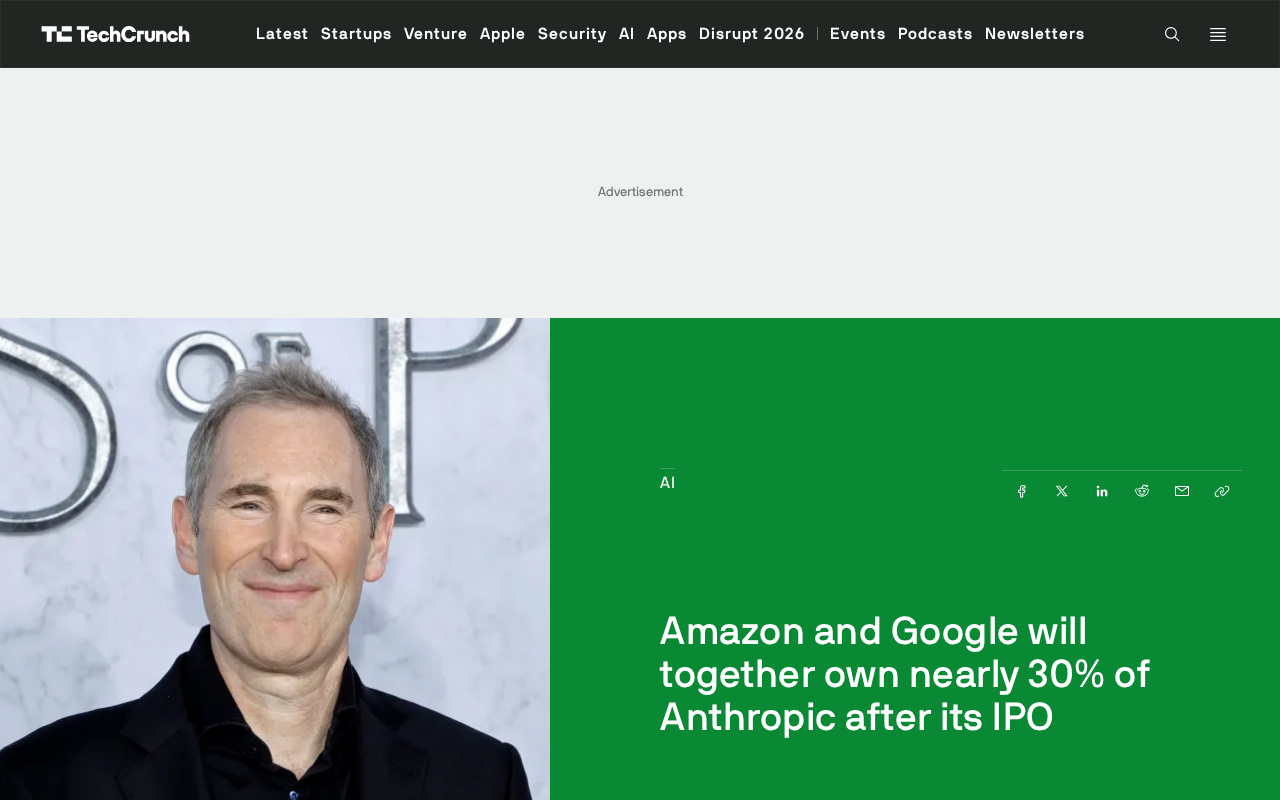
From a capital structure perspective, this dual-giant configuration is uncommon in the history of tech investment. Amazon and Google are both important backers of Anthropic and its potential competitors across multiple layers—cloud services, AI chips, and large models. After the IPO, although neither company's stake reaches an absolute controlling line, their combined share of nearly 30% is enough to form a joint influence that cannot be ignored on major matters.
Shareholding Details: Amazon Slightly Higher, but the Gap Is Narrow
Specifically, Amazon's stake is "just under 15%" and comes with an option to increase its holdings. This arrangement suggests that Amazon is not satisfied with mere financial returns but hopes to retain greater room for maneuver in Anthropic's long-term development. Google ranks second with "nearly 14%," less than one percentage point behind Amazon.
With the two giants' stakes so close, any increase by either side could change the balance of power. Amazon's "option" clause deserves particular attention—if exercised, its stake could significantly widen the gap with Google; if left unused, the two sides maintain a delicate equilibrium. This design reflects both Amazon's negotiating leverage from its early investment and sets the stage for future capital maneuvers.
The Strategic Logic Behind the Huge Stakes
The reason Amazon and Google favor Anthropic lies in the battle for position in generative AI infrastructure. Anthropic's Claude series models have significant influence in the enterprise and developer markets, and model training and inference rely heavily on cloud computing resources and specialized chips. Amazon provides computing power through AWS, while Google participates via Google Cloud and the TPU system. The equity relationship further binds this commercial cooperation into a capital tie, allowing part of Anthropic's growth dividends to flow back to the two giants.
On the other hand, both companies have their own in-house large models (Amazon's Nova series and Google's Gemini series) and compete directly with Anthropic. But through their stakes, they can maintain information and influence at the board or shareholder level of a competitor, forming a complex relationship of "competitive cooperation." This strategy is not unprecedented in the tech industry, but such a high concentration of stakes in the large-model AI field remains quite rare.
TPU (Tensor Processing Unit) is a specialized AI accelerator chip independently developed by Google, designed specifically for machine learning workloads and particularly adept at matrix operations—the core computation of deep learning. Compared with general-purpose GPUs, TPUs can deliver higher energy efficiency and throughput on specific AI tasks. Google has deployed TPUs since 2015, and they have now gone through multiple generations, with computing power offered to external customers through Google Cloud. For large-model companies like Anthropic, the TPU system represents an alternative source of computing power besides Nvidia GPUs, and the equity relationship further consolidates this chip-model synergy.
AWS (Amazon Web Services) is the public cloud platform with the largest global market share, offering full-stack infrastructure from computing and storage to specialized AI chips (such as Trainium and Inferentia). Amazon not only provides training and inference computing power for Anthropic through AWS but also binds it deeply as a strategic investor. This vertically integrated model of "cloud provider + chips + models" is becoming the standard configuration in generative AI competition.
Governance Challenges After the IPO
The combined stake of nearly 30% will bring practical issues to Anthropic's post-IPO governance. Public market investors typically focus on the impact of ownership concentration on the interests of minority shareholders, as well as potential conflicts of interest such as related-party transactions and computing power procurement pricing. Amazon and Google are both shareholders and important suppliers and customers, and this multiple identity needs to be clearly defined in the prospectus and subsequent disclosures.
For Anthropic, the balance between maintaining independence and leveraging giant resources will persist for a long time. Whether the founding team and employee shareholders can maintain sufficient voice after the IPO will determine whether the company's strategic direction is overly influenced by the will of major shareholders. Judging from the currently disclosed proportions, neither giant has crossed the absolute control line, which leaves Anthropic some room for autonomy, but the figure of "nearly 30%" itself is enough to keep external investors alert.
Related-party transactions refer to transactions between a listed company and its related parties (such as major shareholders, directors, senior executives, or enterprises controlled by them). In Anthropic's case, Amazon and Google are both shareholders holding nearly 30% and its computing power suppliers and potential customers; the computing power procurement and cloud service agreements between them constitute related-party transactions. Public market investors and regulators typically require such transactions to be fully disclosed in the prospectus and to ensure fair pricing and compliant procedures, so as to prevent major shareholders from encroaching on the interests of minority shareholders through related-party transactions. This is also one of the most closely watched focuses of Anthropic's governance after the IPO.
Potential Impact on the AI Competitive Landscape
The exposure of this shareholding structure reflects a deeper trend in generative AI competition: behind leading model companies often stand cloud giants that are also vying for AI dominance. Amazon and Google are simultaneously betting on in-house development and external cooperation through capital ties, forming a "dual bet" configuration. For other AI startups, this means financing choices are no longer just a matter of valuation but also involve taking sides and ecosystem affiliation.
Anthropic's IPO will test the public market's acceptance of this ownership structure. If the market gives a positive valuation, it may encourage more AI companies to accept large strategic investments from giants; if investors express concerns about concentrated ownership and related-party transactions, it may prompt subsequent AI companies to be more cautious in financing terms. Regardless of the outcome, Amazon and Google's combined stake of nearly 30% has become a key sample for observing the capital landscape of the AI industry.
"Dual bet" in venture capital and strategic investment refers to the same investor supporting multiple competing targets simultaneously to hedge uncertainty and ensure overall exposure in a given sector. Amazon and Google developing their own large models (Nova, Gemini) while heavily investing in Anthropic is a typical manifestation of this strategy. For AI startups, accepting such strategic investment means gaining computing power, funding, and ecosystem support, but they may also face pressure to take sides, limited independence, and future exit paths influenced by the will of major shareholders. This financing model is reshaping the competitive landscape of the AI industry and the capital choices of startups.
Related articles

Gemini 4 Neon Leak: A Potential Strong Contender Against Opus 5.5
A Hacker News thread suggests Gemini 4 Neon looks like an Opus 5.5 competitor. This article unpacks the product positioning behind this community signal, shifts in the top-model competitive landscape, and what it means for developers' model selection strategy.

Claude Fable 5.2's Self-Authored Short Film 'Fable' Sparks Discussion
A short film 'Fable,' credited to Claude Fable 5.2 for script, visuals, and directing, appears on Hacker News. This article analyzes the significance of full-pipeline AI creation, community reactions, and what it means for content creators.

Anthropic IPO Pricing: A Signal of AI Giants Going Public
Anthropic's IPO pricing draws attention. This article analyzes its potential impact on AI industry valuation, commercialization paths, and the competitive landscape, and highlights public-market expectations and challenges for AI companies.