Amazon Invests in Indiana Nuclear Plant as AI Power Demand Sparks a New Energy Chess Game
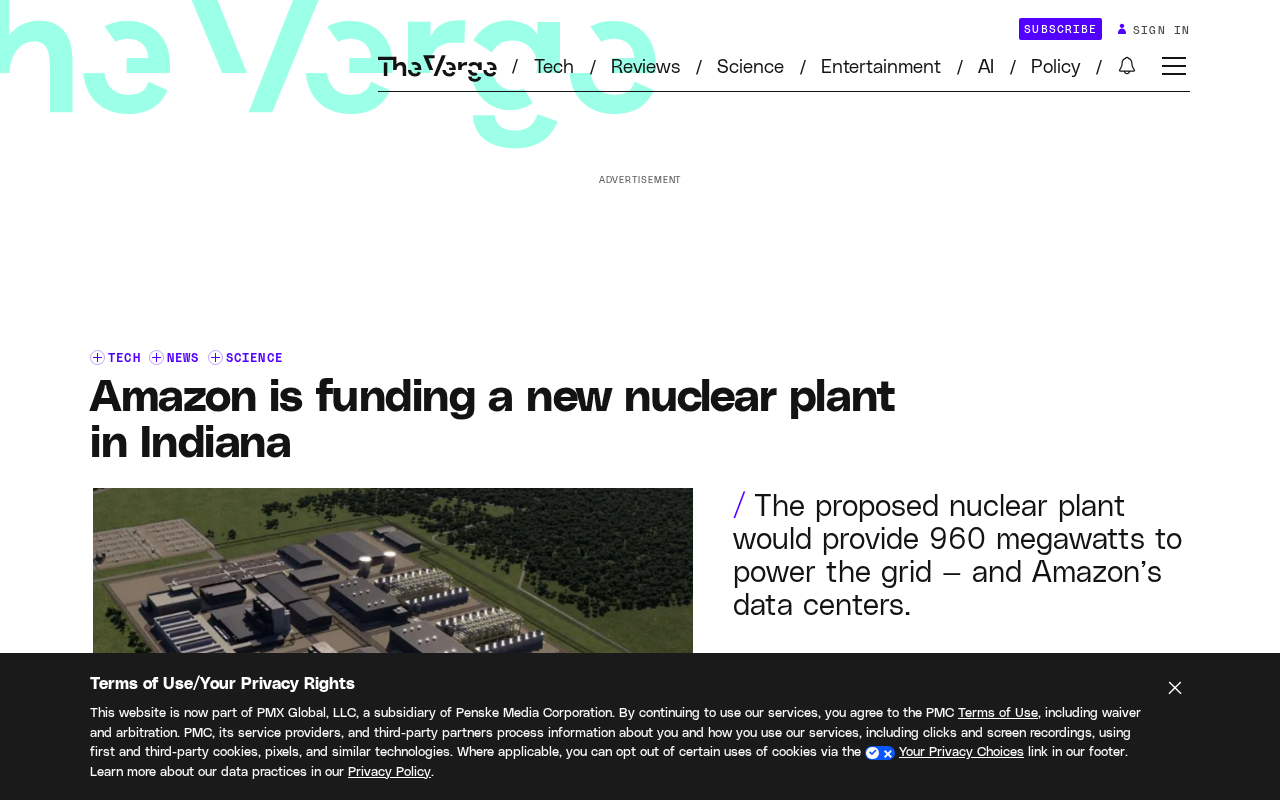
Amazon teams up with X-energy and AEP to fund a 960 MW nuclear plant at a former coal site in Indiana.
Amazon has signed an agreement with X-energy and utility AEP to jointly fund a 960 MW nuclear facility at the decommissioned Breed coal plant in Sullivan County, Indiana. The move signals tech companies shifting from buying renewable energy certificates to directly investing in power generation. As baseload power, nuclear provides round-the-clock stable output for AI data centers. The project reuses coal plant infrastructure to cut costs but faces uncertainties over regulation, SMR commercialization, and cost overruns.
Amazon is expanding its energy footprint into nuclear power. According to the latest news, Amazon has signed an agreement with X-energy and American Electric Power (AEP) to jointly fund the construction of a new nuclear facility in Indiana. The proposed plant will replace the decommissioned coal-fired Breed Generating Station in Fairbanks, Sullivan County, with the goal of providing up to 960 megawatts of carbon-free energy to the region.
A Three-Way Partnership: Tech Giant, Nuclear Upstart, and Utility
The three parties in this collaboration are each representative. Amazon, as a tech giant, has been highly active in clean energy procurement in recent years; X-energy is an upstart in nuclear technology focused on developing advanced small modular reactors (SMRs); and AEP is a major U.S. utility responsible for grid operations and power transmission. This combination sends a signal: tech companies are no longer content to merely purchase renewable energy certificates — they are directly intervening in the investment and construction of power generation facilities.
The specific financial terms of the agreement have not been disclosed, but the phrase "fund construction" implies that Amazon has committed substantive capital in the project's early stages. For a nuclear power plant, upfront capital expenditure is enormous and the timeline is long, so capital injection from a tech company can significantly reduce project development risk.
Small Modular Reactors (SMRs) are a class of nuclear technology distinct from traditional large nuclear units, typically ranging from tens to hundreds of megawatts per unit and built using factory prefabrication and modular assembly. Their core advantages include shorter construction timelines, lower upfront capital investment, more flexible siting, and the ability to flexibly match power demand through multi-module combinations. X-energy's primary focus is the high-temperature gas-cooled reactor (HTGR) pathway, using tri-structural isotropic (TRISO) coated fuel particles, which offer inherent safety characteristics. However, most SMRs remain in the design verification and first-of-a-kind demonstration stage, with very few commercial operating cases worldwide, so their cost curve and construction schedule remain the largest sources of uncertainty.
What 960 Megawatts Means
A installed capacity of 960 megawatts is medium-scale in the nuclear sector, roughly equivalent to a large gas turbine plant or the combined output of dozens of wind farms. More critically is the "carbon-free energy" positioning — nuclear power, as baseload generation, can provide round-the-clock stable output unaffected by weather or day-night cycles.
For Amazon, this capacity is directly tied to the growing power demand of its data centers. The computing expansion driven by AI training and inference is pushing tech companies' electricity consumption curves to new highs. While wind and solar are clean, their intermittent nature makes it difficult to meet data centers' stringent requirements for stable power supply. Nuclear power fills exactly this gap.
Baseload power refers to generation facilities that can operate continuously at relatively stable output and carry the grid's base load. It contrasts with peaking power sources (such as gas turbines) and intermittent sources (such as wind and solar PV). Nuclear plants, due to long fuel replacement cycles and high startup/shutdown costs, are typically designed to run at full power around the clock, with annual utilization hours exceeding 7,000 — far higher than wind (about 2,000–3,000 hours) and solar PV (about 1,000–1,500 hours). For data centers requiring 99.999% power supply reliability, the value of baseload generation lies not only in being clean but also in its predictable output, unaffected by weather and day-night fluctuations, which can significantly reduce dependence on energy storage and backup power.
From Coal to Nuclear: The Logic of Site Reuse
The project is sited at the former Breed coal plant, a choice that is highly symbolic. Coal plants typically have ready-made grid interconnection conditions, cooling water sources, and land resources, and converting them to nuclear plants allows reuse of some infrastructure, lowering upfront costs. At the same time, the transition from fossil fuels to zero-carbon energy aligns with the regional energy transition policy direction.
However, nuclear plant construction timelines are far longer than those of gas or renewable projects. From design and permitting to construction and grid connection, a nuclear plant often takes years or longer. This means Amazon's investment is a long-term strategic play rather than short-term cost optimization.
Nuclear plant siting is subject to a series of strict constraints: adequate and stable cooling water sources, relatively low seismic risk, population density conditions meeting emergency planning zone requirements, and reliable grid interconnection points. Decommissioned coal plants often satisfy multiple of these conditions simultaneously — existing transmission corridors and substations, water intake and discharge facilities, and mature site geological survey data. The U.S. Department of Energy has repeatedly noted in recent reports that converting retired coal plant sites into advanced nuclear facilities can save considerable grid interconnection and civil construction costs, and leverage the host community's existing acceptance to reduce public resistance. This "coal-to-nuclear" pathway is therefore seen as one of the preferred options for deploying advanced reactors.
The Tech Giants' Energy Race
Amazon is not the only tech company betting on nuclear power. Microsoft, Google, and others are also exploring nuclear procurement and investment pathways to meet the power demands of the AI era. The underlying logic of this race is that computing growth is outpacing grid expansion — whoever locks in stable clean power first will gain the initiative in AI infrastructure competition.
According to analyses of tech companies' energy strategies by Bilibili creators and YouTube channels, Amazon's move is consistent with its "net-zero operations" commitment and also reflects the tech industry's deep anxiety about grid reliability. One commentary noted that the commercialization pace of small modular reactors will be the key variable determining the success of such projects.
Challenges and Uncertainties
Nuclear projects face multiple challenges including regulatory approval, cost overruns, and public acceptance. X-energy's SMR technology is still in the early commercialization stage, and whether the first-of-a-kind construction can proceed on schedule remains uncertain. AEP, as the utility party, needs to balance investment returns and customer electricity rates within the regulatory framework.
Moreover, how the 960 megawatts will be allocated between Amazon's data centers and the regional grid has not been disclosed in the agreement details. If most of the power flows to the tech company's own facilities, the benefits to local residents and businesses will depend on subsequent power purchase agreement arrangements.
Whether this nuclear plant can become a model for tech companies' deep involvement in energy infrastructure remains to be verified over time. But one thing is certain: AI's appetite for electricity is reshaping the landscape of energy investment.
One-line Summary
Amazon teams up with X-energy and AEP to fund a 960 MW nuclear plant at a former coal site in Indiana.
Paragraph Summary
Amazon has signed an agreement with nuclear technology company X-energy and utility AEP to jointly fund a 960 MW nuclear facility in Sullivan County, Indiana, sited at the decommissioned Breed coal plant. The article argues this marks a shift by tech companies from purchasing renewable energy certificates to directly investing in power generation facilities. As baseload power, nuclear energy provides round-the-clock stable output that aligns with AI data centers' need for reliable clean electricity. The project reuses the coal plant's grid interconnection, cooling water, and land resources to reduce costs, but still faces uncertainties around regulatory approval, SMR commercialization pace, and cost overruns. Tech giants like Microsoft and Google are also pursuing nuclear energy, reflecting the tension between computing growth and grid expansion.
Related articles

OpenAI Partners with Shield: How the Astra Agent Revolutionizes IT Troubleshooting
OpenAI and Shield launch the Astra agent, which autonomously logs into computers and legacy systems to fix IT issues in real time, 35-40% faster than traditional models, with humans involved only when judgment is needed.

iPhone Duo Battery Life Tested: One Charge a Day Is Unavoidable, and the Large Screen Is the Culprit
iPhone Duo battery test: heavy use needs at least one charge a day, and about 30% remains after 6.5 hours of screen-on time. How often the large screen is unfolded is key; a MagSafe battery pack helps, and long-term degradation is also worth watching.

Kimi K3.1 Pro Open-Sourced: 2.8 Trillion Parameters Close In on Opus
Moonshot releases the open-source MoE model Kimi K3.1 Pro, with 2.8T total parameters and 104B activated, trailing Opus 5.5 by under 1 point on Terminal Bench 4.0.