Ambrosia Energy to Build 10 GWh Battery Factory in Texas to Power Off-Grid Data Centers

Ambrosia Energy plans a 10 GWh battery factory in Texas to supply round-the-clock clean power to off-grid data centers.
The article reports that startup Ambrosia Energy plans to build a 10 GWh battery factory in Texas to provide 24-hour clean power for off-grid data centers. Its approach combines daytime solar generation with battery storage for nighttime use, bypassing aging U.S. grids and long interconnection queues. Texas was chosen for its abundant sunlight and ERCOT's renewables-friendly independent market. The article examines challenges in cost, reliability, and scale, and notes the model could reshape data center siting and create new battery demand.
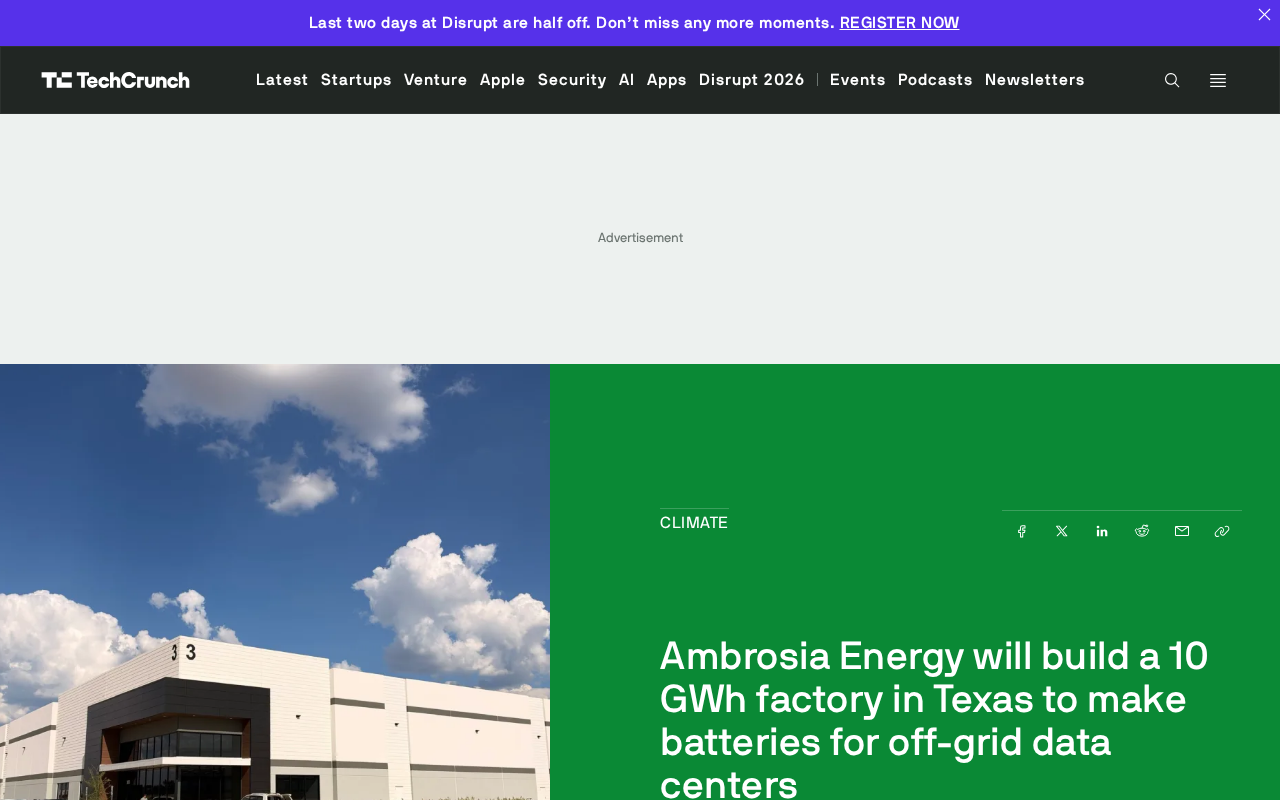
Data centers' demand for power is growing at an astonishing rate, and traditional grids may not be able to keep up. Recently, a startup called Ambrosia Energy announced that it will build a battery factory with a capacity of up to 10 GWh in Texas, specifically to provide round-the-clock clean power for off-grid data centers.
The core goal of this factory is to combine solar power with large-scale energy storage to create an independent power plant that does not rely on the public grid and can operate 24 hours a day.
Why Data Centers Need Off-Grid Power
AI training and cloud computing have an increasingly voracious appetite for power. The electricity consumption of a single large data center is already equivalent to that of a small or medium-sized city. That said, in many parts of the United States the grid is aging and the interconnection queue is long, and some data center projects have even been forced to delay because they cannot get power.
Ambrosia Energy's approach is to bypass the grid bottleneck. Solar panels generate electricity during the day, and batteries store the surplus power for use at night or on cloudy days. In this way, data centers are no longer constrained by the grid's expansion speed and supply stability.
Texas became the chosen location partly because of its abundant sunlight, and partly because Texas has an independent electricity market (ERCOT) that is relatively friendly to renewable energy and off-grid solutions.
The original report noted: this startup will build a giant factory to mass-produce batteries to expand solar panels, thereby forming a clean power plant that can operate around the clock.
ERCOT (Electric Reliability Council of Texas) is the independent grid and electricity market operator for most of Texas, covering about 90% of the state's electricity load. For historical reasons, there is almost no large-scale synchronous interconnection between the Texas grid and the two neighboring major grids (the Eastern Interconnection and the Western Interconnection), and AC tie capacity is extremely small, so it is often called an "island grid." This structure largely exempts ERCOT from federal jurisdiction over interstate transmission under the Federal Power Act, allowing it to design its own market rules, and it has therefore become one of the U.S. grids with the highest share of renewable energy interconnection, with wind and solar accounting for a leading share nationwide for a long time. In addition, ERCOT uses a design centered on the energy market and ancillary services market, with relatively flexible price signals that are more friendly to new generation and energy storage. For companies like Ambrosia Energy, this means that even without directly relying on the public grid, they can more conveniently obtain land, permits, and electricity market support in Texas, which is an important reason Texas was chosen as the off-grid site.
What a 10 GWh Factory Means
10 GWh is a fairly large number. For comparison, the planned capacity of many leading battery factories worldwide is on the order of tens of GWh. A startup directly planning 10 GWh shows that the demand scale of its target customers—off-grid data centers—is large enough, otherwise it would be difficult to support such capacity.
The role of energy storage batteries here is not to power cars, but to act as a "mover of time": shifting surplus solar power from noon to use at night. For data centers, continuity of power supply is more important than electricity price, so the cycle life and safety of the batteries will be key indicators.
GWh (gigawatt-hour) is a unit of measurement for electrical energy or energy storage capacity, and 1 GWh equals 1 million kWh (1 million units of electricity). When used to measure a battery factory, it refers to the total energy capacity of batteries the factory can produce in a year, not instantaneous power. For reference, a common grid-scale energy storage project is usually between 100 MWh and 1 GWh, while a battery factory with an annual output of 10 GWh is equivalent to producing about ten 1 GWh-class energy storage systems each year. Assuming a large data center has a continuous power consumption of 100 MW, if it is to run alone on energy storage for 10 hours without sunlight, it would need about 1 GWh of storage capacity. Therefore, 10 GWh of capacity is enough to support round-the-clock off-grid operation of multiple such data centers, which also indirectly shows that the demand scale of the target customers is indeed enormous.
Challenges Facing This Model
Off-grid power sounds beautiful, but the challenges are equally obvious.
Cost: Whether the levelized cost of solar plus storage can remain lower than grid power over the long term depends on battery prices and sunlight conditions.
Reliability: Data centers usually require extremely high power availability. Under consecutive days of rainy weather, whether the energy storage system can hold up requires redundancy design.
Scale: From announcement to production, a 10 GWh factory still faces a series of practical issues such as construction, yield, and supply chain.
Data center power reliability is usually measured by availability tiers. In industry practice, Tier III requires annual availability of no less than 99.982%, while Tier IV requires more than 99.995%, which translates to no more than about 1.6 hours and 0.4 hours of unplanned downtime per year, respectively. Traditional data centers therefore generally adopt multiple redundant architectures with dual utility feeds, diesel generators, and UPS. A purely off-grid solution must use solar, batteries, and possibly backup generators to build equivalent redundancy, and must also cope with the impact of consecutive cloudy and rainy days, dust shading, and extreme heat on PV output and battery life. This means off-grid data centers cannot look only at average generation, but must still leave sufficient margin under the "worst weather window," significantly increasing design difficulty and cost.
Impact on the Industry
If Ambrosia Energy's model works, it could change the logic of data center siting. In the past, data centers had to be close to the grid and users; in the future, they may be close to areas with abundant sunlight and cheap land.
For the battery industry, data centers are becoming another major source of demand after electric vehicles and energy storage stations. The off-grid data center niche may attract more players to enter.
At present, this is only a factory plan. Whether it can ultimately be realized and whether the products can meet data-center-grade reliability requirements still need time to verify.
One-line Summary
Ambrosia Energy plans to build a 10 GWh battery factory in Texas to provide round-the-clock clean power for off-grid data centers.
Paragraph Summary
This article reports that the startup Ambrosia Energy plans to build a battery factory in Texas with a capacity of up to 10 GWh, specifically to provide 24-hour clean power for off-grid data centers. Its core idea is to use solar power during the day and store it in batteries for release at night, thereby bypassing the bottlenecks of aging U.S. grids and long interconnection queues. Texas was chosen because of its abundant sunlight and because the independent ERCOT electricity market is relatively friendly to renewable energy and off-grid solutions. The article analyzes three major challenges of this model: cost, power supply reliability, and scaled implementation, and notes that if successful, it could change the logic of data center siting while bringing the battery industry new demand after electric vehicles and energy storage stations.
Related articles

NVIDIA's 30,000 Developers Use Cursor, Code Commit Volume Triples
Cursor engineer Chris Diaz breaks down five organizational gaps blocking enterprise AI coding scale—strategy, risk tiering, governance, metrics, and operating model. NVIDIA's 30,000 developers use Cursor daily, tripling code commits while defect rates stay flat. The key: rewrite the SDLC, not add tools.

Ponytail: Giving AI Coding Agents a Senior Engineer's Mindset
Ponytail is a free GitHub tool that injects a senior engineer's mindset into AI coding agents, making them ask whether code is even necessary first. According to TamilDeck, it can compress 200 lines of AI-generated code to 30, cutting token costs, with support for Cursor rules and Claude Code skill integration—though security review still requires human oversight.

Complete Guide to Connecting Cursor AI to the GitHub MCP Server
A step-by-step guide to connecting Cursor AI to the GitHub MCP server: create a personal access token, configure mcp.json, store the token in the ENV block, and verify with a PR query.