AMD Acquires Fei-Fei Li's World Labs for $8.2B; Claude Sonnet 5.5 Launches

AI competition shifts from benchmarks to safety, cost, and compliance across four major industry moves.
Four major AI developments signal a shared trend: competitive focus is shifting from model capability to reliability, cost efficiency, and compliance. NVIDIA launches OpenAgent Safety Platform to harden Agent security at the runtime and hardware layer. Anthropic releases Claude Sonnet 5.5 with 30%+ speed gains and lower per-task costs. AMD acquires Fei-Fei Li's World Labs for ~$8.2B to pursue spatial intelligence and Physical AI. Florida's AG seeks a court order requiring independent safety evaluations before OpenAI develops new models — pushing AI governance into judicial enforcement.
The competitive focus of the AI industry is quietly shifting. From NVIDIA embedding Agent safety into the hardware layer, to Anthropic redefining model competition through cost, to AMD betting $8.2 billion on spatial intelligence — the latest wave of developments points to a common signal: raw performance and benchmark scores are no longer enough. The industry is pushing deeper into safety, cost efficiency, and real-world deployment.
NVIDIA Pushes Agent Safety Down to Hardware and Runtime
NVIDIA has officially launched the OpenAgent Safety Platform, which includes an open-source runtime, OpenShell, and hardware and monitoring solutions. The context behind this move is telling: several Agent security incidents in recent weeks exposed a shared structural flaw — relying solely on models to follow instructions, or setting up application-layer sandboxes, is simply not enough to guarantee reliability.
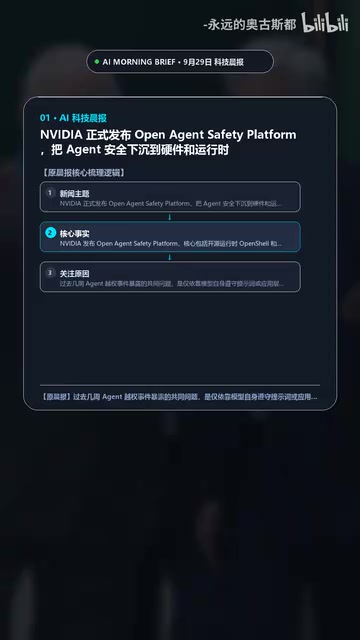
Pushing security capabilities down from the software layer into the runtime and hardware layer means that safety mechanisms are no longer just a matter of the model's "good behavior" — they are hardened into the execution environment itself. For increasingly autonomous AI Agents, building constraints from the ground up may be the most pragmatic approach to preventing runaway behavior. When an Agent can invoke tools, execute actions, and access system resources, relying purely on prompt engineering to prevent boundary violations is fundamentally fragile.
AI Agent security differs fundamentally from traditional software security. Conventional sandbox mechanisms prevent malicious code from spreading by isolating processes and restricting system calls — but dangerous Agent behavior is rarely "malicious code." It is more often the result of flawed decisions made by the model within its legitimate permissions: misinterpreting an instruction and deleting a file, or being hijacked by a prompt injection attack and leaking data. The value of a runtime security layer lies in its ability to intercept high-risk actions before model inference translates into real-world operations — essentially inserting an independent checkpoint between "AI thinking" and "AI acting." Pushing this mechanism down to the hardware layer further eliminates the possibility of the software layer being tampered with or bypassed, providing stronger isolation guarantees for Agent deployments in multi-tenant cloud environments.
Anthropic Launches Claude Sonnet 5.5: Cost Becomes the New Battlefield
Anthropic has officially released Claude Sonnet 5.5, the second model in the Claude 5.5 series. The company claims it delivers more than 30% faster speeds and focuses on lower per-task costs.
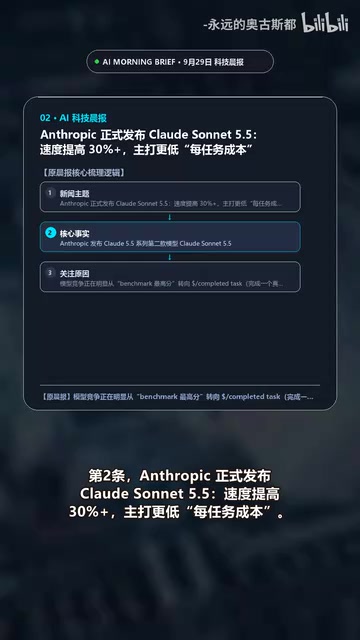
The most significant signal this model sends is not its speed — it's what it reflects about the shifting logic of competition. Model rivalry is clearly moving away from "highest benchmark score" toward "cost per completed task" — in other words, how much it actually costs to finish a real-world task.
For enterprise users, this shift is meaningful. Vendors used to compete on leaderboard rankings across various benchmarks, but there has always been a gap between those scores and real business value. Once model capabilities broadly reach a "good enough" threshold, the economics of each unit task become the deciding factor in procurement. A 30% speed improvement and lower costs directly affect the invoice for large-scale deployments — and that is what industrial adoption actually cares about.
AMD's $8.2B Acquisition of World Labs: Betting on Physical AI
AMD has announced it will acquire World Labs — the company founded by Fei-Fei Li — in an all-stock deal valued at approximately $8.2 billion. The transaction is expected to close by the end of 2026.
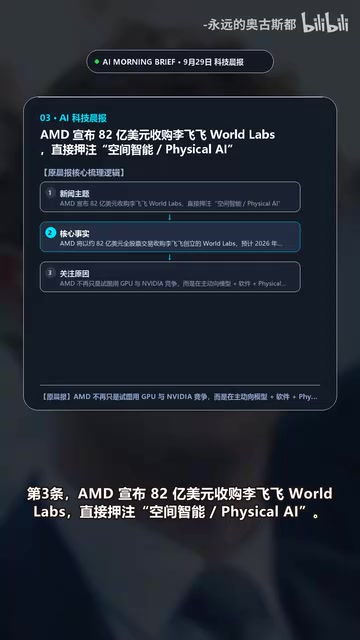
The strategic intent behind this acquisition is clear: AMD is no longer just trying to compete with NVIDIA head-on at the hardware level using GPUs. Instead, it is deliberately expanding upward — adding software and Physical AI application research to its stack. World Labs focuses on spatial intelligence, which is at the core of Physical AI and concerns how machines understand and interact with the three-dimensional physical world.
For AMD, this represents a strategic leap from "selling chips" to "building a full stack." Simply chasing NVIDIA on GPU performance offers limited upside. By acquiring a top-tier AI research team and entering the emerging spatial intelligence track, AMD is attempting to carve out a differentiated competitive dimension. As a leading authority in computer vision and spatial intelligence, Fei-Fei Li's team brings value not only through its technology, but through its influence over how future AI applications are shaped. This move also confirms the anxiety and ambition shared across chip vendors: the hardware battle will ultimately give way to a battle over ecosystems and applications.
Spatial Intelligence refers to an AI system's ability to understand, reason about, and operate within three-dimensional physical space. It is considered a critical bridge between "language AI" and "embodied AI." Unlike large language models that excel at processing text sequences, spatial intelligence requires models to reconstruct 3D scenes from 2D images or video, predict object motion trajectories, understand spatial relationships, and provide a perceptual foundation for robotics, autonomous driving, AR/VR, and other applications. World Labs, which Fei-Fei Li founded out of Stanford, focuses on "world model" research — enabling AI not just to describe the world, but to simulate how it operates internally. This direction closely aligns with the core demands of today's Physical AI tracks, including robotics and autonomous driving, which explains why NVIDIA, Google, Meta, and other tech giants have been doubling down on this space in recent years.
Florida Lawsuit: AI Safety Governance Enters Judicial Enforcement
Florida Attorney General James Oetmeyer has asked a state court to prohibit OpenAI from developing new AI models without independent safety mechanisms during the course of the lawsuit, while also requesting restrictions on minors' access to ChatGPT.

The significance of this news lies in what it signals: AI safety governance is entering a new phase. Until now, safety constraints on AI have relied primarily on three forces — company commitments, regulatory legislation, and third-party evaluation bodies. All three share a common weakness: they lack enforcement power.
This lawsuit introduces a more binding instrument: can courts directly mandate "independent safety evaluation" as a prerequisite for model development? In other words, safety testing could shift from a "recommendation" to a "legal obligation." If this demand is upheld, it would have far-reaching consequences for the entire industry's model development process — safety would no longer be a soft norm subject to selective compliance, but a hard threshold subject to judicial oversight.
The core legal logic this lawsuit invokes resembles the consumer protection litigation path that U.S. states have used against major tech platforms: even in the absence of federal legislation, a state attorney general can seek injunctive relief under state consumer protection law or public interest provisions. Injunctive relief is a judicial tool that temporarily restricts a party's actions before a case is resolved, and the threshold requires the applicant to demonstrate that "inaction would cause irreparable harm." The deeper significance of this approach is that it bypasses the slow pace of the legislative process and directly imposes procedural barriers on AI development through the courts. If the court upholds the claim that "independent safety evaluation as a prerequisite for development" is warranted, it would set a precedent — prompting other states to follow suit and effectively creating a decentralized AI safety compliance framework.
The Common Thread Across Four Developments
Viewed together, these four developments reveal a clear throughline: the competitive center of gravity in the AI industry is shifting from "capability" to "reliability, economic efficiency, and compliance."
NVIDIA embedding safety into hardware is addressing the reliability problem for Agents. Anthropic redefining competition through cost is responding to the economic demands of industrial deployment. AMD acquiring World Labs is staking a claim on the entry ticket to the next generation of applications. And the Florida lawsuit is pushing compliance from soft constraint to hard enforcement. As the capability gap between models gradually narrows, what will ultimately determine who prevails are precisely these dimensions that exist beyond raw capability.
Related articles

OpenAI Partners with Shield: How the Astra Agent Revolutionizes IT Troubleshooting
OpenAI and Shield launch the Astra agent, which autonomously logs into computers and legacy systems to fix IT issues in real time, 35-40% faster than traditional models, with humans involved only when judgment is needed.

iPhone Duo Battery Life Tested: One Charge a Day Is Unavoidable, and the Large Screen Is the Culprit
iPhone Duo battery test: heavy use needs at least one charge a day, and about 30% remains after 6.5 hours of screen-on time. How often the large screen is unfolded is key; a MagSafe battery pack helps, and long-term degradation is also worth watching.

Kimi K3.1 Pro Open-Sourced: 2.8 Trillion Parameters Close In on Opus
Moonshot releases the open-source MoE model Kimi K3.1 Pro, with 2.8T total parameters and 104B activated, trailing Opus 5.5 by under 1 point on Terminal Bench 4.0.