AMD's $8.2 Billion Acquisition of Fei-Fei Li's World Labs Targets Spatial Intelligence

AMD acquires Fei-Fei Li's World Labs for $8.2B to bolster AI research talent and challenge NVIDIA.
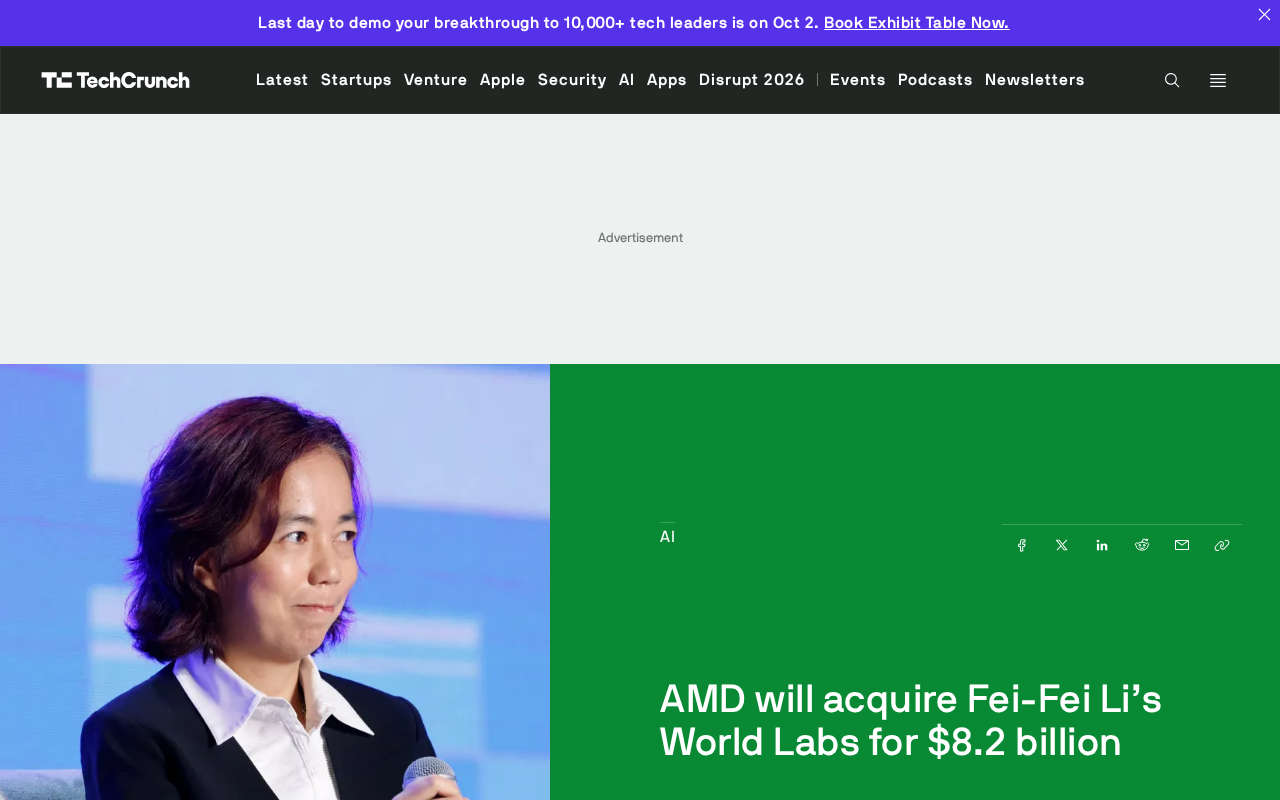
AMD has announced an $8.2 billion acquisition of World Labs, the spatial intelligence startup founded by AI luminary Fei-Fei Li, who will join as Executive Vice President and Chief Scientist. Li is best known for spearheading ImageNet, which helped ignite the deep learning era; World Labs focuses on "Spatial Intelligence" — enabling AI to understand and generate three-dimensional physical environments. For AMD, the strategic intent is clear: long challenged by NVIDIA's hardware dominance and a formidable CUDA software moat, AMD is using this deal to close gaps in research credibility and chart a differentiated technical path. The acquisition also reflects a broader industry trend of hardware vendors moving aggressively upstream into AI research, driving up the strategic value and valuations of top AI talent and frontier startups.
AMD Makes Its Move: $8.2 Billion for Fei-Fei Li's World Labs
AMD has announced it will acquire World Labs — the company founded by Stanford professor and iconic AI figure Fei-Fei Li — for $8.2 billion. Under the terms of the deal, Li will join AMD as Executive Vice President and Chief Scientist.
Both the size of the deal and the personnel arrangement are worth noting. $8.2 billion is no small sum, and placing a scholar of Li's stature — renowned across computer vision and AI research — directly into the company's top scientific role signals that AMD sees this acquisition as far more than a routine technology buy.
Who Is Fei-Fei Li, and What Does World Labs Do?
Fei-Fei Li is an unavoidable name in AI. The ImageNet dataset she spearheaded is widely credited as one of the key catalysts that ignited the deep learning revolution, profoundly shaping the trajectory of computer vision and deep learning over the past decade-plus. She previously served as Chief Scientist at Google Cloud, combining deep academic expertise with real-world industry experience.
World Labs is the company Li founded in recent years, focused on what she calls "Spatial Intelligence" — enabling AI to not just understand images and text, but to understand and generate three-dimensional space and perform spatial reasoning. This is considered a crucial step toward more general artificial intelligence, and a frontier that has attracted significant capital attention beyond the current large language model paradigm.
ImageNet is a large-scale image database released in 2009 by Fei-Fei Li's team, containing over 14 million manually annotated images across more than 20,000 categories. In 2012, AlexNet won the ImageNet Large Scale Visual Recognition Challenge (ILSVRC) by a commanding margin, demonstrating for the first time the breakthrough potential of deep convolutional neural networks for large-scale image recognition — and triggering the deep learning research explosion. Without the massive labeled data ImageNet provided, training and validating AlexNet would have been impossible. This "dataset + competition" model also became an important template for driving technical progress in AI going forward.
The core goal of "Spatial Intelligence" is to give AI systems the ability to perceive, understand, and generate the three-dimensional physical world — not just recognizing "this is a chair," but inferring the chair's position in space, its orientation, its relationship to other objects, and even generating three-dimensional scenes that obey physical laws. This capability is considered a foundational requirement for robotics, embodied intelligence, and autonomous driving applications, and represents a dimension that current large language models — predominantly text- and 2D image-based — generally lack.
Why AMD Needs This Acquisition
For years, NVIDIA has maintained a dominant grip on the AI compute market through the dual moat of its GPU hardware and the CUDA software ecosystem. While AMD has continuously closed the gap in hardware performance, it has faced persistent, significant gaps in AI software ecosystem depth and top-tier research talent.
Acquiring World Labs and bringing in Fei-Fei Li as Chief Scientist can be seen as AMD's bold attempt to address this shortcoming. On one hand, Li's joining will substantially elevate AMD's voice in AI research and its ability to attract talent. On the other, Spatial Intelligence — as a key direction for next-generation AI — could, if deeply integrated with AMD's compute hardware, open a differentiated competitive path against NVIDIA.
CUDA (Compute Unified Device Architecture) is NVIDIA's parallel computing platform and programming model, launched in 2006, allowing developers to directly harness GPU compute using a C-like language. After nearly two decades of development, virtually all mainstream AI frameworks (PyTorch, TensorFlow, etc.) have deeply optimized their underlying implementations for the CUDA ecosystem, and developers' habits are now deeply entrenched. While AMD has launched its ROCm open compute platform as a counterpart, it still lags significantly behind CUDA in operator library completeness, community toolchain maturity, and developer adoption. This software ecosystem "moat" is often far harder to close in the short term than a hardware performance gap, and remains one of the core reasons AMD has long struggled to challenge NVIDIA's dominance in the AI training market.
What This Deal Signals
For the broader industry, this acquisition sends several clear signals. Hardware vendors are increasingly extending upstream into AI research — no longer content to simply provide compute, but seeking the ability to define the direction of the technology. Top AI talent and cutting-edge startups are becoming the core assets that major players compete fiercely for, with their valuations rising accordingly.
That Spatial Intelligence — a relatively nascent concept — can command an $8.2 billion acquisition price itself speaks to the market's high expectations for "AI that understands the physical world." This echoes the excitement we've seen in recent years across robotics, autonomous driving, and embodied intelligence.
Questions Worth Watching
Once the deal closes, the critical question is how World Labs' technology integrates with AMD's existing products and ecosystem — that integration will ultimately determine whether this investment pays off. Li's transition from founder to executive at a large corporation also raises real questions: can she maintain research independence and innovative energy within AMD's sprawling organizational structure?
Since publicly available information remains limited, the specific deal terms, regulatory approval progress, and post-integration product roadmap all await further official disclosure. What is certain, however, is that this landmark acquisition has made AMD's posture in the AI race considerably more assertive.
Related articles

MCP Protocol Explained: How AI Agents Connect to External Tools
What is MCP (Model Context Protocol)? From APIs and Function Calling to MCP's three-layer architecture, this article explains how AI Agents connect to external tools like calendars and email, and reveals two major security risks—prompt injection and tool poisoning—along with four protection principles.

iPhone Duo Hands-On: Is the $2,000 Small-Screen Foldable Worth It?
YouTube's Allison shares her iPhone Duo hands-on: dual-screen multitasking doubles efficiency, great video viewing, nice matte finish—but thick body, small outer screen, and a $2,000 luxury price.

Sentry's Ad Cracks Up Developers: Can On-call Actually Be Fun?
Sentry's ad short film taps into developers' on-call anxiety, using humorous dialogue to showcase its observability platform—errors, logs, traces, metrics, replays, and releases in one place.