An Agent Platform Isn't Just About Runtime: Observability and Governance Are the Real Keys
An Agent platform requires three pillars: runtime, observability/evals, and governance—none can be missing.
The article argues that runtime alone cannot support self-improving Agents; a complete platform also needs observability/evals and governance. Runtime defines expected behavior—deployment, sandboxing, and framework; observability captures actual behavior, monitors tool calls and performance, and drives self-improvement; governance controls tool permissions, costs, and compliance boundaries through LLM and tool gateways. Only together can they enable safe, controllable Agent evolution. LangSmith is building in all three areas.
Introduction
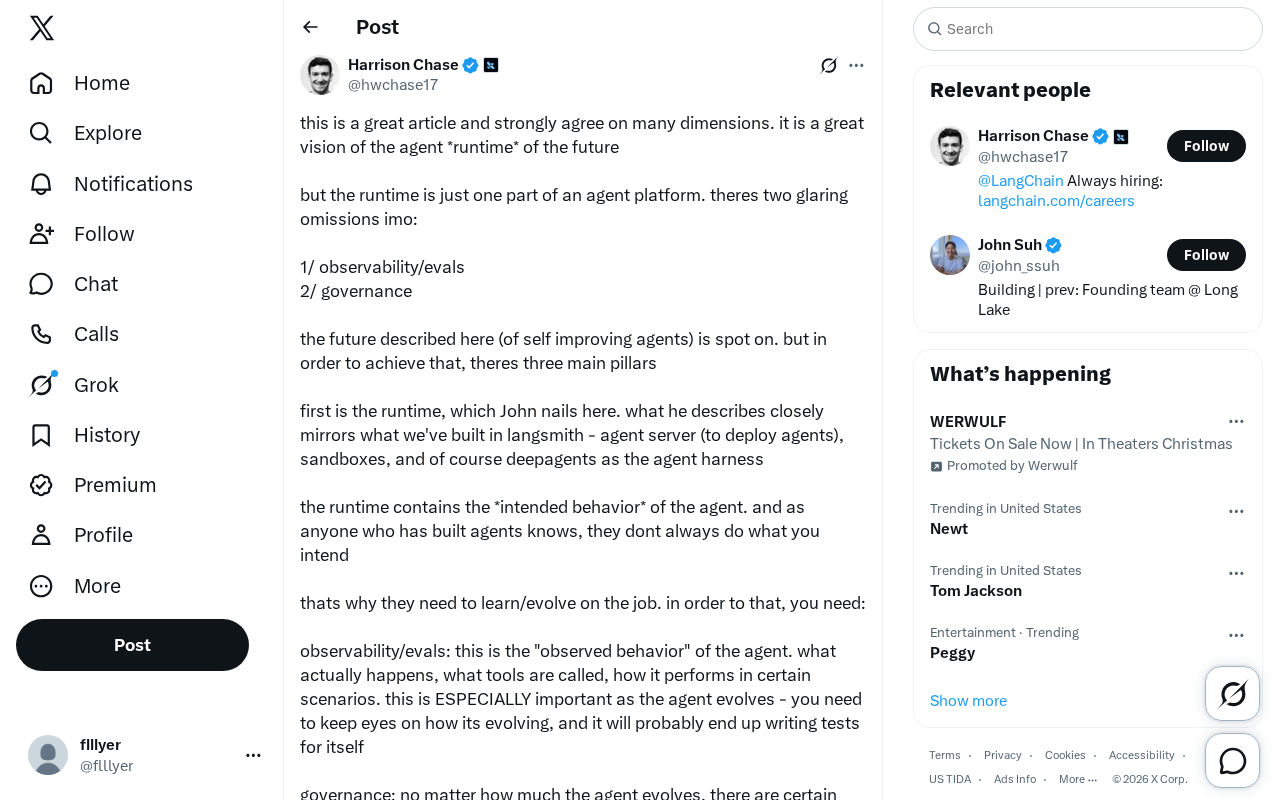
A recent article about the future runtime of Agents sparked widespread discussion. John from LangChain (the original author) outlined a vision for self-evolving Agents in that piece, and many people expressed strong agreement. But as one industry insider pointed out on Twitter: the runtime is only one part of an Agent platform. A complete platform also needs two other pillars—observability/evals and governance. Without these two, the vision of self-improving Agents will be hard to realize.
Based on this viewpoint, this article takes a deep dive into the three pillars of an Agent platform and explores why observability and governance cannot be ignored.
1. The Three Pillars of an Agent Platform
To build Agents capable of self-improvement, three core components must be present simultaneously: runtime, observability/evals, and governance. None can be missing.
- Runtime: Defines the Agent's "expected behavior," including deployment, sandboxing, and the Agent framework.
- Observability/evals: Captures the Agent's "actual behavior," monitors tool calls and performance, and drives self-evolution.
- Governance: Ensures the Agent always stays within boundaries during evolution, controlling tool usage, permissions, and costs.
The original author John's description of the runtime is very precise, and it aligns closely with the direction the LangSmith team is building: Agent Server (for deploying Agents), sandboxing, and DeepAgents (as the Agent framework). However, the runtime alone cannot guarantee that Agents work as expected—this is exactly where the value of the other two pillars lies.
Agent Runtime is the infrastructure environment that executes Agent logic, typically including deployment services, code execution sandboxes, and Agent development frameworks. The runtime determines how an Agent is instantiated, in what isolated environment it calls tools, and in what orchestration style (such as ReAct or Plan-and-Execute) it advances tasks. It is essentially the Agent's "operating system," defining what the Agent can do and under what constraints it executes. But the runtime itself only provides execution capability and expected behavior specifications; it cannot automatically verify whether the Agent acts according to design intent. Therefore, it must work with the observability and governance layers to form a closed loop.
2. Observability and Evals: Teaching Agents to Self-Improve
Anyone who has built an Agent knows that Agents don't always behave as expected. They need to learn and evolve during operation. To achieve this, observability must come first.
Observability focuses on the Agent's "actual behavior": which tools it calls, how it performs in specific scenarios, and whether it deviates from the expected path. As Agents continue to evolve, this monitoring becomes especially important—you need to continuously observe its evolution, and the Agent will likely eventually write tests for itself.
LangSmith is building related capabilities to help developers capture these behavioral data. Without observability, self-improvement is like the blind men and the elephant.
Observability in the Agent context usually consists of three parts: logs (recording the input and output of each step), traces (showing the tool call chain and decision path), and metrics (latency, success rate, token consumption, etc.). Unlike traditional APM, Agent observability needs to capture non-deterministic reasoning trajectories, so the granularity requirements for traces are higher. Evals, on the other hand, establish quantitative standards on top of observability data, scoring Agent behavior through offline datasets or online feedback to form an "observe—evaluate—improve" loop. Only by combining the two can an Agent identify its own deviations and automatically adjust strategies or generate test cases.
3. Governance: Setting Boundaries for Agent Evolution
No matter how an Agent evolves, there are always some rules that must be enforced. Governance must answer the questions: On whose behalf does the Agent call tools? How are these tools used? How much can be spent?
Governance is best implemented through an LLM gateway and a tool gateway. The LLM gateway can control model invocation permissions and costs, while the tool gateway manages tool access and usage policies. As Agent autonomy continues to increase, governance is key to ensuring safety and compliance.
LangSmith is also building governance capabilities to help teams enjoy the benefits of Agent evolution while avoiding the risk of losing control.
LLM Gateway is a proxy layer between applications and model APIs that uniformly handles authentication, rate limiting, routing, caching, and cost accounting. It allows teams to control which models are accessible per Agent identity, set budget caps, and record audit logs for every call. Tool Gateway is similar but applies to the external tools and APIs that Agents can call, handling permission checks, parameter filtering, and invocation quotas. Together, the governance layer can dynamically tighten or relax autonomy without modifying Agent code, making it a key control plane for addressing the uncertainty brought by Agent evolution.
4. Summary and Outlook
Self-improving Agents are the direction of the future, but runtime alone is far from enough. Observability/evals give Agent evolution a basis in evidence, while governance sets safety boundaries for that evolution. Only when the three work together can a truly reliable and controllable Agent platform be built.
If you are struggling with any of these parts, consider following LangSmith's progress or engaging with the community. The future is already here, but it needs a complete platform to support it.
One-line Summary
An Agent platform needs three pillars—runtime, observability/evals, and governance—none of which can be missing.
Paragraph Summary
The article points out that runtime alone cannot support self-improving Agents; a complete platform also needs observability/evals and governance as two additional pillars. Runtime defines the Agent's expected behavior, including deployment, sandboxing, and framework; observability captures actual behavior, monitors tool calls and performance, and drives the Agent to self-improve during evolution; governance, through LLM gateways and tool gateways, controls tool permissions, costs, and compliance boundaries. Only when the three work together can Agents continue to evolve under safe and controllable conditions. LangSmith is simultaneously laying out these three directions to build a complete Agent platform.
Related articles
When AI Starts Blogging: Scott Aaronso…
When AI Starts Blogging: Scott Aaronson's Kitchen Wine Experiment
Scott Aaronson shares a kitchen wine AI writing experiment on his blog, sparking Hacker News debate. This analysis explores the authenticity gap in AI-generated blog content, transparency disputes, and implications for content creators.
Amazon Loses Recall Case: Liability for 400,000 Dangerous Products Established
A U.S. court ruled Amazon is a distributor, not a logistics provider, and must recall over 400,000 dangerous products. This analysis examines the ruling's impact on platform liability boundaries and e-commerce compliance.
Google Familiar Faces Comes to Walmart's Budget Cameras
Google Familiar Faces facial recognition now supports Walmart's Onn outdoor and floodlight cameras at $35 and $77, but requires a Google Home Premium subscription.