An Instructor's Perspective: Four Motivations Behind AI Cheating and the Academic Integrity Crisis

A study of 2.01 million instructor forum posts reveals four main motivations students use to justify AI cheating.
A qualitative study mining 2.01 million posts from the Reddit instructor community r/Professors identifies, from instructors' perspectives, four typical rationalizations students use to justify AI-assisted cheating: viewing cheating as "academic system gaming" against rigid grading systems; a "digital-academic literacy gap" stemming from unfamiliarity with AI use boundaries; "performance anxiety" under high-pressure environments; and "normalization of dishonesty" driven by widespread peer violations. The study argues that these intertwined motivations mean rules and punishment alone are unlikely to work. Educators should design interventions targeting different motivations: rethinking assignment authenticity, explicitly teaching AI norms, attending to student mental health, and building a transparent integrity culture to construct a more effective academic integrity framework in the AI era.
Introduction
As AI tools become widely adopted in academic settings, academic integrity is facing a crisis. Past research has mostly focused on quantifying cheating behavior, but rarely explored the motivations behind students' AI-assisted cheating from instructors' perspectives. A recent study analyzed 2.01 million posts on the Reddit forum r/Professors, revealing from instructors' viewpoints the four main rationalizations students use to justify AI-assisted cheating. These findings not only outline the complex motivations behind cheating behavior but also offer educators new ways of thinking about integrity challenges in the AI era.
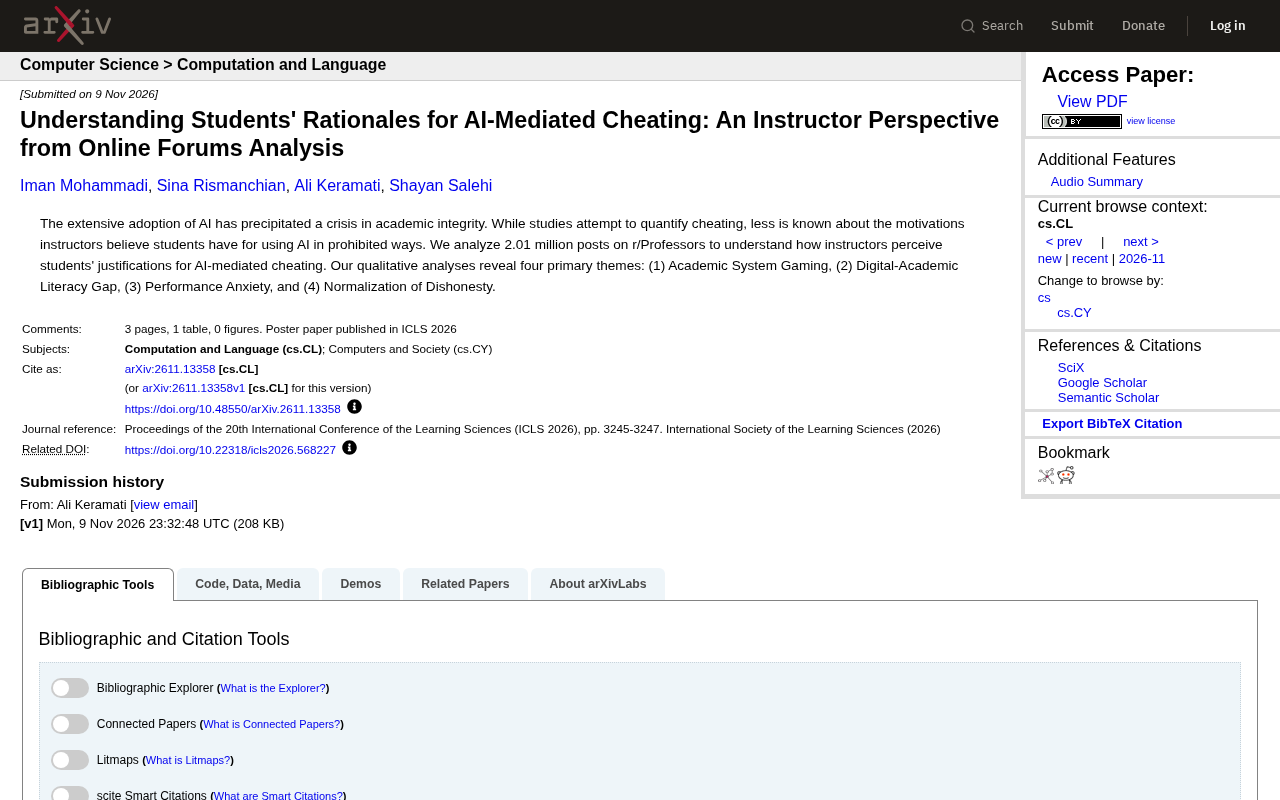
Research Method: Mining Authentic Voices from an Instructor Community
This study used qualitative analysis to mine 2.01 million posts on the r/Professors forum. This community gathers a large number of university instructors who share teaching experiences and discuss student behavior. By analyzing instructors' narratives, researchers identified the main reasons they believe students use to justify AI cheating. This approach bypasses the potential bias of directly asking students and captures motivations from a third-party observer perspective, which has unique value.
r/Professors is one of the largest anonymous online communities for university instructors on Reddit, with members consisting mainly of tenure-track faculty, lecturers, and adjunct instructors at North American universities. Its discussions are spontaneous, unstructured, and de-identified, and instructors there are often more willing than in formal surveys to describe specific details of student misconduct and their own genuine judgments. Choosing this community as a data source is essentially a form of "naturalistic sampling": the posts were not written for research and are therefore less affected by social desirability bias. However, this approach has limitations—instructors' attributions of cheating motives are secondhand observations and may include personal emotions and stereotypes, and the sample consists mainly of STEM and social science instructors from English-speaking countries, so the cross-cultural applicability of the conclusions should be treated with caution. The scale of 2.01 million posts ensured thematic saturation, giving the four categories of rationalizations statistical generality.
Four Themes: Typical Rationalizations Students Use to Justify AI Cheating
Based on instructors' discussions, the study distilled four core themes:
1. Academic System Gaming
Instructors believe that some students view AI cheating as resistance to rigid grading systems or "useless" assignments. They feel the system itself is flawed and that using AI is simply "smartly" responding to the rules rather than genuine deception. This mindset redefines cheating as a reasonable game against an unfair system.
"Academic system gaming" can be connected to "rule exploitation" in game studies and "moral disengagement" in moral psychology. Bandura proposed that individuals can make unethical behavior acceptable in self-evaluation through mechanisms such as redefining the behavior, minimizing consequences, and blaming the victim. When students describe assignments as "useless" and grading systems as "rigid," they are in effect transferring responsibility: the responsibility for cheating is assigned to the system rather than to themselves. This mindset is especially prominent against the backdrop of massification of higher education, rising tuition, and intensifying job competition; students tend to evaluate their studies in terms of "return on investment," and AI thus becomes instrumentalized as an efficiency optimization tool. Understanding this is crucial for instructional design—if assignments themselves lack authenticity (authentic assessment), students' gaming excuses are more likely to gain peer approval.
2. Digital-Academic Literacy Gap
Instructors observed that students may lack awareness of the boundaries of AI tool use. They are unclear about when using AI constitutes plagiarism and do not understand academic norms regarding originality. This literacy gap leads students to cross boundaries unintentionally while believing they are being reasonable.
"Digital-academic literacy" is the intersection of digital literacy and academic literacy. Digital literacy refers to the ability to use digital tools effectively and critically; academic literacy refers to the ability to understand disciplinary writing conventions, citation practices, and the logic of knowledge production. The gap between the two lies in this: students may be proficient with generative AI yet have not internalized the disciplinary consensus on "what counts as an original contribution" and "when sources must be cited." This concept aligns with the "AI literacy" framework, which usually includes four dimensions: technical understanding, critical evaluation, ethical judgment, and practical application. Research shows that most universities' AI use policies are mainly prohibitions or declarations, lacking explicit instruction at the course level, so students can only infer boundaries from peers or tools' default behavior. Therefore, "unintentional boundary crossing" is not purely a moral issue but a structural gap in which course design fails to provide sufficient scaffolding.
3. Performance Anxiety
High-pressure learning environments breed anxiety. Instructors believe that students turn to AI cheating because they fear failure and pursue high grades. In a highly competitive atmosphere, AI is seen as a shortcut to relieve anxiety, and cheating motivation is closely tied to emotional stress.
4. Normalization of Dishonesty
When classmates around them are all using AI to cheat without punishment, individuals are more likely to see it as normal. Instructors pointed out that this group effect weakens moral constraints, reduces students' guilt about cheating, and gradually leads them to accept dishonest behavior.
The "normalization" mechanism can be understood through social norms theory. Descriptive norms refer to "what others actually do," while injunctive norms refer to "what others think should be done." When students observe that peers commonly use AI and face no consequences, descriptive norms override injunctive norms, creating a perception that "everyone does it." This is consistent with the concept of a "cheating culture" in academic integrity research: the prevalence of cheating at the class level is one of the strongest predictors of individual cheating behavior. In addition, detection difficulties exacerbate this process—the outputs of generative AI are hard to identify reliably, and uncertainty about punishment lowers the expected cost of being caught, further weakening deterrence. The study suggests that transparent, consistent, and widely known integrity policies and low-risk assignment design are more effective than post hoc punishment in curbing norm drift.
Implications for Teaching Practice
These findings suggest that simply emphasizing rules and punishment may not be enough to address AI cheating. Understanding students' motivations is a prerequisite for designing effective interventions. For example, in response to a system-gaming mindset, instructors can reflect on the reasonableness of assignment design; in response to the literacy gap, explicit instruction on AI use norms is needed; in response to anxiety, attention should be paid to students' mental health; and in response to normalization, a more transparent academic integrity culture should be built.
Conclusion
This study reveals the multifaceted nature of AI cheating motivations from instructors' perspectives, providing an empirical basis for building academic integrity. As AI technology continues to evolve, educators need a deeper understanding of the logic behind student behavior in order to construct integrity frameworks suited to the times.
Related articles

Lewis's Scoring Completely Out of Control: An Absurd Observation of Gaming Entertainment
Lewis's scoring rules completely out of control in gameplay, switching from rewards to penalties at will, even offsetting deductions and additions to zero. This article analyzes the entertainment logic and rule transparency issues behind such absurd scoring.

The Democrats' Leftward Path for 2028: Blurry Labels and Backroom Games
Using Florida candidate Angie Nixon's case, this analysis examines the Democrats' leftward path for 2028: the mismatch between national media label wars and local voter perception, and how elite donations, polls, and endorsements will decide candidates' fates before the 2027 primary.

One Glass of Orange Juice Contains a Shocking Amount of Sugar: How Continuous Glucose Monitoring Changes Dietary Perception
A glass of orange juice contains up to eight teaspoons of sugar. Continuous glucose monitoring reveals individualized dietary responses. This article explores the link between blood sugar and brain health and how CGM helps ordinary people make smarter dietary choices.