Analyzing the Voyage Patch Update for Vercel AI SDK

@ai-sdk/voyage 2.0.84 is a patch that only syncs dependencies with no API changes—low upgrade cost.
@ai-sdk/voyage released patch version 2.0.84, whose core change is only a dependency sync: bumping @ai-sdk/provider to 4.0.39 and @ai-sdk/provider-utils to 5.0.82. Published automatically by github-actions via changesets with verified-signature commits and a traceable process. As a patch-level update with no public API changes, consumers only need to pull the latest patch to get underlying provider-layer fixes. The article reminds developers to watch dependency tree consistency to avoid type conflicts from multiple provider copies, and recommends following patch upgrades for long-term stability.
The AI SDK ecosystem iterates rapidly, and this 2.0.84 patch release for @ai-sdk/voyage looks like a simple dependency sync on the surface—but it actually ripples through the provider-layer compatibility chain.
One patch update, three dependency syncs
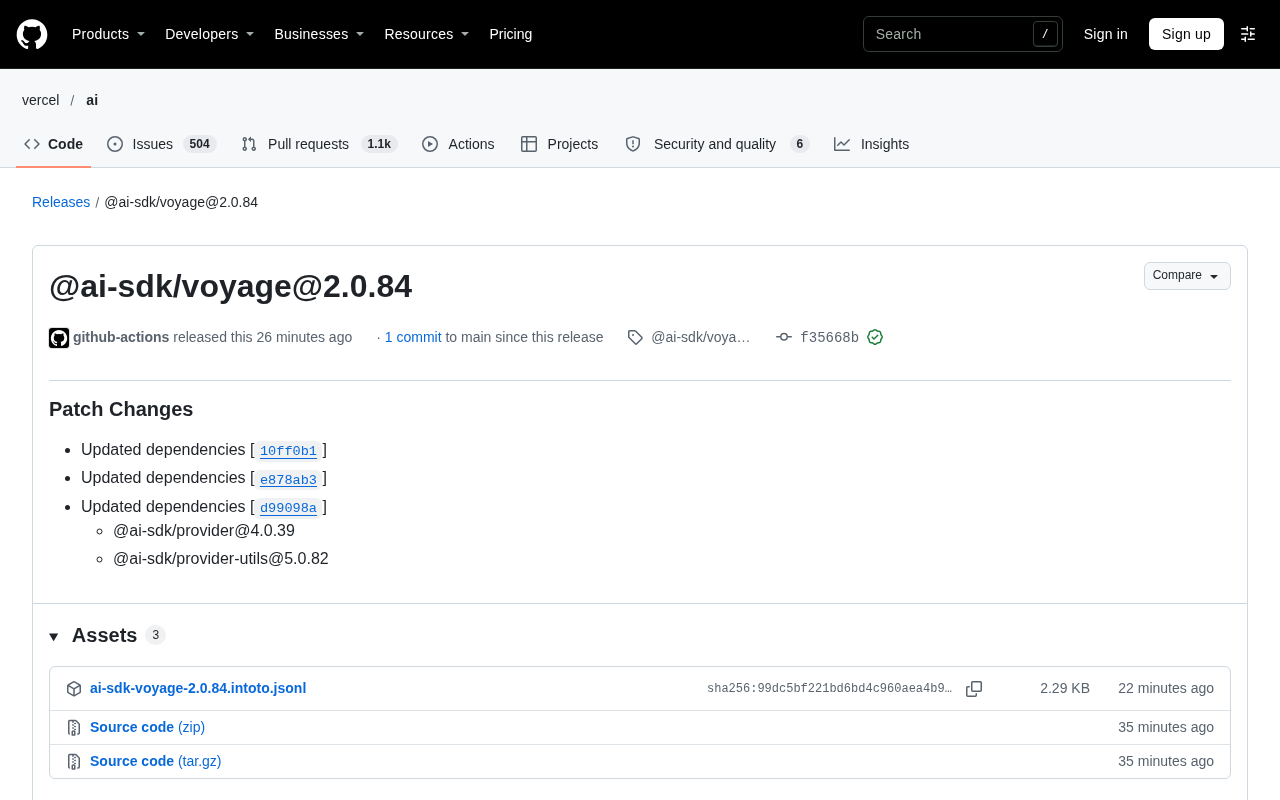
According to the auto-published record on GitHub by github-actions, @ai-sdk/voyage@2.0.84 is a patch-level update whose core change is just one thing: updating dependencies. It involves three commits (10ff0b1, e878ab3, d99098a), bumping @ai-sdk/provider to 4.0.39 and @ai-sdk/provider-utils to 5.0.82.
These bot-created release commits carry GitHub verified signatures, making them typical CI pipeline artifacts. For consumers, it means you don't need to manually change version numbers—just pull the latest patch to get the latest fixes from the underlying provider layer.
Why dependency syncs deserve attention
@ai-sdk/voyage is the adapter layer that connects AI SDK to Voyage AI's embedding models, and its behavior is largely determined by @ai-sdk/provider and @ai-sdk/provider-utils. The former defines the abstract provider interfaces; the latter wraps common utilities like request construction and error handling.
When these two packages receive patch updates, the adapter layer may indirectly gain tweaks to request parameter validation, error message formatting, or type definitions. Although the release notes don't detail the specific changes, judging by the version increment magnitude, these are backward-compatible corrective updates with no breaking changes.
Division of responsibilities between @ai-sdk/provider and provider-utils
@ai-sdk/provider is the contract layer for all provider implementations in AI SDK. It defines the types and method signatures for abstract interfaces such as language models, embedding models, and image models. Any concrete provider (like @ai-sdk/voyage) must implement these interfaces so that the AI SDK core can dispatch them uniformly. @ai-sdk/provider-utils is the auxiliary toolkit for these interfaces, containing common logic like request body construction, response parsing, streaming handling, and error normalization. Adapter layers typically don't write network request details directly; instead, they call utility functions from provider-utils. Therefore, when provider-utils receives a patch update, the adapter layer may gain behavioral fixes without modifying its own code—such as stricter parameter validation or clearer error messages. This layered design lets provider maintainers focus only on protocol integration with specific vendors, while improvements to common logic are pushed upstream uniformly.
Practical impact on users
If your project uses AI SDK to call Voyage's embedding capabilities, upgrading to 2.0.84 is low-cost: no API changes to migrate, just lock the version and reinstall. The real concern is dependency tree consistency—provider and provider-utils versions need to match the SDK main package to avoid type conflicts caused by multiple copies.
For teams using AI SDK as a unified model access layer, these patch updates are foundational work for long-term stability. They don't bring new features, but they reduce hidden risks that accumulate when underlying toolkits fall behind.
Specific manifestations of dependency tree consistency risks
In the Node.js ecosystem, if a project depends on multiple AI SDK provider packages that each declare different versions of @ai-sdk/provider, the package manager may install multiple copies in node_modules. This causes TypeScript type mismatches: an embedding result type returned by one provider may come from provider@4.0.38, while the core SDK expects the definition from provider@4.0.39—producing compilation errors or unpredictable runtime behavior. Using a lockfile to pin versions and regularly running npm ls @ai-sdk/provider to check for duplicate copies are standard practices to avoid such issues. For monorepos or teams using pnpm, you can also force a unified provider layer version via the overrides/resolutions fields.
Transparency of the release process
As seen on the release page, this update was published by github-actions on 17 Nov at 18:43, containing just 1 commit merged into main with 3 asset files. The recurring "Updated dependencies" in the release notes is the standardized output of the changesets tool, and the short hashes linked in commit messages point to specific dependency upgrade records.
This automated process ensures every patch is traceable: who triggered it, what dependencies changed, which commit it corresponds to—the chain is complete. For developers building products on AI SDK, tracking these release records is more effective than following major version announcements for staying on top of subtle ecosystem changes.
Changesets and the automated release pipeline
Changesets is a commonly used version management and release tool in the JavaScript ecosystem. Developers submit changeset files in markdown format to describe change types (patch/minor/major), and the CI pipeline automatically calculates version numbers, generates CHANGELOGs, and publishes to npm based on these files. The "Updated dependencies" in this article is the standardized description that changesets auto-generates when dependencies are upgraded. The github-actions bot executes the release action, and its commits carry GitHub verified signatures ensuring release contents haven't been tampered with. This combination of "changeset description + bot execution" gives every patch version a clear change record and traceable commit hash, reducing supply chain risk and letting downstream consumers quickly judge the necessity of upgrading.
FAQ
Does this update require code changes?
No. The patch version only syncs dependencies with no public API changes.
Should I upgrade?
If your project is already using @ai-sdk/voyage, it's recommended to follow the patch upgrade to maintain consistency with the provider-layer toolkit.
How do I confirm dependency versions?
Check the resolved results for @ai-sdk/provider and @ai-sdk/provider-utils in your project's lockfile to ensure they match the requirements declared by 2.0.84.
One-line Summary
@ai-sdk/voyage 2.0.84 is a patch that only syncs dependencies with no API changes—low upgrade cost.
Paragraph Summary
@ai-sdk/voyage released patch version 2.0.84, with the core change being only a dependency sync: bumping @ai-sdk/provider to 4.0.39 and @ai-sdk/provider-utils to 5.0.82. This version was auto-published by github-actions via the changesets tool, with verified-signature commits and a traceable process. As a patch-level update with no public API changes, consumers don't need to modify code—just pull the latest patch to get fixes from the underlying provider layer. The article reminds developers to watch dependency tree consistency, avoid type conflicts from multiple provider copies, and recommends following patch upgrades to maintain long-term stability.
Related articles

Nothing CMF Buds 2A Drops to $17.89 on Black Friday: A New Low for ANC Earbuds
Nothing CMF Buds 2A wireless earbuds Black Friday deal: just $17.89 on Amazon, about $11 off retail and a record low. ANC earbuds at an entry-level price.

When AI Creation Gets Accused of "Spitting": Hacker News Heats Up Over the Glaude Controversy
A Hacker News post, "Spitting in the Face of Glaude," sparks debate on AI creation transparency and attribution ethics. This analysis examines the blurred creator identity behind the controversy and offers practical advice for AI content production.

Akai Embraces Custom Firmware: MPC Sample 1.4 Lets Users AI-Program Their Sampler
Akai embraces the modding community with MPC Sample 1.4 firmware, supporting vibe-coded custom firmware and effects. We analyze the impact of this open strategy on music hardware and AI-assisted programming.