Andrew Ng Partners with Google to Launch Gemini CLI Course: A Practical Guide to AI Coding Assistants

Andrew Ng and Google launch a free hands-on Gemini CLI course teaching AI-assisted agentic coding.
DeepLearning.ai and Google have released a free Gemini CLI course taught by Google's technical experts. Using an AI developer conference as a practical scenario, the course systematically covers everything from installation to MCP server-powered automated workflows, teaching developers how to boost productivity with this open-source Agentic Coding Assistant. Gemini CLI stands out with its fully open-source codebase, native Google Workspace integration, and MCP protocol support — marking the shift from simple code completion to autonomous planning and execution in AI-assisted programming.
Andrew Ng's DeepLearning.ai has once again partnered with Google to release a brand-new hands-on course — Gemini CLI. Taught by Google Developer Advocate Jack Weatherspoon, the course systematically covers everything from installation and configuration to advanced automated workflows, showing developers how to dramatically boost productivity with this open-source AI coding assistant.
DeepLearning.ai is an online education platform founded by Andrew Ng in 2017, focused on developing courses in artificial intelligence and deep learning. The platform is known for its "Short Course" format, typically produced in collaboration with leading AI companies (such as OpenAI, Anthropic, Google, Meta, etc.), with technical experts from these companies serving as instructors. The courses track the latest technology trends and are completely free. This collaborative model has made DeepLearning.ai an essential channel for AI practitioners to access cutting-edge practical knowledge. The Gemini CLI course continues the platform's established paradigm of "tech companies provide expertise, the platform provides distribution."
Course Overview: From Getting Started to Automated Workflows
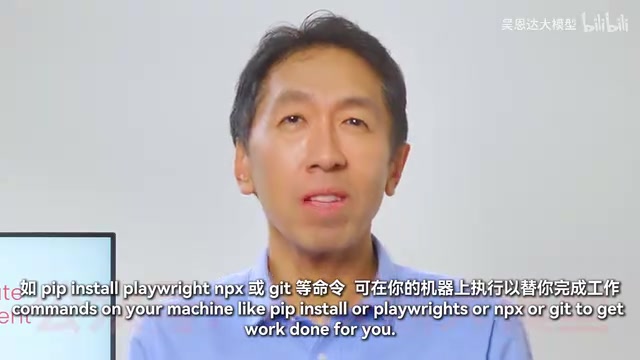
Gemini CLI is an Agentic Coding Assistant developed by Google. Similar to Claude Code, OpenAI Codex, and other tools, it can directly access your local machine and — once authorized — execute commands like pip install, playwright, npx, git, and more to help you accomplish real development work.
The concept of an Agentic Coding Assistant represents the latest evolution in AI programming tools during 2024-2025. Unlike earlier code completion tools (such as GitHub Copilot's autocomplete mode), AI in Agentic mode possesses the ability to autonomously plan, execute, and iterate. It doesn't just generate code snippets — it understands the entire project context, independently decides which files to read, which commands to execute, which dependencies to install, and automatically debugs and fixes issues when errors arise. This shift from "passive response" to "proactive execution" is the core battleground in today's AI coding tool competition. The major competitors currently include Anthropic's Claude Code, OpenAI's Codex CLI, and Google's Gemini CLI.
The course follows a very clear learning path: starting with installing Gemini CLI and progressively advancing to organizing and orchestrating automated workflows with multiple tools and MCP servers. You'll learn how to coordinate between local files and cloud services, develop features, analyze data, and use engineering approaches to optimize Gemini CLI's context and memory for the best possible output.
MCP (Model Context Protocol) mentioned here is a standardized protocol proposed and open-sourced by Anthropic in late 2024, designed to provide AI models with a unified interface for interacting with external tools and data sources. Think of MCP as the "USB port" of the AI world — it defines a standardized communication method that allows AI assistants to connect to various third-party services (such as Canva, Slack, databases, etc.) through MCP servers, without needing to write custom integration code for each service. The MCP protocol has rapidly gained broad industry adoption, and Google's Gemini CLI natively supports MCP. This means developers can extend Gemini CLI's capabilities by configuring MCP servers, enabling it to go beyond programming tasks and control design tools, office suites, and other applications.
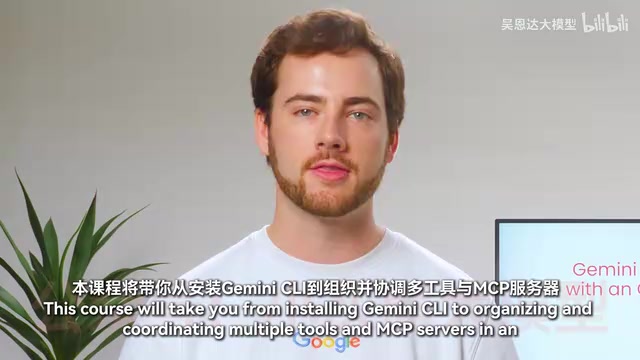
Andrew Ng shared in the course introduction: "Especially for prototyping, I almost never write code by hand anymore — I let AI coding assistants do it for me. This has dramatically accelerated my workflow and that of many other developers. Prototyping has never been faster."
Hands-On Project: A Full-Stack Exercise Built Around an AI Conference
The course doesn't stay at the level of abstract concepts. Instead, all teaching content revolves around a single end-to-end practical scenario — planning an AI developer conference (Next AI Dev Conference). This is a clever design choice because it covers multiple dimensions of both software development and non-coding tasks:
Website & Marketing Materials
You'll use Gemini CLI to build key features for the conference website, leveraging its native Google Workspace extensions to interact with Google Docs and Calendar. Google Workspace extensions are a key differentiator that sets Gemini CLI apart from competitors. Since Gemini CLI is Google's own product, it natively integrates with Google's entire productivity suite — including Google Docs, Sheets, Calendar, Drive, and more. This deep integration means developers can use natural language instructions to have Gemini CLI directly read and edit Google documents, create calendar events, query data in Google Sheets, and more, enabling cross-tool automated workflows. This capability is particularly important in enterprise scenarios, where much of the development work actually involves interaction with non-code assets (documents, spreadsheets, project management tools).
The course also teaches you to use the Canva MCP server to create conference marketing materials, demonstrating Gemini CLI's powerful capabilities in non-pure-coding scenarios. By connecting to Canva's design service through the MCP protocol, developers can describe design requirements in natural language, and Gemini CLI will call Canva's API to automatically generate posters, social media graphics, and other visual assets — no manual design software operation required.
Data Dashboard
In the course, you'll also build a data dashboard that combines attendee data with an existing company database. This section demonstrates Gemini CLI's practical application in data analysis and visualization.
Multimedia Content Processing
A particularly interesting segment involves using Gemini CLI to process multimedia content — transforming conference podcasts into social media short videos and posts. This illustrates that Gemini CLI's applications extend far beyond writing code; it's becoming a general-purpose AI work assistant.
Why Gemini CLI Deserves Your Attention
Open Source, Transparent, and Community-Driven
One of Gemini CLI's standout features is that it's completely open source. Every line of code is public on GitHub, including the actual instructions and system prompts. In an era where AI tools are increasingly "black-boxed," this level of transparency is especially valuable.
System prompts are the core instructions in AI applications that define the model's behavior, role, and constraints — typically considered one of the product's key competitive advantages. Most commercial AI tools (including ChatGPT, Claude, etc.) treat system prompts as closely guarded trade secrets, with users only able to glimpse their contents through informal methods like "jailbreaking." Gemini CLI's decision to fully publish its system prompts is a remarkably bold move in the industry. It not only allows developers to understand the AI assistant's decision logic and behavioral boundaries but also enables community members to suggest improvements or even make direct modifications. This transparency is significant for building developer trust and driving community contributions, and it reflects Google's strategic choice to pursue an open ecosystem approach in the AI development tools space.
Google has already merged thousands of Pull Requests from community members, including popular features like Session Management. Jack Weatherspoon specifically encourages students in the course to consider contributing to Gemini CLI or other open-source projects after completing the course: "These contributions create value for everyone."
Core Advantages of Agentic Coding
Unlike traditional code completion tools, the core advantage of Agentic Coding Assistants lies in their access to the local environment. With just a small set of tools, these intelligent coding systems can automatically set up the required development environment and rapidly build complete applications or feature sets.
This means the developer's role is shifting from "the person who writes code" to "the person who guides AI to write code." What you need to master is no longer just programming language syntax — more importantly, it's how to collaborate effectively with AI: how to describe requirements, how to provide context, and how to validate and iterate on outputs.
This role shift reflects a profound paradigm change underway in software engineering. Traditional software development revolves around "humans write code, machines execute it," while in the Agentic Coding model, the developer's core work shifts to requirement description, architectural decisions, code review, and quality assurance. This transformation is sometimes called the evolution "from programmer to AI orchestrator." Notably, this doesn't mean programming knowledge becomes less important — quite the opposite. Only developers who deeply understand code logic and system architecture can effectively review AI-generated code, identify potential issues, and make sound technical decisions. Agentic Coding tools lower the barrier for repetitive coding work, not the demand for engineering judgment.
Bonus Content
The course also includes a practical bonus: demonstrating how Gemini CLI can help organize and search through messy course materials, making learning easier. Andrew Ng humorously notes that this skill "will hopefully come in handy for your next DeepLearning.ai course."
Summary and Outlook
The launch of this course signals that AI-assisted programming is moving from "nice to have" to "indispensable." When an industry leader like Andrew Ng publicly states that he "almost never writes code by hand anymore," this isn't just a personal habit change — it's a signal of a paradigm shift across the entire software development landscape.
For developers, mastering the Agentic Coding workflow early and understanding how to effectively leverage tools like Gemini CLI will become an important component of future competitiveness. And this free course is undoubtedly an excellent starting point.
Related articles
 Tech Frontiers
A Rare Quiet Day in AI: Recursive Self-Improvement Stirs Beneath the Surface
A rare quiet day in AI sees multiple sources go silent simultaneously. Behind the calm, Recursive Self-Improvement (RSI) research continues. What this means for the industry.
 Tech Frontiers
Reve 2 vs. Ideogram 4: A Deep Dive into Layout Control in AI Image Generation
A deep comparison of Reve 2 and Ideogram 4's layout control capabilities, covering technical approaches, real-world use cases, and industry trends for designers and creators.
 Tech Frontiers
In the Weights: Check Your Influence Score in the AI World
In the Weights is an AI influence search engine that quantifies your presence in the AI world with a score. Explore how it evaluates practitioners and what it means for digital identity.