Andrew Ng's New Course: Experience the Vibe Coding Paradigm with Replit

Andrew Ng and Replit launch a Vibe Coding course teaching rapid web app development with AI agents.
Andrew Ng has partnered with Replit to launch *Vibe Coding 101 with Replit*, a course that systematically teaches how to use AI coding agents to rapidly build and deploy web applications. Designed for users with zero coding background, the core philosophy is letting AI handle the coding while developers focus on problem decomposition and requirement description. The Replit platform provides a cloud development environment with one-click deployment, and its Agent offers a fully integrated development loop. The course teaches progressively through two projects: an SEO analyzer and a voting application.
Andrew Ng has partnered with Replit to launch a brand-new course, Vibe Coding 101 with Replit, which systematically teaches how to use AI coding agents to rapidly build and deploy web applications. This course isn't just for experienced developers—it also opens the door to users with zero coding background. You can get started in three minutes and let AI handle most of the coding work for you.
What Is Vibe Coding?
Vibe Coding is a hot concept in the AI programming space right now. The term was first coined and popularized by OpenAI co-founder Andrej Karpathy in early 2025 on social media—he described a new programming paradigm where developers fully immerse themselves in creative intent, delegating all technical implementation details to AI, and no longer even carefully reading the AI-generated code. The concept quickly sparked widespread discussion in the developer community, reflecting a qualitative shift in large language models' code generation capabilities: evolving from early code completion assistants to programming agents capable of understanding high-level intent and autonomously completing entire functional modules.
The core idea is: Let AI coding agents handle most of the heavy lifting in coding work, while developers focus solely on problem decomposition and requirement description.
At the beginning of the course, Andrew Ng shared his own development experience: he still does a lot of software development, but his workflow has fundamentally transformed—he breaks problems into manageable modules, spends time writing precise prompts to describe requirements, and then has LLMs generate code module by module. Notably, "writing precise prompts" isn't simply natural language description—it's a skill that requires deliberate practice. Effective programming prompts typically need to include clear functional boundary definitions, tech stack preferences or constraints, example descriptions of data structures, and expected input/output formats. Research shows that structured prompts produce code output 30-50% higher in quality than vague natural language descriptions. This approach has dramatically boosted productivity and development speed for Andrew Ng and many other developers.
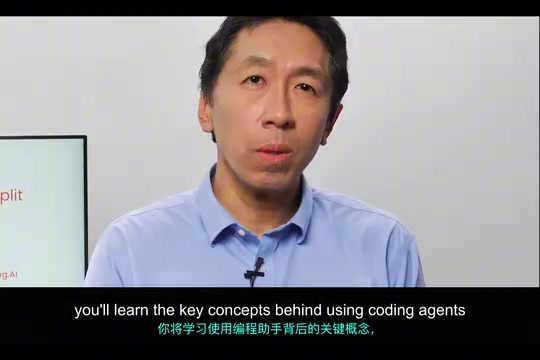
This isn't simply "having AI write code"—it's an entirely new human-machine collaboration paradigm: humans handle architectural thinking and requirement definition, while AI handles code implementation. Moderate upfront planning can significantly improve the quality of the final results.
Replit: Eliminating All Barriers to Programming and Deployment
Replit President Michele Catasta provided a detailed introduction in the course about how the Replit platform offers an ideal environment for Vibe Coding. Replit's technical architecture is based on containerized isolated environments (each project runs in an independent Linux container), uses the Nix package manager for cross-language dependency management, and supports instant runtime environments for 50+ programming languages. As a cloud-based development environment, Replit solves multiple pain points in traditional development:
- Powerful code editor and universal package manager: No need to manually install language packages for Python, JavaScript, etc.
- Streamlined version control: Based on Git but significantly simplified, hiding complex operations like branch management and conflict resolution, retaining only "checkpoint"-style history functionality
- Built-in data storage solutions: Provides key-value storage (Replit DB, suitable for simple state storage), PostgreSQL database (suitable for structured data), and deployment solutions
- One-click deployment: Combined with automated HTTPS certificate provisioning and CDN distribution, applications can be published publicly as soon as the build is complete

The most critical change is the addition of Replit Agent. A Coding Agent is an autonomous task execution system built on top of a base LLM, with a core architecture that includes tool use capabilities, a plan-execute loop, and error feedback mechanisms. What makes Replit Agent special is its deep integration with the cloud environment—it can directly manipulate the file system, install dependency packages, run tests, and preview results, forming a complete "perceive-decide-execute" closed loop. Michele emphasized: "Now, even someone with absolutely no coding experience can create an app and deploy it online. It only takes three minutes to get started. Even if you don't understand those technical terms, you can still build an application."
This means Replit is lowering the barrier to software development from "needing to master a programming language" to "being able to clearly describe requirements."
Course Content: From SEO Analyzer to Voting App
The course is taught by Matt Palmer, Replit's Head of Developer Relations, using a progressive, project-driven approach:
Project One: SEO Analyzer
The first project involves building a Search Engine Optimization (SEO) analysis tool. This is a beginner-level application designed to help learners familiarize themselves with the basic workflow of AI coding agents and understand the core building blocks of web applications.
Project Two: Head-to-Head Voting App
The second project is significantly more complex, involving data extraction and storage functionality. Through this project, learners will master more advanced web development concepts like handling user interactions and data persistence.
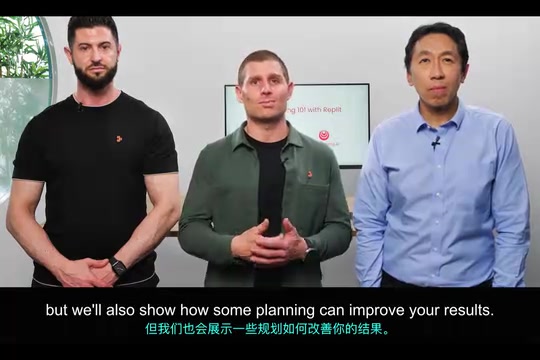
The course also intersperses explanations of Replit's own building experience. Michele noted that Replit itself is a complex Agentic Workflow, and the team has accumulated extensive practical experience over the past year. An Agentic Workflow refers to a working pattern where AI models complete complex tasks through multiple iterations, tool calls, and self-reflection, distinguishing it from the traditional single prompt-response interaction paradigm. A typical Agentic Workflow includes four design patterns: Reflection, Tool Use, Planning, and Multi-Agent collaboration. Andrew Ng specifically pointed out that the experience accumulated by the Replit team has reference value for building other AI agent applications as well.
The Course's Special Format and Positioning
Here's an interesting detail: since Replit is a cloud-hosted environment, this course cannot run on DeepLearning.AI's standard platform, so it adopts a video-only teaching format. Learners can grasp the core concepts of using AI coding agents and the LLM workflow simply by watching the videos.
This design choice also reflects a current trend in AI education: when the tools themselves are powerful and easy enough to use, "understanding and grasping the process" may be more important than "manually typing code for practice."
What Does Vibe Coding Mean for Developers?
The rise of Vibe Coding is redefining the role of "developer." Traditionally, developers needed to master programming language syntax, framework APIs, deployment processes, and other technical details. With the assistance of AI coding agents, problem decomposition ability, requirement articulation ability, and architectural thinking are becoming more core competitive advantages. The breakthroughs of modern LLMs in code generation stem from the accumulation of multiple technological advances: pre-training on ultra-large-scale code corpora, reinforcement learning from human feedback (RLHF) for fine-tuning code quality, and massive expansion of context windows (from early 4K tokens to today's 100K+ tokens)—longer context windows mean AI can simultaneously "see" multiple files across an entire project, understand cross-file dependencies, and thus generate more consistent code.
Andrew Ng has proven this through his own practice: even experienced developers can achieve significant efficiency gains by embracing AI-assisted programming. And for those with non-technical backgrounds, this represents an unprecedented opportunity—transforming creative ideas directly into running applications, no longer blocked by technical barriers.
Of course, Vibe Coding isn't a silver bullet. The course also emphasizes the importance of "moderate planning.
Related articles
 Tech Frontiers
A Rare Quiet Day in AI: Recursive Self-Improvement Stirs Beneath the Surface
A rare quiet day in AI sees multiple sources go silent simultaneously. Behind the calm, Recursive Self-Improvement (RSI) research continues. What this means for the industry.
 Tech Frontiers
Reve 2 vs. Ideogram 4: A Deep Dive into Layout Control in AI Image Generation
A deep comparison of Reve 2 and Ideogram 4's layout control capabilities, covering technical approaches, real-world use cases, and industry trends for designers and creators.
 Tech Frontiers
In the Weights: Check Your Influence Score in the AI World
In the Weights is an AI influence search engine that quantifies your presence in the AI world with a score. Explore how it evaluates practitioners and what it means for digital identity.