Andrew Ng's New Course Explained: Agent Memory Engineering from Basics to Practice

Andrew Ng partners with Oracle to teach how to build persistent memory systems for AI agents.
Andrew Ng collaborates with Oracle to launch the "Agent Memory" course, addressing the core pain point of information loss after AI agent sessions end by proposing the new paradigm of "Memory Engineering." The course emphasizes treating long-term memory as core infrastructure in Agent architecture, requiring memory to be external, persistent, and structured — enabling agents to evolve from single-response systems into ones that can remember, improve, and perceive their own memory state.
Course Overview: Why Do Agents Need Memory?
Andrew Ng has partnered with Oracle to launch a brand-new course — Agent Memory: Building Memory-Aware Agents — focused on the engineering design of memory systems for AI agents. This course addresses the most critical pain point in current Agent development: agents perform brilliantly within a single session, but once the session ends, all learned information is lost.
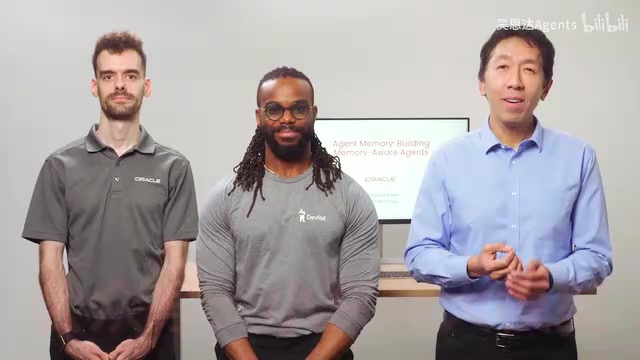
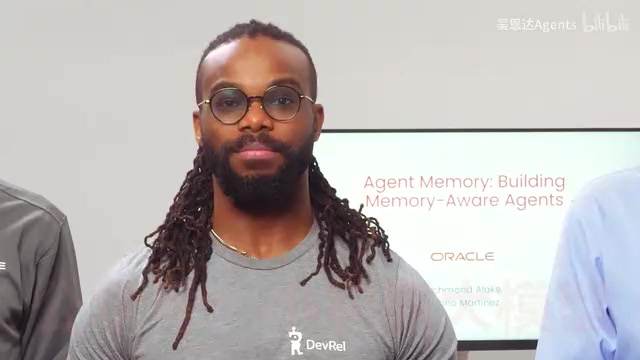
The course is taught by Richmond Alake and Nacho Martinez, built on Oracle AI Database as the infrastructure layer, combined with LangChain and LLM-driven memory-augmented pipelines, systematically teaching how to build agents with persistent memory capabilities.
To understand the root cause of this pain point, we first need to recognize the fundamental limitations of large language model "memory." An LLM's memory relies on the Context Window — the maximum number of tokens the model can process in a single inference call. GPT-4's context window is approximately 128K tokens, and Claude 3 series can reach 200K tokens. While this seems large, it's still a temporary buffer with a hard upper limit. Once a conversation ends or exceeds the window length, all information is discarded. More critically, even within the window's range, as context length increases, the model's "attention" to earlier information significantly decays — the so-called "Lost in the Middle" phenomenon, where information positioned in the middle of the context tends to be ignored by the model. This fundamentally determines that simply expanding the context window cannot solve the Agent's long-term memory problem.
From Prompt Engineering to Memory Engineering: A Paradigm Shift
In the course introduction, Andrew Ng presents a highly insightful observation: over the past few years, the industry's attention has focused on Prompt Engineering and Context Engineering, with the core goal of achieving the best results in a single LLM call. But for Agents that need to run continuously over days or even weeks, this is far from sufficient.

This introduces the course's core concept — Memory Engineering. It requires developers to treat long-term memory as first-class infrastructure, with three key characteristics:
- External: Memory exists independently of the model itself, not dependent on the context window
- Persistent: Maintained across sessions, not lost when conversations end
- Structured: Stored in an organized manner for efficient retrieval and manipulation
The significance of this paradigm shift cannot be underestimated. When we stop treating memory as a "nice-to-have" feature and instead design it as a core pillar of Agent architecture, the agent's capability boundaries undergo a qualitative leap — evolving from "can answer questions" to "can remember, can improve, and can perceive its own memory state."
Core Course Content Analysis
Memory-First Architecture
The course first analyzes the failure modes of stateless Agents. In traditional architectures, an Agent starts every conversation "from scratch"
Related articles
 Tutorials
ChatGPT Plus Subscription Guide: Are GPT-5.5, image-2, and Codex Worth the Upgrade?
A detailed look at ChatGPT Plus features — GPT-5.5, image-2, and Codex — with a Plus vs Pro comparison and a complete step-by-step subscription guide for users outside the US.
 Tutorials
Harness AI Engineering in Practice: Using Claude Code to Master Enterprise-Level E-Commerce Development
Deep dive into Harness AI Engineering: master enterprise e-commerce development with Claude Code using the Rules, Skills, Wiki, and Changes framework.
 Tutorials
Cursor + Codex Dual-IDE Collaboration: A Practical Methodology for Open-Source Project Customization
A complete methodology for open-source project customization based on real-world experience, detailing the Cursor+Codex dual-IDE workflow, seven-stage process, MVP validation, and AI source code reading techniques.