Andrew Ng's New Course: Qodo Teaches AI Code Review in Practice
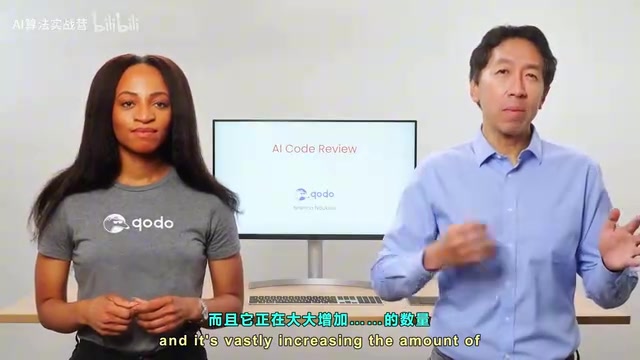
Andrew Ng and Qodo launch an AI code review course teaching you to build context-aware review agents.
Andrew Ng has partnered with the code intelligence platform Qodo to launch the "AI Code Review" course, addressing the problem that AI-generated code is surging and manual line-by-line review has become a pipeline bottleneck. The course notes that AI-generated PRs may look reasonable yet miss key requirements or hide security vulnerabilities, which eyeball review struggles to catch, so the review workflow itself needs to evolve. It covers what good code review is, three practical techniques (local review before PR, richer task and repository context, ranking issues by impact), emphasizes context over model strength, and finally has learners build a context engine from scratch and combine specialized agents.
AI is writing code faster and faster, but code review has become the new bottleneck. The "AI Code Review" course, launched by Andrew Ng in collaboration with the code intelligence platform Qodo, targets exactly this problem—not only teaching you how to use AI to review code, but also having you build a review agent that understands context and gives feedback prioritized by risk.
Why AI Code Review Has Become a Must-Have
At the start of the course, Andrew Ng offers a blunt assessment: AI-generated code has vastly increased the total volume of code we write, but if that code still has to be reviewed line by line by humans, developers themselves become the slowest link in the entire pipeline. This is exactly why he has incorporated AI code review into his daily workflow, and it is also the change many teams are experiencing.
What's trickier is that AI-generated code brings risks that traditional review experience struggles to cover. A pull request may look entirely reasonable—clear structure, consistent style—yet it may miss a key requirement or quietly introduce a security vulnerability. Such problems leave no obvious traces on the surface of the code and are hard to spot by eyeballing the diff.
The course's conclusion is that the code review workflow itself needs to evolve alongside the pace of AI code writing. This is not about simply outsourcing review work to a model, but about redesigning when review happens, what context it uses, and what it focuses on.
Pull Request (PR) is the core unit of work on code collaboration platforms (such as GitHub and GitLab): a developer submits a set of changes to a separate branch, opens a PR requesting to merge into the mainline, and team members comment line by line on the diff view, discuss, and approve. Because a PR naturally carries "change intent + context + discussion history," it has also become the primary object of work for AI code review systems—most review agents are triggered when a PR is created or updated, reading the diff and related files and then generating comments. Understanding this structure of the PR helps explain what is meant later by "providing richer task and repository context": the information available to a review agent is often limited to what the PR itself exposes.
What the Course Teaches: From Concepts to Hands-On Implementation
According to the course description, the content is organized into several progressive levels.
What a Good Code Review Looks Like
The course starts with foundational questions: what makes a code review effective, where the essential differences between AI review and traditional human review lie, and how modern AI review systems analyze pull requests and generate feedback. This part determines the starting point for all subsequent techniques—if the definition of a "good review" is itself vague, even the strongest model can only produce generic comments.
Three Practical Techniques to Improve Review Quality
The course offers several directly actionable approaches:
- Do a local review before opening a PR, so developers can resolve some issues before submitting and reduce back-and-forth in the review process;
- Provide richer task and repository context, so the review agent knows what this change is actually meant to solve and which modules it touches;
- Rank findings by potential impact, focusing attention on high-risk issues rather than being overwhelmed by a flood of low-value suggestions.
The common thread of these techniques is "steering"—not passively accepting all the opinions the model gives, but actively controlling what it looks at and what it prioritizes reporting.
Here, "steering" refers to actively imposing constraints and direction during the review process rather than letting the model run free. Common methods include specifying review priorities in the prompt (such as security, performance, and requirement coverage), limiting the severity levels at which comments are allowed, providing project guidelines or past review comments as references, and filtering and ranking model outputs. The quality of steering directly determines the signal-to-noise ratio—an unsteered review agent tends to produce a large number of stylistic, trivial suggestions, which actually dilute the truly important issues. The three techniques emphasized in the course are essentially all about steering at the "input end," which is also the core idea of context engineering.
Context Matters More Than Model Strength
The course dedicates a section to a judgment that is easy to overlook: context is often the biggest factor determining review quality. In other words, switching to a more powerful model will not improve results if the information fed to it is wrong. This view has a direct impact on practical engineering decisions—rather than relentlessly pursuing larger models, it is better to first get retrieval and context construction right.
Building a Context-Aware Review System from Scratch
The final stage of the course is hands-on. Learners need to build a context engine to retrieve relevant code, then extend the reviewer on that basis, combining specialized agents with different domain expertise to work together. Andrew Ng emphasizes that only by building one yourself can you understand how these systems retrieve context, how they reason about code, and why some steering approaches work noticeably better than others.
A context engine is responsible for retrieving and assembling information relevant to the current change before review begins: including the full contents of modified files, callers and callees, related tests, interface definitions, historical commits and review records, and even requirements documents. A common approach is to index the codebase (for example, chunking based on the AST and vector retrieval, supplemented by symbol reference relationships), then locate relevant snippets based on the PR diff. The retrieval quality of the context engine often determines the final result more than the review model itself—if key dependencies are not retrieved, even the strongest model can only judge based on incomplete information. This is also why the course places hands-on engine building in the final stage.
A Few Signals Worth Noting
This course is co-built with Qodo, and the acknowledgments mention Ismail Ghaghari, Brendan Brown, and Nick Lewis from Qodo. Compared with courses that merely teach prompt techniques, it focuses on context engineering and agent orchestration, which precisely corresponds to the current shift in the focus of competition among AI programming tools—from "can the model write" to "can the system review reliably."
For developers who use AI-assisted programming daily, the core message of the course can be condensed into one sentence: the value of AI review is not in replacing human judgment, but in freeing people from massive diffs so they can devote their energy to truly high-risk decisions. And to achieve this, context design is more worth investing in than model selection.
One-line Summary
Andrew Ng and Qodo launch an AI code review course that teaches you to build context-aware review agents.
Paragraph Summary
Andrew Ng has partnered with the code intelligence platform Qodo to launch the "AI Code Review" course, addressing the problem that AI-generated code is surging and manual line-by-line review has become a pipeline bottleneck. The course points out that AI-generated PRs may look reasonable on the surface yet miss key requirements or hide security vulnerabilities, which traditional eyeball review struggles to catch, so the review workflow itself needs to evolve. The course starts from "what makes a good code review" and offers three practical techniques: do a local review before submitting a PR, provide richer task and repository context, and rank issues by potential impact. The course particularly emphasizes that context, rather than model strength, is the biggest factor determining review quality, and finally asks learners to build a context engine from scratch and combine multiple specialized agents to work together.
Related articles

How Does Chemotherapy Damage Ovarian and Bone Health?
Alkylating agents like cyclophosphamide in chemotherapy can cause ovarian toxicity, affecting bone health in breast cancer patients. Learn about baseline DEXA scans, biennial follow-up, and monitoring for aromatase inhibitor, tamoxifen, and GnRH agonist users.

USMLE Radiology 12-Question Challenge: Core Imaging Diagnosis Points Explained
Using a 12-question USMLE radiology quiz, this article explains key imaging points for pneumothorax, pleural effusion, intussusception, bowel obstruction, Salter-Harris classification, gout, SAH, and ischemic stroke, plus MRI in pregnancy and multiple myeloma.

Hot Flashes and Menopausal Symptoms After Cancer: A Guide to Non-Hormonal Management
How to manage menopausal symptoms after cancer? This article reviews guideline-recommended non-hormonal options: water-based lubricants, SNRIs/SSRIs, gabapentin, plus psychological support and environmental adjustments.