AngelList Link: Using the MCP Protocol to Turn Funds into Conversational AI Assistants

AngelList Link turns fund data into a conversational AI interface for GPs via the MCP protocol.
AngelList Link is a new MCP server designed for fund managers (GPs) that connects AngelList's database of 25,000+ funds and SPVs to AI tools like Claude and ChatGPT. It enables conversational queries on capital calls, LP holdings, and valuations with verified answers, eliminating information fragmentation. By positioning itself as AI-native data infrastructure rather than building its own interface, AngelList signals a broader SaaS shift toward "data as service" in the agentic AI era.
When Fund Management Meets the MCP Protocol
In the daily operations of venture capital and private equity funds, general partners (GPs) often need to navigate between multiple systems just to piece together a complete answer: What stage is a particular capital call at? What are the holdings of a specific limited partner (LP) across different investment vehicles? What's the latest valuation of a particular investment? These seemingly simple questions often require digging through databases, spreadsheets, and emails to answer.
It's worth noting that capital calls are among the most complex administrative processes in private equity. Unlike public fund investors who pay in full upfront, LPs in private funds only make a commitment when signing the partnership agreement — the capital isn't deployed all at once. Only when the GP identifies a suitable investment target or needs to pay management fees do they issue a capital call notice, requiring LPs to contribute their proportional share within a specified period. A single fund's lifecycle may involve dozens of capital calls, each requiring calculations for proportional allocation based on each LP's commitment, deductions for previously contributed amounts, late payment interest calculations, and extensive document generation. The complexity of this process grows exponentially with the number of LPs and the fund's structural complexity, making it one of the most time-consuming administrative tasks in fund management.
AngelList's latest product, AngelList Link, aims to fundamentally change this situation. Its positioning is crystal clear — an MCP (Model Context Protocol) server designed for GPs that turns the fund itself into "something you can talk to." In the product's own words: "turn your fund into something you can talk to."
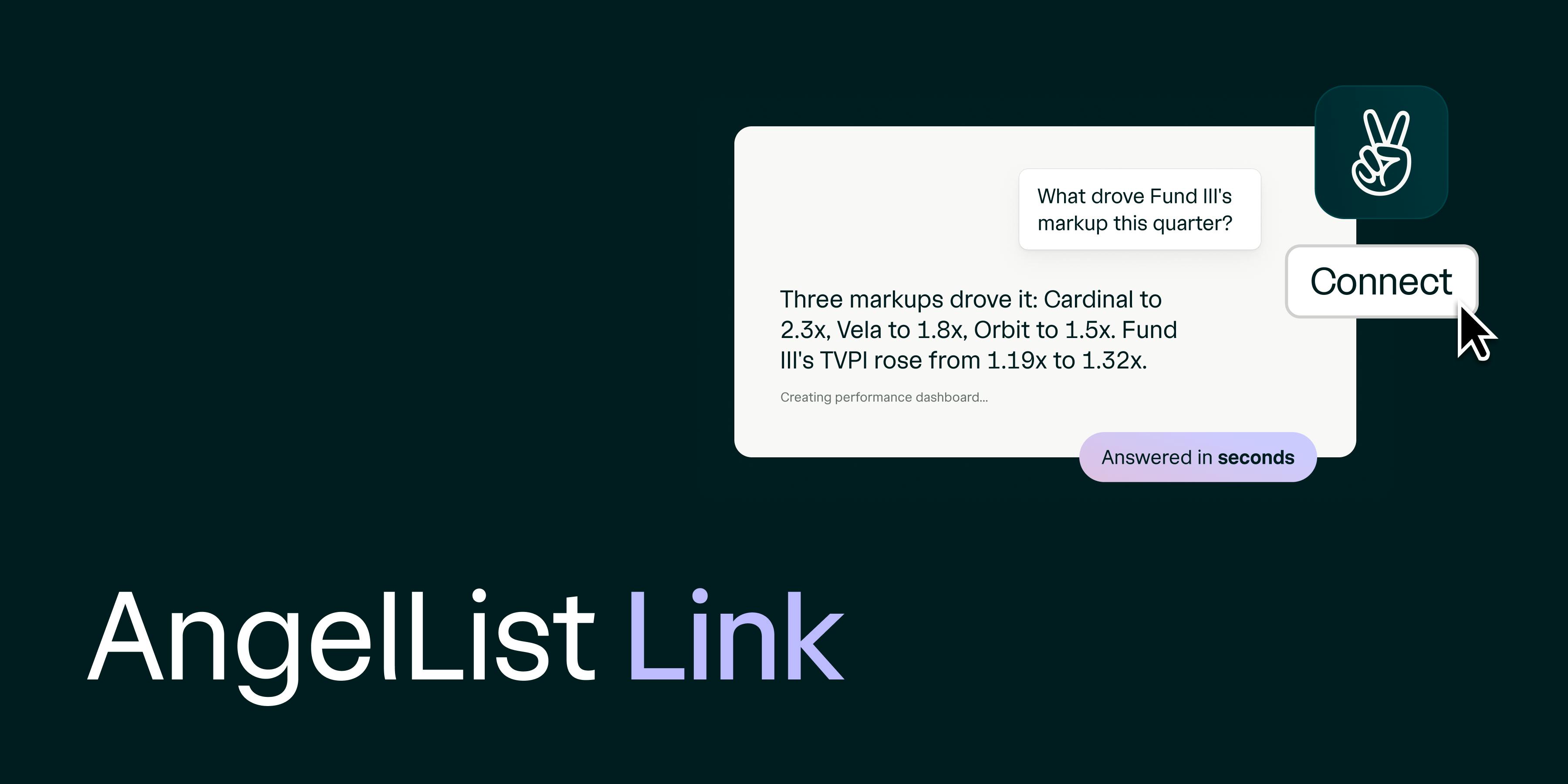
Since launching on Product Hunt, the product received 30 upvotes, ranking 20th on the daily leaderboard. It was categorized under Fintech, Venture Capital, and Artificial Intelligence — three intersecting domains that perfectly reflect its unique position at the convergence of financial technology and AI.
Core Features of AngelList Link: What Is a "Conversational Fund"?
A Single Source of Truth — Eliminating Fund Information Fragmentation
One of AngelList Link's core value propositions is "one source of truth." As the system of record for over 25,000 funds and SPVs (Special Purpose Vehicles), AngelList has accumulated a massive amount of structured fund data. What Link does is open up this vast record system through the MCP protocol, enabling AI tools to query it directly.
To understand AngelList's position in the VC ecosystem, it helps to know the company's history. Founded in 2010, AngelList started as a platform connecting startups with angel investors. Over more than a decade, it has evolved into one of the core infrastructure providers for the venture capital industry. Its fund management business (AngelList Venture) offers GPs end-to-end services from fund formation, LP management, and capital calls to tax filing. The 25,000+ funds and SPVs hosted on the platform span a broad client base from emerging managers to well-known VC firms. SPVs (Special Purpose Vehicles) are legal entities established specifically for individual investments, widely used in the VC industry for co-investments, employee stock ownership plans, and similar scenarios. By scaling these operational processes, AngelList automates work that traditionally required lawyers and administrative teams, enabling small funds to operate efficiently at low cost.
This means GPs no longer need to open dedicated fund management software outside of Claude, ChatGPT, or other AI tools they use daily. You can ask questions directly within the conversational interface you're already comfortable with, and the system returns verified answers rather than AI-generated speculation. This is crucial for financial scenarios — any hallucination involving funds and valuations could lead to serious consequences.
AI hallucination refers to large language models generating information that appears plausible but is actually incorrect. In general scenarios, hallucinations may only cause inconvenience, but in finance, the consequences can be severe. For example, if an AI incorrectly reports an investment's valuation or an LP's contribution status, it could lead to incorrect capital call amounts, non-compliant investor reports, or even legal disputes. In 2023, there was a famous incident where a lawyer used ChatGPT to generate fictitious case citations. AngelList Link mitigates this risk by anchoring AI responses in verified platform data rather than letting the model reason independently. This approach of combining retrieval with generation is particularly critical in financial compliance scenarios.
Daily Financial Data Updates
The product emphasizes providing "daily financials." Compared to the quarterly or monthly reporting cadence in traditional fund management, this near-real-time data update capability allows GPs to stay current on their fund's latest status at all times. When an LP suddenly asks about the latest progress on an investment, the GP can immediately provide an accurate answer through their AI assistant, rather than waiting for the finance team to compile reports.
How the MCP Protocol Is Reshaping Fund Management Infrastructure in the AI Era
What deserves special attention is the technical path AngelList Link has chosen — MCP (Model Context Protocol). MCP is a protocol that enables AI models to securely and standardly connect to external data sources and tools. By packaging itself as an MCP server, AngelList cleverly positions itself as a "plugin" within the AI ecosystem.
The MCP protocol was formally proposed and open-sourced by Anthropic in late 2024, aiming to solve the standardization problem of connecting large language models with external data sources. Before MCP, every AI application that needed to access external data required custom integration code, leading to severe ecosystem fragmentation. MCP adopts a client-server architecture: AI applications (such as Claude Desktop) serve as MCP clients, while external data sources or tools serve as MCP servers. The protocol defines three core capabilities — Resources (data resource exposure), Tools (callable operations), and Prompts (predefined interaction templates). This design is analogous to how REST APIs standardized inter-application communication in the Web era — MCP standardizes how AI models interact with the external world. Hundreds of MCP servers have already been developed by the community, covering everything from code repositories and databases to SaaS platforms. AngelList Link is an important piece of this ecosystem focused on the financial vertical.
The brilliance of this design lies in the fact that AngelList doesn't need to develop its own conversational AI interface. Instead, it plugs directly into the mainstream AI tools users are already using (Claude, ChatGPT, etc.). The service extends to wherever the users are. This both lowers the barrier to adoption and gives AngelList's data assets broader application scenarios.
From an industry trend perspective, this represents an important evolution for SaaS products in the AI era: shifting from "interface as product" to "data as service." When AI assistants become the primary gateway for users to interact with information, the value of structured data sources that AI can directly access will be fundamentally redefined.
The core competitive advantage of traditional SaaS products lies in user interface and workflow design — whoever has the better interface and smoother processes wins customers. But in the AI era, the way users interact with software is undergoing fundamental change: more and more work may be completed through AI assistants' natural language interfaces rather than traditional click-based operations. This means the center of gravity for SaaS value is shifting from front-end interfaces to back-end data assets. Platforms with high-quality, structured, authoritative data can continue creating value by being called upon by AI systems through APIs or protocols like MCP, even without directly facing end users. This is similar to the transition from web applications to the API economy during the mobile internet era — Twilio became communications infrastructure without needing a user interface, and future SaaS products may become data infrastructure for the AI era without needing traditional UIs. AngelList Link is an early practitioner of this trend.
Agentic Fund Management: The Emergence of AI Agent-Driven Fund Operations
AngelList calls this system "agentic fund management." This framing reveals the product's larger ambition — not just making fund data "queryable," but gradually moving toward enabling AI agents to actively participate in daily fund operations.
Agentic AI represents a paradigm shift in AI applications from passive response to proactive action. Traditional AI assistants wait for user questions before providing answers, while agents can set goals, plan steps, invoke tools, and autonomously execute tasks. In fund management, this means AI can not only answer "what's this LP's contribution status" but also proactively monitor all LPs' payment progress, issue early warnings when detecting overdue risks, and even automatically draft reminder emails. Since 2024, major players like OpenAI, Google, and Microsoft have been aggressively advancing Agent capabilities, with the industry widely expecting 2025-2026 to be the critical window for large-scale Agent application deployment. AngelList's positioning of its product as "agentic fund management" is a bet that this trend will first materialize in financial operations.
Imaginable scenarios include:
- AI assistants proactively reminding of upcoming capital call deadlines
- Automatically compiling LP cross-vehicle holdings reports
- Generating investor communication drafts after valuation updates
- Monitoring fund compliance metrics and issuing alerts when approaching thresholds
- Automatically comparing performance across similar funds and generating analysis summaries
While the current version focuses on "query and answer," its architecture leaves room for more proactive agent capabilities in the future. The MCP protocol itself supports the definition of Tools capabilities, meaning that in the future, AngelList Link can not only "be asked" but also "be delegated" to execute specific operations.
Who Needs AngelList Link? Use Cases and Limitations
For GPs managing multiple funds and SPVs, AngelList Link addresses a real, high-frequency pain point: information fragmentation. The larger the fund scale and the more investment vehicles involved, the more time GPs spend "searching for answers." Delegating these queries to an AI assistant can significantly improve operational efficiency.
However, it's important to objectively assess its limitations:
- Data lock-in: This system's prerequisite is that fund data is already stored on the AngelList platform. For funds not using AngelList as their system of record, the tool's value is significantly diminished.
- Verification boundaries: While the product emphasizes "verified answers," complex financial judgments and strategic decisions still require human oversight. AI is currently better suited for information retrieval rather than decision-making roles.
- Early stage: The product has just launched, and actual query accuracy and breadth of covered scenarios remain to be validated by the market.
- Competitive landscape: Fund management platforms like Carta and Juniper Square also possess large amounts of structured fund data. If they launch similar MCP or AI interfaces, how long AngelList Link's first-mover advantage can last remains uncertain.
Conclusion: The Direction of AI and Financial Infrastructure Convergence
AngelList Link is a representative case of combining AI with traditional financial infrastructure. Rather than trying to reinvent the wheel, it seamlessly connects AngelList's years of accumulated fund record system into AI workflows through the MCP protocol. For GPs navigating the AI wave, a "conversational fund" may still sound novel, but the direction it points toward — making professional domain data assets directly accessible to AI, automating repetitive information work — is the dominant theme of B2B software evolution for the coming years.
As more vertical industry data sources embrace the MCP protocol, the capability boundaries of AI assistants will continue to expand accordingly. AngelList Link is just one microcosm of this transformation. From a broader perspective, we are witnessing the formation of a new infrastructure layer: above operating systems, above application software, above AI models, a "data interconnection layer" connected by protocols like MCP is gradually taking shape. Whoever can occupy key positions in this layer will gain lasting competitive advantage in the AI era's value chain.
Related articles

Hungarian Algorithm Explained: Principles, Complexity, and Engineering Implementation Guide
In-depth explanation of the Hungarian Algorithm: core principles, O(N³) time complexity advantages, and engineering implementation. Covers assignment problem definition, step-by-step algorithm walkthrough, Python/C++ libraries, and applications in multi-object tracking and resource scheduling.
OpenAI's First Enterprise AI Report: H…
OpenAI's First Enterprise AI Report: How ChatGPT Is Changing the Way Organizations Work
OpenAI's first enterprise AI report reveals three key traits of ChatGPT Enterprise adoption: the shift from novelty to necessity, writing and coding as top use cases, and data governance as a core prerequisite.

DeepSeek-V4-Pro Released: A Comprehensive Analysis of Agent Capabilities and Elastic Reasoning Mechanism
DeepSeek-V4-Pro launches with major Agent capability upgrades, elastic reasoning effort mechanism, and native OpenAI Responses API compatibility. A deep dive into production deployment and cost optimization.