Anker Nano Smart Display Charger: A New Choice for iPhone 18 Fast Charging and Battery Health

Anker's new charger uses device recognition and a screen to provide on-demand fast charging for the iPhone 18, but battery health data remains to be verified.
Aiming at the pain point that the stock charger may not reach peak power after the iPhone 18 series improved charging speeds, the Anker Nano Smart Display Charger focuses on device recognition and screen feedback. It detects the connected iPhone and outputs the maximum power it can accept, charging an iPhone 18 Pro from zero to 50% in 15 minutes in testing; App OTA updates also let it recognize future new models. It is 47% smaller and 36% lighter than the first-generation 30W charger, and the screen can show temperature, switch to care mode (power drops to about 19W), and adjust timeout; it has passed TUV certification. The manufacturer claims precise power delivery extends battery health by 20%, but independent long-term testing is lacking, so it is advisable to pay attention to third-party testing before purchase.
After the iPhone 18 series improved charging speeds, the stock charger may not reach peak power. Anker's Nano Smart Display Charger attempts to solve this pain point with "device recognition + screen feedback"—can it become the perfect companion for the new iPhone?
Core Feature: Recognizing Devices and Supplying Power on Demand
The core selling point of this charger is device recognition. According to a YouTube review video, Anker was the first in the charging industry to introduce device recognition earlier this year, and this generation takes that capability a step further: the charger detects the connected iPhone and outputs the maximum power the device can accept, thereby charging at the fastest possible speed.
In actual performance, it can charge an iPhone 18 Pro from zero to 50% in 15 minutes, and displays the progress directly on the screen.
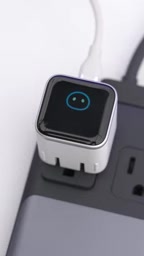
This "power on demand" approach is not only for the present. The video points out that through OTA updates in the Anker App, the charger can continuously recognize future new iPhone models and match the corresponding power strategy—in other words, it attempts to turn the charger from one-time hardware into an iterable accessory.
USB PD and PPS Protocols
So-called "power on demand" relies at its foundation on the USB Power Delivery (USB PD) protocol and its extension PPS (Programmable Power Supply). Traditional chargers often output a few fixed voltage levels (such as 5V/9V/12V), while the PD protocol allows the charger and phone to perform handshake negotiation over the CC line: the phone tells the charger what voltage and current it can currently accept, and the charger adjusts its output accordingly. PPS further refines voltage adjustment granularity to the 20mV level, allowing output to more closely match the battery's actual needs. What Anker calls "device recognition" can be understood as layering vendor-specific device fingerprints or database matching on top of the standard handshake, so that a more precise power tier is selected during the handshake stage rather than probing tier by tier. This also explains why it needs App OTA updates—as new models are added, the recognition database needs to be expanded accordingly.
Screen and Interaction: An Information Window in a Small Body
The Nano Smart Display Charger is quite aggressive in size control: 47% smaller and 36% lighter than the first-generation 30W charger. The video repeatedly emphasizes "look at this size" and demonstrates two orientations for wall use—horizontal or vertical insertion both work, accommodating different outlet layouts.
The screen is what differentiates this product. Users can view real-time temperature, switch to "care mode," and adjust the screen timeout from 1 minute to 5 minutes; double-tapping the body enters care mode, at which point output power drops to around 19W.
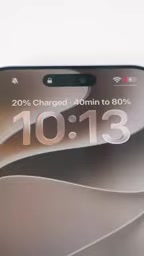
From a product logic perspective, the screen serves two roles: first, it visualizes the otherwise invisible charging status; second, it gives users an entry point for actively intervening in battery management. For users accustomed to "plug it in and forget it," this screen may have limited presence; but for users concerned about battery health, real-time feedback on temperature and power does reduce information asymmetry.
Battery Health: Where Does the 20% Improvement Come From?
The key figure given in the video is that by precisely outputting the power requested by the iPhone, this charger can extend battery health by 20%. The logic chain is: avoid over-supplying power, control temperature, and actively reduce power in care mode, thereby slowing battery aging.
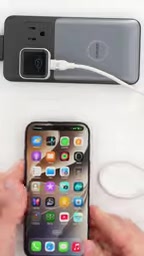
It should be noted that this figure comes from manufacturer marketing claims, and the video does not show long-term controlled testing. Battery health is affected by multiple factors such as charge-discharge cycles, temperature, and usage habits, and how much a single charger can contribute still requires independent verification. However, the approach of reducing power to around 19W in care mode is consistent with the industry consensus that "slow charging protects the battery."
In terms of safety, the product has passed TUV certification, which is one of the few third-party qualifications explicitly mentioned in the video.
Battery Health and Charging Cycles
Battery health is usually expressed as the percentage of current maximum capacity relative to the factory design capacity, and iPhone users can view it in "Settings—Battery—Battery Health." Capacity degradation in lithium-ion batteries mainly comes from three types of stress: the number of charge-discharge cycles, prolonged periods at high charge levels or high temperatures, and heat generated by high-current fast charging. If the manufacturer's claimed "20% extension" holds true, it often means that under the same usage intensity, capacity retention is higher after hundreds of cycles. But health itself is a statistical quantity with large individual differences, and it is affected by ambient temperature and whether the device is used while charging, making it difficult to attribute to a charger alone—this is also why the figure needs verification through controlled experiments.
Design Details and Buying Advice
In terms of appearance, the review shows the Aurora white colorway, with black stone, misty blue, and burgundy also available.
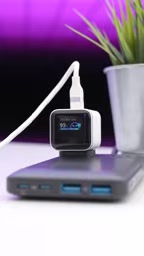
Who should buy it? If you have just switched to the iPhone 18 series and want to achieve full fast charging with a small charger while also wanting more visibility and control over the charging process, this product's combination of device recognition + screen display + care mode has clear value. If you do not need a charger that is "visible" and care more about price, a standard fast charger remains the more economical choice.
It should be noted that all performance and health data in this article come from one-sided statements by the manufacturer and the review video, and it is advisable to pay attention to third-party testing before purchase.
What Is TUV Certification
TUV is the collective name for third-party testing and certification bodies such as TÜV Rheinland and TÜV SÜD in Germany. In consumer electronics, TÜV Rheinland safety and performance certifications are common. Such certifications usually cover electrical safety (insulation, temperature rise, short-circuit protection), electromagnetic compatibility, and some energy-efficiency indicators. They are voluntary third-party certifications, not mandatory market access. For chargers, passing TUV certification means that temperature-rise control and electrical safety have been tested by an independent laboratory, which is more convincing than manufacturer self-inspection alone. However, certification applies to submitted samples and established standards, and does not directly equate to long-term reliability or compatibility with a specific phone. When purchasing, you should still combine third-party testing with your own device matching.
One-line Summary
Anker's new charger uses device recognition and a screen to provide on-demand fast charging for the iPhone 18, but battery health data remains to be verified.
Paragraph Summary
Aiming at the pain point that the stock charger may not reach peak power after the iPhone 18 series improved charging speeds, the Anker Nano Smart Display Charger focuses on device recognition and screen feedback. It can detect the connected iPhone and output the maximum power it can accept, and in testing charged an iPhone 18 Pro from zero to 50% in 15 minutes; with App OTA updates it can also recognize future new models. The product is 47% smaller and 36% lighter than the first-generation 30W charger, and the screen lets users view temperature, switch to care mode (power drops to about 19W), and adjust timeout; it has also passed TUV certification. The manufacturer claims precise power delivery can extend battery health by 20%, but independent long-term testing is lacking, so it is advisable to pay attention to third-party testing before purchase.
Related articles

Training a PPO Agent for the Hidden-Information Card Game Cabo on a MacBook
A developer trained a self-play PPO agent for the hidden-information card game Cabo on a MacBook. The article covers training configuration, slot symmetry handling, emergent strategies, and plateau challenges.

Training PPO on a MacBook: A Browser-Based Cabo Card Game with Hidden Information
A Reddit developer trained a self-play PPO AI for the hidden-information card game Cabo on a MacBook and made it playable in the browser, offering insights for AI app development.
Jensen Huang's Internal Letter on Rumors: An Unpublicized PR Crisis?
A Hacker News post claims Nvidia CEO Jensen Huang sent staff a letter about an affair, but lacks the original text or official confirmation. This article examines the background, community discussion, and potential impact on investors and employees, urging caution with unverified information.