Anthropic API Update v2.1.0: New Enforcement Status and Filtering for User Profiles

Anthropic SDK v2.1.0 adds enforcement status, actions, and filtering to user profiles.
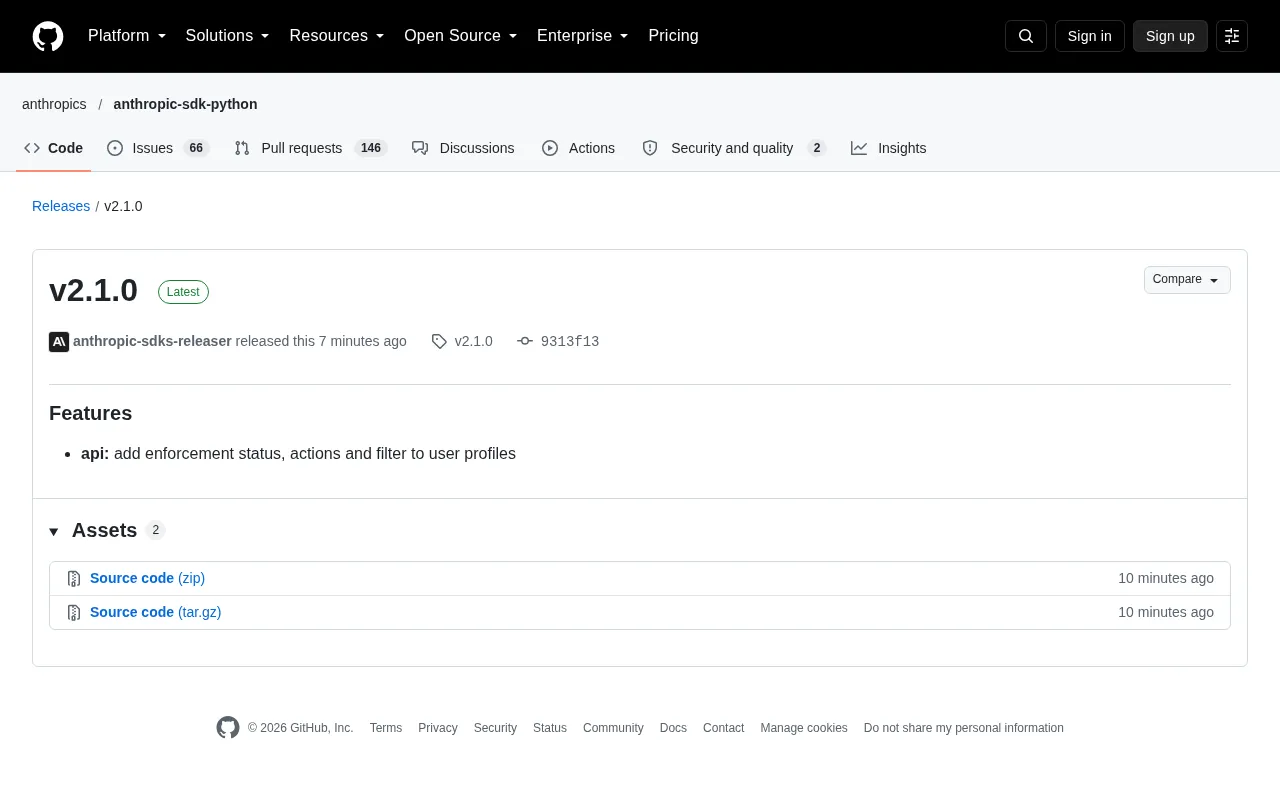
Anthropic SDK released v2.1.0 (commit 9313f13, Oct 21), with the sole feature entry under `api`: adding enforcement status, actions, and filter to user profiles. This targets developers accessing profile data via the API, not model capability iterations. enforcement status expresses compliance states at the profile level, actions suggests associated action records, and filter enables conditional filtering to reduce data transfer. Since the release log lacks field-level definitions and examples, semantics can only be inferred from naming; actual behavior should follow official documentation. Teams using profile endpoints should check strict-mode parsing configs and regression-test filter combinations before upgrading.
According to information published via RSS, the Anthropic SDK has released version v2.1.0. The core update in this version is concentrated at the API layer, adding enforcement status, actions, and filter capabilities to "user profiles."
Version Update Overview
According to the release log, v2.1.0 was published by the SDK release account anthropic-sdks-releaser on October 21 at 22:00, with commit hash 9313f13. The changelog categorizes the sole feature entry under the api category, described as "add enforcement status, actions and filter to user profiles." This means the update is primarily aimed at developers who access user profile data via the API, rather than an iteration on model capabilities themselves.
SDK vs. API Version Relationship: The Anthropic SDK (e.g., the Python package anthropic, the TypeScript package @anthropic-ai/sdk) is a client library whose version number is independent of the server-side API version. SDK minor versions (such as 2.1.0 relative to 2.0.x) typically only expose incremental features and fix bugs, and do not represent breaking changes to the underlying model or API semantics. Entries in the changelog under the api category refer to the SDK adding corresponding type definitions, request parameters, and convenience methods for server-side capabilities that already exist or have just launched. Therefore, when you see "API layer update," it should be understood as the client beginning to support a server-side capability, not that the server-side itself only took effect at that moment.
Changelog Categories and Commit Hashes: Release logs often organize entries by categories such as api, client, docs, and internal; the api category typically involves changes to request/response models. Commit hash 9313f13 is the Git commit hash corresponding to the version, which can be used to locate the specific code diff included in that version in the repository — more precise than the changelog's one-sentence description.
Changes to User Profile Capabilities
User profiles are commonly used on the application side for grouping, labeling, and behavior tracking of end users. The newly added enforcement status field lets developers directly express some kind of enforcement or compliance state at the profile level, such as whether an account is subject to policy restrictions; actions suggests a record of actions or a list of executable actions associated with the profile; and the filter capability lets callers filter profile data by condition when fetching it, reducing unnecessary data transfer.
Practical Impact on Developers
For teams that have already integrated the Anthropic SDK, this change is worth noting on two fronts. First, the profile data structure may be extended; if clients parse responses in strict mode, type definitions need to be updated in sync. Second, the addition of filtering means more query parameters, so API documentation needs to be re-checked. Since the release log provides no field-level descriptions, actual behavior should be based on the official API documentation.
Strict-Mode Parsing and Unknown Fields: Serialization libraries in many languages validate fields strictly by default. For example, Python's Pydantic raises an error when unknown fields appear in a response if model_config = ConfigDict(extra='forbid') is set; TypeScript with zod's .strict() will also fail validation. Adding new fields on the server is a backward-compatible additive change, but strict clients will fail passively. Before upgrading, you can change the configuration to extra='ignore' or .passthrough(), or update type definitions in sync, to ensure a smooth transition.
Judgment with Limited Information
The publicly disclosed changes this time are fairly concise, with only one feature description and neither field definitions nor example requests and responses. Therefore, regarding the specific semantics of enforcement status and actions, we can currently only make reasonable inferences based on naming, and developers should avoid relying on behavior not confirmed by documentation.
Common Semantics of enforcement status: In most risk control and compliance systems, enforcement status is an enum field used to indicate the current level of restriction applied to an entity, such as active (normal), restricted (restricted), suspended (suspended), banned (banned), etc. It is typically written by the platform's policy engine and is read-only to clients. If Anthropic exposes this field at the profile level, developers can use it to drive in-app prompts and restrict feature entry points without maintaining their own external mapping table. The specific enum values must be based on the official documentation.
filter and Design Conventions for Query Parameters: Filtering on profile-type endpoints usually takes the form of query parameters, such as ?status=restricted&limit=50, and may also support field selection (fields) and cursor pagination (cursor). With filter introduced, the response structure is often accompanied by a pagination envelope (such as data, has_more, next_cursor), and client parsing logic needs to be adjusted accordingly — you cannot assume a full list is returned in one go.
Release Cadence and Usage Recommendations
SDK minor version updates are generally backward compatible, but regression testing is still needed when data structures are extended. It is recommended to review existing code handling user profile responses before upgrading, especially serialization and deserialization, and to verify filter parameter combinations in a test environment.
FAQ
Will this update affect existing API calls?
If existing calls do not use user profile-related endpoints, the impact is minimal; if they do, new fields may appear in responses, and you should confirm that your code can tolerate unknown fields.
Where can I find the exact field definitions?
The release log does not include field descriptions; you should consult the user profiles section of Anthropic's official API reference documentation.
One-line Summary
Anthropic SDK v2.1.0 adds enforcement status, actions, and filtering capabilities to user profiles.
Paragraph Summary
Anthropic SDK released v2.1.0 (commit hash 9313f13, October 21), with the sole feature entry categorized under api: adding enforcement status, actions, and filter capabilities to user profiles. This means the update targets developers who access profile data via the API, not model capability iterations. enforcement status lets developers express compliance or enforcement states at the profile level, actions suggests action records associated with profiles, and filter supports conditional filtering to reduce unnecessary data transfer. Since the release log provides no field-level definitions or examples, specific semantics can only be inferred from naming, and actual behavior should be based on the official API documentation. The article recommends that teams using profile endpoints check strict-mode response parsing configurations before upgrading and regression-test filter parameter combinations.
Related articles

The Touchscreen MacBook and Apple's Delightful Mess: A Deliberate Gamble
The Vergecast unpacks the touchscreen MacBook Pro's launch logic, the ProLed naming controversy, the iPad squeezed between iPhone and Mac, and how Apple stays competitive with premium hardware in the AI era.

Fifty Years Studying Power: Robert Caro's Writing and Insights on Power
Robert Caro reflects on 50 years studying power: Lyndon Johnson's persuasion and leverage, Robert Moses's transformation from idealist to ruthless builder, the dilemmas of large-scale construction, and his methods of compressing themes and solitary focus in biography writing.

Can a $20,000 Robot Do Your Chores? The Test Results Are Surprising
A YouTube test video shows how a $20,000 robot responds to commands like washing dishes, turning off lights, taking out trash, and feeding the dog. This article analyzes its real capability boundaries, the state of voice interaction technology, and how far household robots are from mainstream adoption.