Anthropic Build Day Hackathon: How Top Developers Build AI Applications with Claude

Anthropic's Build Day hackathon showcases top developers building innovative AI apps with Claude models.
Anthropic hosted an elite, invitation-only hackathon called Build Day in Cerebral Valley, where top developers showcased AI applications built on Claude. The event reflects the intensifying competition among AI companies—including OpenAI, Google, and Meta—to win over developer ecosystems. Key trends highlighted include Agentic AI, RAG architectures, multimodal applications, and AI workflow orchestration, signaling a broader industry shift from model performance races to ecosystem battles.
Anthropic Build Day Overview
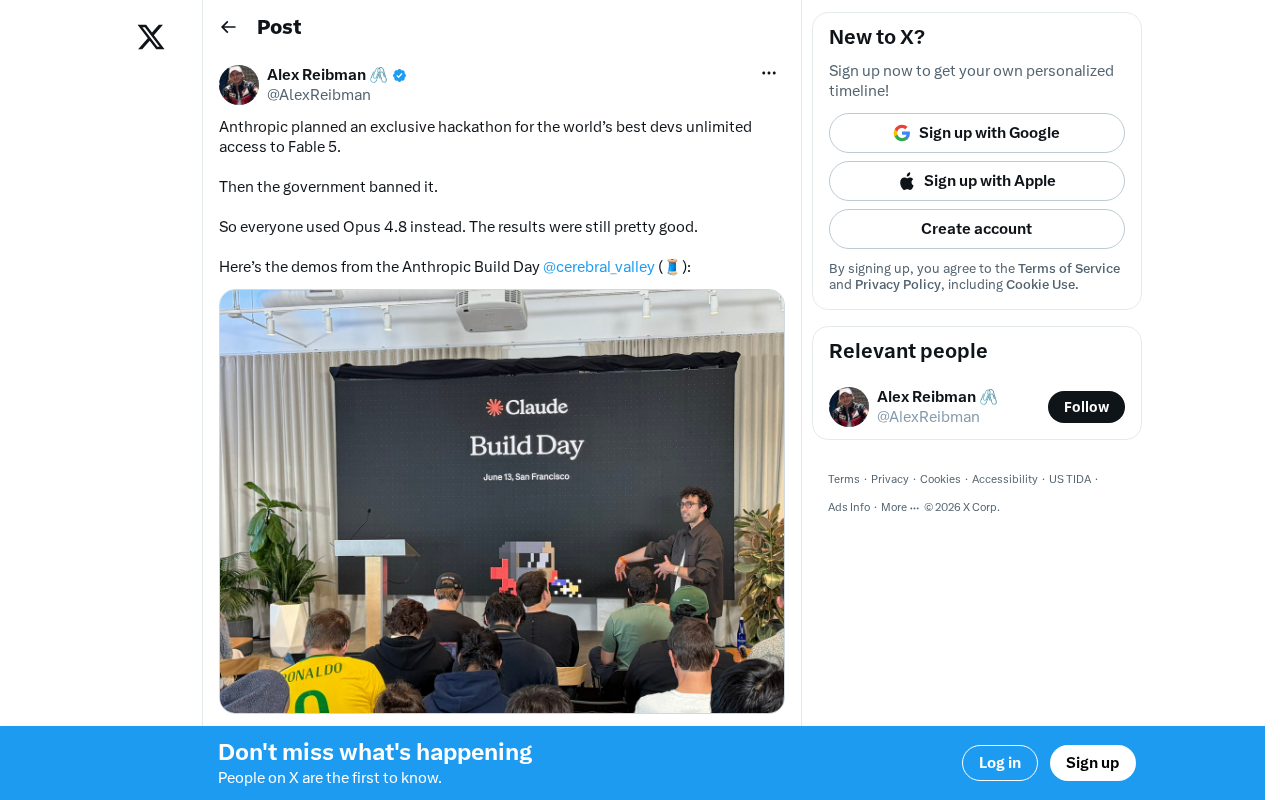
Anthropic recently hosted a hackathon called "Build Day" in Cerebral Valley, inviting a group of top developers to participate and showcase various application demos built on the Claude model. The event generated widespread attention on social media, not only because of the high-quality output from participants, but also because the organizers promoted it with a notably humorous approach.
Anthropic was co-founded in 2021 by former OpenAI Research VP Dario Amodei and his sister Daniela Amodei. The company centers on "AI safety" as its core philosophy, dedicated to building reliable, interpretable, and controllable AI systems. Its flagship Claude model family employs a unique "Constitutional AI" training method, guiding model behavior through an explicit set of principles rather than relying solely on Reinforcement Learning from Human Feedback (RLHF). To date, Anthropic has raised over $10 billion in cumulative funding from investors including tech giants like Google and Amazon, with its valuation ranking among the top AI companies globally.
Background: The Developer Ecosystem of Cerebral Valley
Cerebral Valley is synonymous with Silicon Valley's AI developer community, home to a large concentration of engineers and entrepreneurs working on cutting-edge AI applications. Anthropic's choice to host Build Day here was clearly aimed at reaching the most active AI developer demographic.
The name "Cerebral Valley" is a playful riff on San Francisco's Hayes Valley neighborhood, gaining popularity around late 2022 after ChatGPT exploded onto the scene. Hayes Valley and its surrounding areas (including SoMa, Mission, and other neighborhoods) quickly became a hub for AI startups and independent developers, with countless AI entrepreneurs building next-generation AI applications in local coffee shops, co-working spaces, and apartments. This community's formation has a unique historical context: traditional Silicon Valley (Palo Alto, Mountain View, and other South Bay locations) is dominated by large tech companies, while Cerebral Valley represents a more grassroots, rapid-iteration AI startup culture. Dozens of AI-themed meetups, demo nights, and hackathons take place here every week, forming a high-density knowledge exchange network. Many AI companies that later secured major funding rounds (such as Perplexity, Character.AI, etc.) had early team members active in this community.
The promotional approach itself embodied the dark humor typical of Silicon Valley tech circles—the "Fable 5" and "Opus 4.8" mentioned in the tweet are not real model names, but rather a tongue-in-cheek marketing tactic implying that Anthropic possesses powerful model capabilities not yet publicly released. To understand this joke, you need to know Claude's naming convention: Anthropic's current models are tiered by capability from low to high as Haiku, Sonnet, and Opus—all named after literary forms. "Fable" is clearly a humorous extension of this literary naming tradition, while "Opus 4.8" implies a future model far beyond current versions. This kind of "meme culture" is extremely popular in the AI developer community and reflects the current industry's anticipation of rapid model capability iteration.
Hackathon Positioning: Elite Invitation-Only
Unlike typical developer events, Anthropic Build Day functions more like an "elite invitational." Participants were described as "the world's best developers," indicating the event had a high barrier to entry, designed to showcase the upper limits of what Claude models can achieve in the hands of top-tier developers.
The hackathon format originated around 1999, independently initiated by the OpenBSD developer community and Sun Microsystems. Traditional hackathons typically last 24-48 hours, with participants building software prototypes from scratch within the time limit. However, AI-era hackathons are undergoing a profound paradigm shift: developers no longer need to write all code from the ground up, but instead increasingly play the role of "AI orchestrators"—assembling large language model capabilities into complete applications through carefully designed Prompt Engineering, API call chains, and tool integrations. This means an excellent AI hackathon participant needs not only traditional programming skills but also a deep understanding of model capability boundaries, knowing how to maximize output quality through System Prompt design, Few-shot Learning, Function Calling, and other technical approaches. Anthropic's invitation-only strategy is precisely designed to filter for these hybrid developers who combine engineering ability with AI literacy.
Decoding AI Companies' Developer Operations Strategy
Anthropic's Build Day reveals that AI model companies are ramping up investment in developer ecosystems. This directly competes with OpenAI's DevDay and Google's I/O developer conference. Through hackathon formats, AI companies can achieve multiple objectives:
- Demonstrating model capability boundaries: Letting top developers explore the extreme use cases of Claude models
- Collecting real usage feedback: Discovering model strengths and weaknesses under high-intensity usage scenarios
- Building community loyalty: Enhancing developer stickiness through exclusive access and elite community belonging
- Producing marketing materials: Outstanding demos are themselves the most persuasive product promotion
The Developer Battle Reaches Fever Pitch
Competition in the current AI landscape has extended beyond pure model performance benchmarks to the battle for developer ecosystems. Whoever attracts the best developers to build applications on their platform gains a first-mover advantage on the path to commercialization. Through high-profile events like these, Anthropic is actively building its developer moat.
The intensity of this battle far exceeds what's visible on the surface. OpenAI's inaugural DevDay in November 2023 launched GPT-4 Turbo, the GPTs Store, and the Assistants API, elevating the developer toolchain by an entire dimension. Google responded at its 2024 I/O conference with the Gemini series developer toolkit, attempting to capture market share with extremely competitive API pricing (in some scenarios, one-tenth the cost of OpenAI). Meta chose the open-source route, building its developer community through free access to the Llama model series. Against this backdrop, competition dimensions have expanded to include API pricing strategies, SDK and developer tool usability, technical documentation quality, developer community operations, and flexibility in model fine-tuning and deployment. Anthropic's differentiation strategy emphasizes Claude's advantages in long-context processing, instruction following, and safety, while attracting high-end developers building complex AI Agents through innovative features like Tool Use and Computer Use.
Three Takeaways for AI Developers
For practitioners focused on AI application development, this hackathon signals several noteworthy trends:
- Model capabilities are still advancing rapidly: Even with "second-tier" model versions, the quality of demos produced remains impressive
- Massive innovation space at the application layer: The fact that top developers can build valuable prototypes in short timeframes demonstrates that current models like Claude already support many innovative application scenarios
- Community participation cannot be overlooked: Joining active AI developer communities like Cerebral Valley provides first-hand access to technical resources and collaboration opportunities
Regarding application-layer innovation, several key technical paradigms are emerging in AI development today—these are also the types of demos that frequently appear at hackathons. First is Agentic AI, where AI models don't just answer questions but autonomously plan tasks, invoke external tools, and execute multi-step operations—Claude's Tool Use and Computer Use features are designed precisely for this. Second is RAG (Retrieval-Augmented Generation) architecture, which combines external knowledge bases with large language models to address knowledge cutoff dates and hallucination issues, particularly critical for enterprise applications. Third is multimodal applications—as Claude and other models support images, PDFs, and various input formats, developers can build composite applications spanning text, vision, and structured data. Finally, there's AI workflow orchestration, using frameworks like LangChain and LlamaIndex to chain multiple AI calls into complex automated processes. Understanding these technical trends helps developers quickly identify valuable innovation directions when participating in similar hackathons.
Conclusion
While Anthropic Build Day was promoted with a lighthearted, humorous tone, it reflects the deep investment AI companies are making in developer ecosystem building. As the capabilities of AI models like Claude continue to advance, hackathon events like these will catalyze increasingly impressive application innovations, providing developers with an excellent stage to explore the boundaries of AI capabilities.
From a broader perspective, the AI industry is experiencing a critical pivot from a "model race" to an "ecosystem race." Just as competition between iOS and Android in the mobile internet era ultimately depended on the richness of their respective app ecosystems, the winners of the AI era will be those companies that can build the most vibrant application ecosystems around their models. Events like Anthropic Build Day are a microcosm of this ecosystem competition.
Related articles

The Truth Behind Codex 'Build a Website in 5 Minutes': AI Isn't Creating Sites—It's Helping You Copy Them
Exposing the truth behind viral Codex 5-minute website videos: creators aren't building original sites with AI—they're copying shared prompts or scraping others' work. Learn AI coding tools' real limits.

Getting Started with AI Agent Development: A Complete Guide from Concept to Practice
A comprehensive guide to AI Agent architecture and development, covering automated marketing, intelligent customer service, and investment analysis scenarios with single and multi-agent collaboration.

The Truth Behind Codex 'Build a Website in 5 Minutes': AI Isn't Creating Sites — It's Helping You Copy Them
Exposing the truth behind viral Codex 5-minute website videos: creators aren't building original sites with AI — they're copying shared prompts or scraping others' work.