Anthropic Filing Leak: Why Tech Stocks Are Under Pressure

Anthropic filing triggers tech stock selloff, reflecting declining capital market patience with the AI narrative.
A Hacker News post about an Anthropic filing pressuring tech stocks sparked discussion. The article argues investors sought signals on AI commercialization and competition, and the filing may have fallen short of optimistic expectations. Key sensitivities: training/inference costs, customer concentration and revenue quality, and regulatory risk. It reminds AI entrepreneurs that capital markets are shifting from narratives to unit economics, and any external document can trigger sentiment. For ordinary users, stock volatility feeds through to product pricing and free quotas.
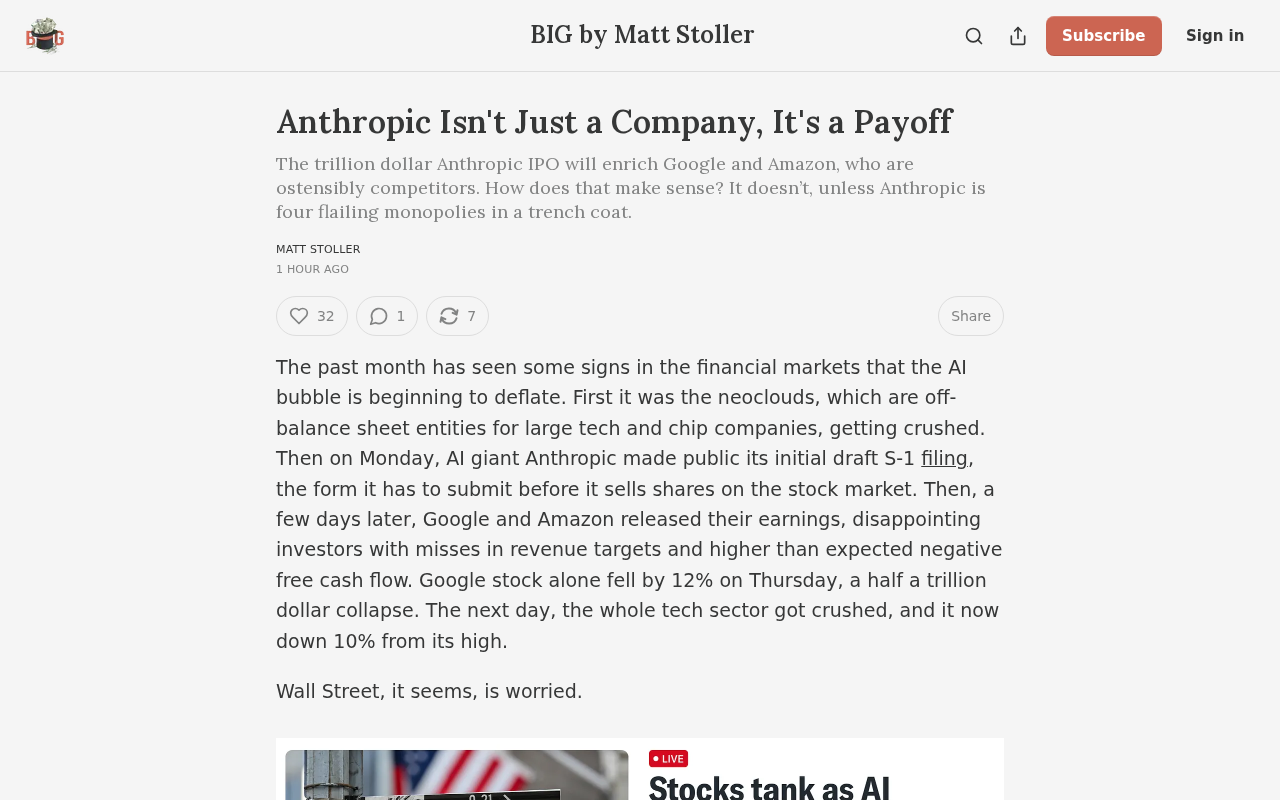
Recently, a post titled "Why Anthropic's Filing Crushed Tech Stocks" sparked a small-scale discussion on Hacker News. The post itself has only 5 points and 1 comment, but it points to a phenomenon worth digging into: a public filing from AI company Anthropic somehow triggered a chain reaction across tech stocks in the capital markets.
How a Single Filing Shook the Market
Although the original post offers limited information, the title itself reveals key clues — "Filing" typically refers to a formal document submitted by a company to regulators, such as financial reports, prospectuses, or disclosures of major events. When such a document comes from a leading AI company like Anthropic, the market instinctively looks for two signals: the real commercialization progress of the AI industry, and changes in the competitive landscape among top players.
Tech stocks are highly sensitive to the AI narrative. Any detail suggesting slowing growth, rising costs, or intensifying competition can be amplified and interpreted as a sell signal. The reason Anthropic's filing "crushed" tech stocks is most likely that the information it contained fell short of the market's previously optimistic expectations.
Filing in the U.S. stock market context typically refers to periodic or ad-hoc disclosure documents that public companies submit under U.S. Securities and Exchange Commission (SEC) requirements, including common types such as 10-K (annual report), 10-Q (quarterly report), 8-K (announcement of major events), and S-1 (prospectus). Although private companies have no mandatory disclosure obligations, they may also release audited or semi-audited financial information through specific channels during financing, M&A, or when they have significant business dealings with public companies. Once such documents become public, sell-side analysts, quant funds, and financial media dissect them within hours, leading to a repricing of industry fundamentals. As an unlisted AI company, Anthropic's "filing" more likely refers to financing-related materials or regulatory filings rather than standard SEC periodic reports, so the market's interpretation of the details often comes with higher uncertainty and emotional amplification.
What the Market Is Worried About
Combined with recent hot topics in the AI industry, this filing may have touched on several sensitive points. The first is the cost structure of model training and inference. If the spending scale disclosed in the filing far exceeds expectations, investors will reassess the profitability timeline of AI companies. The second is customer concentration and revenue quality. Renewal rates and changes in average contract value for enterprise AI services are key indicators of industry health. The third is regulatory and compliance risk. Anthropic has always emphasized a "safety-first" positioning, which may win policy goodwill but could also mean longer product deployment cycles and higher compliance costs.
It should be noted that since the original material only provides a title and a screenshot, the above analysis is reasonable inference based on industry background rather than a direct restatement of the filing's contents.
Unit economics refers to an analytical framework that measures the relationship between revenue and costs on a per-customer, per-call, or per-product basis. For AI companies, core variables include the compute cost per model inference, customer acquisition cost, renewal rate, and average contract value. Since large model inference requires continuous consumption of GPU compute, if revenue per call cannot cover marginal compute costs, scaling up will actually amplify losses. In recent years, the valuation logic of capital markets for AI companies has been shifting from "technological leadership" to "whether unit economics can work," which is the fundamental reason why cost structure data in any disclosure document can trigger violent stock price reactions.
Implications for AI Entrepreneurs
The real value of this incident is not in guessing what Anthropic actually wrote, but in reminding all AI practitioners: the capital market's patience is becoming limited. In the early days, a technological narrative alone could secure high valuations; now investors care more about whether unit economics hold up. For startups, any external document — whether financing materials or regulatory filings — can become a trigger for industry sentiment. Information transparency is increasing, market reaction speed is accelerating, and the room left for "storytelling" is shrinking.
Customer concentration is a key indicator of revenue stability, typically measured by the revenue share of the top five customers. If an enterprise AI services company relies too heavily on a few large customers, losing a major customer or worsening renewal terms could cause revenue to plummet. When interpreting Anthropic's filing, investors will pay special attention to whether its revenue is diversified across multiple industries and customers, and whether enterprise contract renewal rates are healthy. High customer concentration often means weak bargaining power and poor revenue predictability, which directly lowers valuation multiples — one of the deeper reasons tech stocks get sold off heavily when negative signals emerge.
Should Ordinary Users Care?
If you're not an investor, this is still worth noting. Fluctuations in tech stocks affect AI product pricing strategies and free quotas, which then feed through to everyday user experience. Financial disclosures from leading companies also influence hiring pace and the tool ecosystem across the industry. In other words, Anthropic's filing isn't just Wall Street's business — it's not far removed from ordinary developers and product users.
Currently, the Hacker News post has very low engagement, with only one comment, suggesting this is more of an early signal than a fully developed public event. If more media follow up with details of the filing, it will be worth continued attention.
One-line Summary
A public Anthropic filing triggered a tech stock selloff, reflecting declining capital market patience with the AI narrative.
Paragraph Summary
A Hacker News post about an Anthropic public filing pressuring tech stocks sparked small-scale discussion. The article argues that the "filing" shook the market because investors sought signals about AI commercialization progress and the competitive landscape, and its contents may have fallen short of optimistic expectations. Market sensitivities center on three areas: model training and inference cost structure, customer concentration and revenue quality, and regulatory compliance risk. The article also reminds AI entrepreneurs that capital markets are shifting from technological narratives to unit economics, and increasing information transparency means any external document can become an emotional trigger. For ordinary users, tech stock volatility feeds through to product pricing and free quotas. Due to limited source material, the analysis is inferred from industry background.
Related articles

beacon.sh: Giving AI Coding Assistants a Self-Evolving Memory
beacon.sh is an open-source, self-evolving memory layer for AI coding agents, supporting Claude Code, Cursor, Codex and 20+ harnesses—turning agent sessions into a compounding knowledge layer.

Xmind 2027 Launches: Mind Mapping Evolves into an AI Thinking Partner
Xmind 2027 launches on Product Hunt as an "AI thinking partner." It adds Xmind Agent for research with local documents and mind maps, and connects mind map context to ChatGPT, Claude, and other AI workflows via MCP. This article analyzes its product logic, differentiation, and open questions.

Display 1.0: Build Docs and Apps with Any Agent
Display 1.0 launches on Product Hunt, letting any Agent create docs, prototypes, and apps in one workspace, organized via Spaces and Folders into a team knowledge base with flat pricing.