Anthropic IPO Filing Decoded: The Compute Gambit Behind High Growth and the Real Cost for Chinese Developers

Anthropic's IPO filing reveals surging revenue alongside massive book losses, with developers bearing the cost of bans and migration.
Anthropic filed for an IPO with half-year revenue of about $16.3 billion, up 14x year-over-year, and a net loss of about $80.7 billion—but about $72.4 billion comes from fair value changes on convertible notes and SAFEs, while operating loss was only about $693 million, with Q2 already showing about $1 billion in operating income. Behind the 85% gross margin are $9.74 billion in R&D spending, $265.6 billion in purchase commitments, and $321.4 billion in uncommenced compute leases—high-margin software alongside heavy long-term infrastructure contracts. Amazon, Google, and Microsoft are simultaneously shareholders, suppliers, and competitors, with about 48% of revenue sold through cloud platforms. Restrictions on Chinese customers have entered commercial access, with developers bearing downtime, appeal, and migration costs, while domestic platforms absorb demand. In governance, Class T and F shares give the founders' entity 50.1% voting power.
Title
Anthropic IPO Filing Decoded: The Compute Gambit Behind High Growth and the Real Cost for Chinese Developers
Meta Description
Decoding Anthropic's IPO filing: how half-year revenue of $16.3B contrasts with a $80.7B net loss, the $265.6B purchase commitments behind 85% gross margin, and the real costs account bans and migration impose on Chinese developers.
Article Content
News of Anthropic filing for an IPO has set the AI world abuzz. Half-year revenue of roughly $16.3 billion, a 14x year-over-year increase, yet a net loss of about $80.7 billion on the books—this stark contrast lays bare both sides of a frontier AI company racing toward a trillion-dollar valuation in front of the capital markets.
Bulls focus on the growth rate, bears focus on the losses, but developers caught in the middle care about something else: after an account ban, what happens to my workflow?

1. Revenue Explosion and Massive Book Losses—How Do Both Hold True?
Let's look at the two sets of numbers together. Half-year revenue of about $16.3 billion, 14 times the same period last year, with roughly 80% billed by usage. Once tools like Claude Code are embedded in enterprise workflows, as call volume scales, so does the potential for the bill to grow. Altimeter's Brad Gerstner said on X that institutions already hold shares and look forward to participating further in the IPO.
On the loss side, of the roughly $80.7 billion net loss, about $72.4 billion comes from fair value changes on convertible notes and SAFEs. This isn't operating cash bleed but a book figure from revaluing financing instruments—conversion also involves equity allocation among existing shareholders.
Switch to an operating yardstick: half-year operating loss was about $693 million, Q2 alone saw operating income of about $1 billion, and net cash from operations was about $3.9 billion. The business itself is improving, but sustained profitability still needs to deliver.
As for valuation, private financing in May was at $965 billion, and market expectations cited by the Associated Press reach $1.5 trillion to $2 trillion, with the final offering price still to be announced.
Convertible notes and SAFEs: A convertible note is a financing instrument where money is lent first and later converted to equity under agreed conditions; a SAFE (Simple Agreement for Future Equity) is a simplified convertible agreement common in early-stage Silicon Valley financing—money upfront, with shares exchanged when a future valuation trigger occurs. Both are measured at fair value in accounting; when a company's valuation rises rapidly, conversion value climbs accordingly, and the books recognize a massive "fair value change loss." This loss does not represent cash outflow—it's essentially a revaluation of equity value for investors, often called a "paper loss." Understanding this is key to distinguishing the two yardsticks of the $80.7 billion net loss and the $693 million operating loss.
2. 85% Gross Margin and Heavy Long-Term Compute Contracts
On a disclosed basis, cost of revenue was about $2.38 billion, for a book gross margin of about 85%. Investment firm Jemimball compares this with publicly listed cloud software companies, placing it among the top—here comparing Anthropic's half-year figures with peers' trailing twelve months.
The other side of high gross margin is hard costs. R&D spending for the period was about $9.74 billion, with next-generation models requiring continuous investment; copyright is also real money, with the $1.5 billion settlement in the Bartz authors' book lawsuit approved by the court in July this year.
More interesting are two long-duration commitments: as of end-June, certain fixed or minimum purchase commitments totaled about $265.6 billion, spanning the next 1 to 20 years.
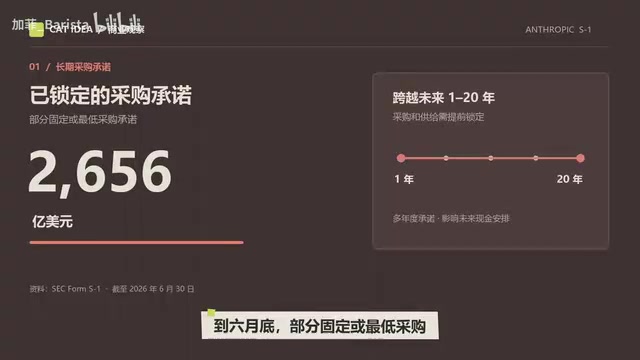
Another is compute and infrastructure leases not yet commenced, with undiscounted future rent of about $321.4 billion, some commencement contingent on delivery and other contractual conditions. The two measures should be read separately, but together they point to the same judgment: high-margin software, heavy long-term infrastructure contracts. This is exactly how Reddit financial analysts summarized it.
Current capital expenditure is about $482 million, with more spending to come—supply locked in ahead of time, customers paying by usage, and if demand slows or prices are cut, cash arrangements come under pressure. Cash and short-term investments total about $131.7 billion, a buffer but not unlimited ammunition.
Gross margin and purchase commitments: Gross margin is the ratio of revenue minus cost of revenue, reflecting how efficiently the software business itself makes money. High margins for AI companies are often built on not owning all the compute—training and inference rely heavily on cloud providers, so the real cost pressure shows up in off-balance-sheet long-term commitments. "Fixed or minimum purchase commitments" refer to minimum amounts the company has contracted to pay regardless of actual usage; "undiscounted future rent" is the sum of rent payable over the lease term, not discounted over time, making the figure appear larger. Both are future cash obligations and must be read against current capex and cash reserves to judge whether a company is locking in supply ahead of growth or pushing risk into the future.
3. Cloud Giants Are Both Shareholders and Competitors
Amazon, Google, and Microsoft play multiple roles with Anthropic: investors, suppliers, channels, and competitors. About 48% of half-year revenue came through cloud platform marketplace sales.
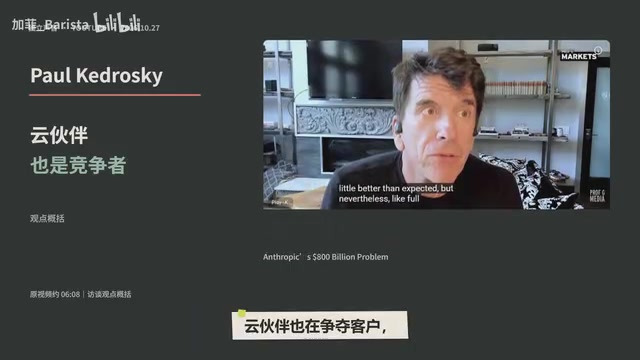
Guests on Semi Analysis's program were bullish on its cash reserves and compute efficiency. But Paul Kedrosky in a Prof G Markets interview cautioned that cloud partners are themselves competing for customers, and more direct chip and data center leasing will raise capital needs. OpenAI, Google, and open-weight models all compete at the same table.
Tech creator Patrick Boyle discussed another side on YouTube: technological leadership ultimately comes down to purchase price and future returns. The growth story and the transaction price are two connected exams.
Model distillation and cloud platform distribution: Model distillation refers to using a large model's outputs as training data to train a smaller or cheaper model, thereby replicating some capabilities at low cost. It is both a common engineering technique and, for leading vendors, a channel of intellectual property and competitive advantage loss, making it a common justification for restrictive clauses. On the other hand, "sold through cloud platforms" means customers purchase model services directly in Amazon, Google, or Microsoft cloud marketplaces—cloud providers are both compute suppliers and distribution channels, while also selling their own or resold competing models. This multiplicity of roles makes cooperation and competition coexist in the same contract.
4. The Real Cost for Chinese Developers
For domestic developers, beyond model capability there's another ledger to balance: how long will the service last?
In a September 2025 announcement, Anthropic directly called China an adversary nation, extending restrictions to overseas entities controlled by China, citing national security, intelligence, and model distillation risks, and explicitly discussing the competitiveness of U.S. and allied companies. Geopolitical stance has entered commercial access.
For developers, the loss is first downtime and migration. In October, V2EX user Taylor77 described their organization being banned, chat functionality disabled, and appeals fruitless; another poster said they recovered a $100 subscription fee via credit card dispute after a ban. How subscription fees are handled, how much effort sudden downtime and appeals consume, how many work hours to rewrite prompts and migrate workflows—these are all part of procurement cost and product quality.
Domestic platforms thereby gain an opportunity to absorb demand. Zhipu's official assistant supports connecting GLM to tools like Claude Code and Open Code, preserving operating habits while switching the underlying model. Access restrictions will push some teams to migrate, but retaining customers truly depends on capability, price, and delivery stability.
Globally, about 11.4 million accounts were banned in the half-year, with about 398,000 appeals in the same period and 42,000 decisions overturned. At this scale, appeal efficiency becomes a real user experience issue. The filing also estimates that 5% to 7% of global revenue in the first nine months came from customers later judged to have violated usage policies or commercial terms, and the company expects this proportion to change as detection is strengthened. China's Ministry of Commerce has opposed U.S. threats of investigation and sanctions on distillation grounds.

5. Governance Structure and Three Post-IPO Tests
Under the filing's design, the Long-Term Benefit Trust elects a majority of the board through Class T shares, and the founders' entity holds 50.1% voting power on general shareholder matters through Class F shares. This arrangement builds institutional safeguards for the mission but also makes it harder for ordinary shareholders to change direction.
After listing, Anthropic must answer three questions: can growth catch up with multi-year compute commitments; how to retain leadership when partnering with cloud giants; and what price its defined safety boundaries will impose on global developers. The grander the safety commitments, the more seriously the fees, time, and trust paid by ordinary customers deserve to be treated.
Dual-class shares and Long-Term Benefit Trust: A dual-class structure gives different share classes different voting rights, allowing founders' high-vote shares to control the company with a smaller economic stake. The Long-Term Benefit Trust is a special-purpose entity whose trustees act according to a defined mission rather than financial returns, locking in company direction by electing a board majority. The intent is to resist short-term capital market pressure and protect the safety mission, at the cost of ordinary shareholders' inability to change strategy through voting. For investors, it means a governance discount; for customers and regulators, it means company behavior depends more on internal mission definition than external shareholder will.
One-line Summary
Anthropic's IPO filing reveals surging revenue alongside massive book losses, with developers bearing the cost of bans and migration.
Paragraph Summary
Anthropic filed for an IPO with half-year revenue of about $16.3 billion, up 14x year-over-year, and a net loss of about $80.7 billion—but about $72.4 billion comes from fair value changes on convertible notes and SAFEs, while operating loss was only about $693 million, with Q2 already showing about $1 billion in operating income. Behind the 85% gross margin are $9.74 billion in R&D spending, $265.6 billion in purchase commitments, and $321.4 billion in uncommenced compute leases—high-margin software alongside heavy long-term infrastructure contracts. Amazon, Google, and Microsoft are simultaneously shareholders, suppliers, and competitors, with about 48% of revenue sold through cloud platforms. Restrictions on Chinese customers have entered commercial access, with developers bearing downtime, appeal, and migration costs, while domestic platforms absorb demand. In governance, Class T and F shares give the founders' entity 50.1% voting power.
Related articles

On-Device LLM + ESP32: Build a DIY Calorie Reminder
A Bilibili creator open-sourced a calorie intake reminder: a phone app uses the open-source miniCPM model to locally recognize food photos and estimate calories, while an ESP32 mini screen syncs data and shows intake status with green/yellow/red rings — magnetically attachable to the fridge door for constant reminders.

Running 125B MoE on a 12GB GPU? Inside Strata's Three-Tier Cooperative Engine
Open-source C++ engine Strata runs 125B MoE models locally on 12-16GB consumer GPUs at 40-95 tokens/s. Here's how its VRAM/memory/SSD three-tier pipeline works.

Running Audio and Vision Locally with a 2B Model: LFM3 Hands-On Revealed
A blogger tests Liquid AI's LFM3 Audio 2B and Omni 2B on a MacBook Air: 2B parameters run speech and vision offline, tool calling exceeds expectations, but noise transcription and hallucination issues are evident.