Anthropic IPO Prospectus Revealed: Behind 12x Revenue Growth, the Twin Tests of Compute Costs and Customer Concentration

Anthropic's IPO prospectus reveals a $2T valuation target amid a $42B net loss, extreme customer concentration, and founder control risks.
Anthropic has filed its IPO prospectus targeting a $2 trillion valuation. The prospectus shows 2025 revenue of about $4.6 billion (up nearly 12x YoY) and a $42 billion net loss, including $34 billion in non-cash accounting expenses and an $8.06 billion operating loss. Compute spending hit $7.33 billion (1.6x revenue), with future cloud commitments of $518.1 billion. The valuation is based on July 2025 annualized revenue of $65 billion, discounting the future. Customer concentration is extreme — two customers each account for ~12% of revenue with no long-term contracts. Founders control 50.1% voting rights via Class F shares. Of the 261-page prospectus, 80 pages cover risk factors, with the company warning its products could cause human extinction.
According to Reuters, AI company Anthropic has filed its IPO prospectus, targeting a valuation of up to $2 trillion. The most striking aspect of this prospectus isn't the listing itself, but a set of contradictory financial figures: revenue grew nearly 12x year-over-year, yet net loss reached $42 billion. What's the truth behind these numbers? This article breaks down the core data in the prospectus, analyzing its business model, potential risks, and governance structure.
Revenue and Losses: The Truth Behind the $42 Billion Net Loss
The prospectus shows that Anthropic generated approximately $4.6 billion in revenue in 2025, a nearly 12x year-over-year increase. But net loss reached a staggering $42 billion. This figure can easily lead people to believe the company's business itself is burning cash uncontrollably, but that's not the actual situation.
About $34 billion of that comes from non-cash accounting expenses related to changes in the valuation of financing instruments. The loss actually reflecting business operations is approximately $8.06 billion. Even so, the operating loss scale remains significant. Compute and infrastructure spending is the largest cost item — reaching $7.33 billion in 2025, accounting for over 58% of total operating expenses of $12.65 billion, and 1.6x that year's revenue. Simply put, for every 1 yuan the company earns, it spends 1.6 yuan on compute alone.
This "higher revenue, bigger investment" model is essentially using massive investment to buy high revenue growth. The prospectus also discloses that Anthropic's contractual commitments for cloud and compute over the next few years total up to $518.1 billion, with giants like Amazon, Google Cloud, and Microsoft all involved. The company says it will slow down while locking in future compute in advance, and its model release pace hasn't decelerated either.
Non-cash accounting expenses are key to understanding the $42 billion net loss. When a company issues financing instruments such as convertible preferred stock, warrants, or convertible bonds, the fair value of these instruments increases as the company's valuation rises. Accounting rules require the appreciation to be recognized as an expense, but the company doesn't actually pay cash. Anthropic's valuation surged dramatically in 2025, causing the book value of early financing instruments to balloon by approximately $34 billion, directly inflating the net loss. Such expenses typically disappear after a company goes public as financing instruments convert, so when analyzing tech companies, the market focuses more on operating losses and free cash flow.
The $2 Trillion Valuation: A Gamble on Discounting the Future
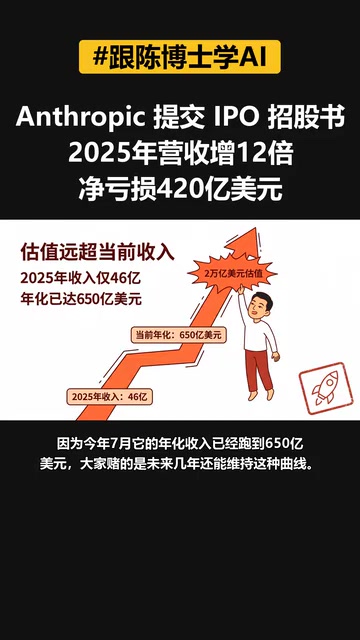
Even more surreal is the valuation. With 2025 revenue of just $4.6 billion, the IPO target valuation has shot up to $2 trillion, more than double this May's figure. Why does the market dare to price it this way? Because by July 2025, its annualized revenue had already reached $65 billion. Investors are betting that Anthropic can maintain this growth curve in the coming years.
The $2 trillion valuation isn't based on current revenue — it's discounting the future in advance. This valuation logic isn't uncommon among tech companies, but the risk is: once growth slows, the valuation will face a sharp correction. The prospectus itself acknowledges this in its risk factors.
Annualized Revenue is estimated full-year revenue obtained by multiplying a month's or quarter's revenue by 12, often used by high-growth companies to showcase recent growth rates. Anthropic's July 2025 annualized revenue reached $65 billion, meaning that month's revenue was approximately $5.4 billion, far exceeding the actual 2025 full-year revenue of $4.6 billion (as revenue was mainly concentrated in the second half). Annualized revenue can amplify growth signals, but it can also be distorted by seasonal fluctuations or one-time large orders. Investors need to distinguish between annualized revenue and realized revenue, avoiding mistaking short-term surges for long-term trends.
Customer Concentration: The Risk Most Worth Watching After IPO
The risks are equally specific and clear. The prospectus discloses that two customers each account for approximately 12% of revenue, together nearly a quarter. More critically, many large customers aren't locked in by long-term contracts. Previous market rumors suggested Meta might be one of them, with related revenue exceeding $5 billion, which has already been excluded from some calculations.
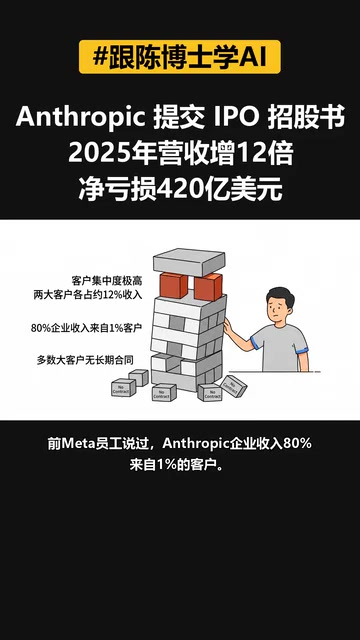
A former Meta employee once revealed that 1% of Anthropic's enterprise revenue comes from 1% of its customers. This extreme customer concentration means that if a major customer pulls the plug, cloud revenue could plummet instantly. As of the prospectus disclosure, the company had $20.28 billion in cash on its books, so short-term solvency isn't a major issue, but customer concentration is what investors most need to watch after the IPO.
Customer concentration risk refers to a company's revenue being overly dependent on a few large customers. If major customers are lost or reduce purchases, revenue will fluctuate dramatically. In the AI cloud services sector, large customers are typically tech giants or large enterprises with strong bargaining power, and they may simultaneously support multiple suppliers. Prospectuses require disclosure of customers accounting for over 10% of revenue. Anthropic's two major customers each account for about 12%, together nearly a quarter, with no long-term contract lock-in, meaning renewal and pricing power aren't in its own hands. Compared to mature SaaS companies, healthy customer concentration is typically below 5%, making Anthropic's dependence notably high.
Governance Structure: The Founding Team's Absolute Control
Anthropic also has special arrangements in its governance structure. The company established a Founder LLC, through which seven co-founders hold 50.1% voting rights on key matters via special Class F shares. This means that although external shareholders put in money, key decisions are still made by the founding team.
This structure isn't uncommon among tech companies, but for a public company, the influence of external investors is significantly weakened.
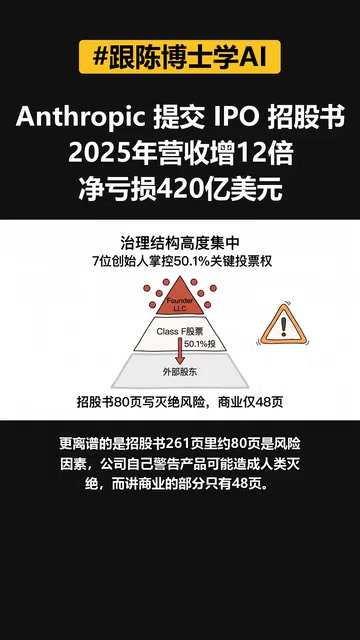
Dual-Class Share Structure allows founding teams to control company decisions even with relatively low shareholding by issuing shares with different voting rights. Anthropic's Class F shares give seven co-founders 50.1% voting rights, so even with future equity dilution, they can still dominate the board and major matters. This structure is common among tech giants (such as Google and Meta), capable of withstanding short-term market pressure, but it weakens external shareholders' voice and also raises corporate governance controversies. Investors need to assess whether the founding team's decisions align with shareholder interests in the long term.
The 261-Page Prospectus: 80 Pages Discussing Risk
The prospectus is 261 pages in total, of which about 80 pages are risk factors. The company itself warns that its products could cause human extinction. The section describing the business is only 48 pages. A company scaring itself this much should be a first among public companies.
Anthropic has also explicitly abandoned image and video generation, aiming to invest limited compute into frontier research and safety. This is close to DeepSeekAd's philosophy, reflecting the company's trade-offs on its technology roadmap.
Triple Bet: A Sexy Story with Fragile Assumptions
Overall, Anthropic's listing looks like a triple bet of high multiples, high investment, and high concentration. The story is sexy, but the assumptions are also fragile. If major customers loosen or revenue growth slows, the $2 trillion valuation will be less defensible than imagined.
For readers interested in the AI industry and capital markets, this prospectus provides an excellent sample — it demonstrates the real financial constraints, customer dependencies, and governance challenges frontier AI companies face in pursuing growth.
One-line Summary
Anthropic filed its IPO prospectus targeting a $2 trillion valuation, but the $42 billion net loss, customer concentration, and governance risks reveal the fragility of a high-multiple gamble.
Paragraph Summary
Anthropic filed its IPO prospectus targeting a $2 trillion valuation, drawing market attention. The prospectus shows 2025 revenue of approximately $4.6 billion, up nearly 12x year-over-year, with a net loss of $42 billion, of which about $34 billion is non-cash accounting expenses, and the actual operating loss is $8.06 billion. Compute spending reached $7.33 billion, 1.6x revenue, with future cloud contract commitments totaling $518.1 billion. The valuation is based on the growth expectation of $65 billion annualized revenue in July 2025, representing an advance discount of the future. Customer concentration is extremely high, with two major customers each accounting for about 12% of revenue and no long-term contracts. In terms of governance, the founders hold 50.1% voting rights through Class F shares. Of the 261-page prospectus, 80 pages are risk factors, and the company itself warns that its products could cause human extinction. Overall, this is a high-investment, high-concentration gamble with fragile assumptions.
Related articles

The Disinformation War in the Russia-Ukraine Conflict: Bot Farms Still Operating After Drone Strike on Yandex
After Ukrainian drone strikes on Russian data centers, Zelensky claimed social platforms improved, but Russian bot farms are still operating. This article analyzes the decentralized architecture and resilience of disinformation networks.

Nothing Headphone A Hits Half Price for the First Time: Headphone + Album Bundle Promo
Nothing Headphone A is on sale at half price for the first time via an Amazon bundle deal: add the headphone and Charli XCX's album CD to get 33% off the full order. Black and white both included. Here's how the bundle works and whether it's worth it.

Flox Intelligence Uses AI Acoustic Deterrence to Protect Transportation Infrastructure
Flox Intelligence uses edge AI devices to identify wildlife species and play species-specific sounds to deter them from railways, airports, and highways, addressing the habituation problem of traditional deterrence methods.