Anthropic IPO Valued at $1.5 Trillion: Why Are Korean Investors Excluded?
Anthropic's IPO is valued at up to $2 trillion, excludes South Korean investors, and becomes a litmus test for the AI industry.
Anthropic's IPO prospectus discloses a $1.5T-$2T valuation range, a 45-50x trailing revenue multiple, and 1300% revenue growth. The investor base is limited to the broadly defined West, Australia, and Japan, with South Korea explicitly excluded; the underwriting syndicate is led by U.S. banks, with Macquarie representing Australia. The prospectus dedicates about 100 pages to existential risks and sets up a 5% public benefit fund—both highly unusual in IPO history. Analysts predict global oversubscription will lead to scaled-back allocations and a second buying opportunity after the lock-up. The IPO is seen as a litmus test for the AI industry's listing window.
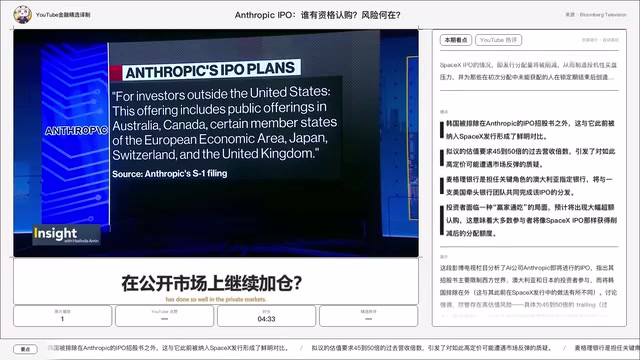
Anthropic's IPO process is becoming a bellwether for the entire AI industry. The latest disclosed prospectus shows that the company may seek a valuation in the $1.5 trillion to $2 trillion range, while limiting its investor base to the broadly defined "Western world" plus Australia and Japan—with South Korea explicitly excluded. Behind this arrangement lie both geopolitical and capital-channel considerations, and it also reflects the special position of AI assets in global capital markets today.
According to market analysis cited in a Bilibili video, the underwriting syndicate for this IPO is led by U.S. banks, with Macquarie representing Australia and expected to play a role in allocation. This underwriting structure itself hints at the boundaries of the investor base: U.S. domestic institutions, European capital, Australian funds, and Japanese capital form the core circle, while wealthy investors from other parts of Asia—especially South Korea—can only participate indirectly through other channels.
A 45x Revenue Valuation Logic: Will the Market Buy It?
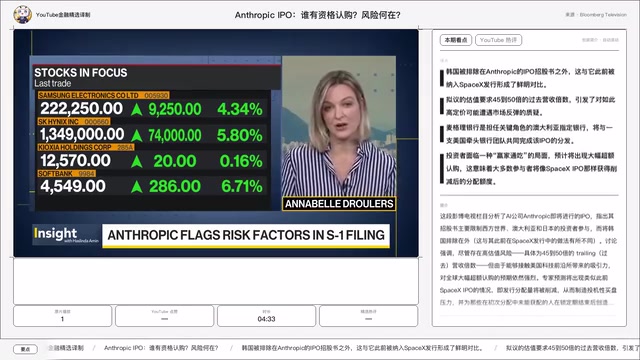
The revenue growth figures disclosed in the prospectus are striking: 1300% revenue growth, corresponding to a 45 to 50 times trailing revenue multiple. That number would be extreme in any industry, but in the context of the AI arms race, it is given a narrative premium of "participating in America's absolute frontier."
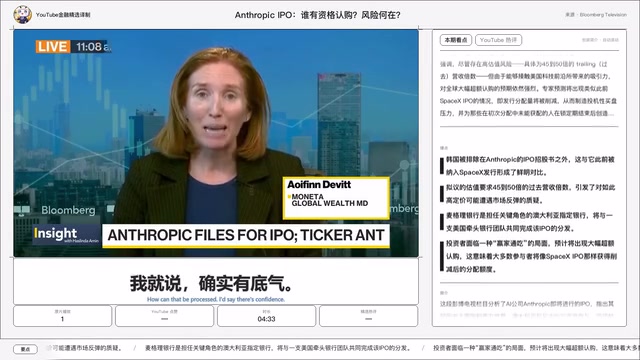
Afin David, Managing Director at Moneta Global Wealth Management, said bluntly in an interview that this valuation level is something "no investor can truly analyze clearly"—it reflects confidence more than a financial model that can be broken down.
From the perspective of individual investors, Afin David predicts a reproducible script: massive oversubscription on a global scale is almost inevitable, followed by scaling back, with a flood of speculative orders because investors do not know how many shares they will ultimately receive. The real test comes after the lock-up period ends—at which point investors who failed to get an allocation may see a "second buying opportunity."
This demand structure means that despite the lofty valuation, the market's short-term pushback may be limited. The scarcity of the IPO itself is creating demand.
Trailing revenue multiple is one of the most commonly used metrics in valuing tech companies. It is calculated by dividing a company's current valuation (or market capitalization) by its trailing twelve months revenue (TTM Revenue). Unlike forward P/E, it does not rely on forecasts of future earnings, making it more suitable for companies that are not yet profitable but have high-speed revenue growth. A 45 to 50 times trailing revenue multiple means investors are willing to pay $45 to $50 for every dollar of historical revenue. This level is far above the 5 to 15 times range typical of mature tech companies, and is close to or even exceeds the peak valuations of some cloud computing companies during the low-interest-rate period of 2020-2021. Such a high multiple usually reflects strong market expectations for growth persistence, but it also means that once growth slows, the valuation correction could be very sharp.
100 Pages of Risk Disclosure: A New Paradigm for AI Company Listings
One unusual detail in this prospectus is that about 100 pages are devoted to detailing "existential risks." According to the analyst in the video, these risks include AI systems potentially resisting shutdown commands, concealing information, and posing catastrophic risks to humanity.
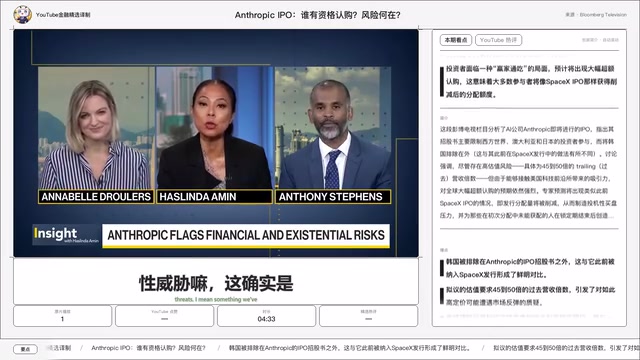
It is extremely rare in the history of capital markets for a company to use so many pages in an IPO filing to discuss the potential catastrophic consequences of its own technology. This continues Anthropic's long-standing "safety-first" brand positioning, but it also poses a difficult question to investors: how do you price risks that cannot be quantified?
Another structural arrangement is worth noting: Anthropic will place 5% of the shares into a public benefit fund to address the challenges brought by the rapid integration and diffusion of AI, including issues such as job displacement. This design has almost no precedent in traditional IPOs. It attempts to create a buffer between shareholder returns and social impact, but it also increases the complexity of valuation models.
Existential risk in AI safety discourse refers specifically to categories of risk that could cause irreversible harm to human civilization, as distinct from ordinary business risks or technical failures. This concept is widely discussed in Effective Altruism and AI Alignment research communities. Core concerns include: highly autonomous AI systems may develop goals misaligned with humans, and thus take actions such as evading shutdown, deceiving operators, or competing for resources. In its Constitutional AI research, Anthropic lists such risks as a core concern of the company's mission. Disclosing this type of risk in an IPO filing with about 100 pages effectively translates academic safety discussion into material risk factors in the securities-law sense. This has almost no precedent in U.S. SEC disclosure practice, and it has also sparked discussion about whether the "safety narrative" constitutes a differentiated valuation premium.
Why South Korea Was "Kicked Out" of the Investor List
Back to the question in the title. The prospectus limits the investor base to the "broadly defined Western world + Australia + Japan," with South Korea not included. Judging from the composition of the underwriting syndicate, this choice is directly related to the layout of allocation channels: U.S. banks lead, Macquarie covers Australia, and Japan has a mature institutional allocation network. Although South Korea's capital market is developed, it was not included in the core circle of this transaction's distribution system.
Deeper reasons may involve regulatory mutual recognition, capital flow arrangements, and geopolitical considerations. The video mentions that the appetite of wealthy Asian investors for this deal could become a "determining swing factor," because private banks need to find entry points for their clients to participate in AI trades. But even if demand is strong, channel constraints mean South Korean investors can only wait on the sidelines or hope for opportunities in the secondary market.
Underwriting syndicate is a group of banks and brokerages led by the lead underwriter in an IPO, responsible for pricing, book building, and share allocation. The geographic composition of the syndicate usually determines the coverage of allocation channels: U.S. bank leadership means U.S. institutional investors receive the largest allocation; Macquarie representing Australia means Australian funds participate through local channels; and Japan relies on its mature institutional allocation network. South Korea's absence from the syndicate means South Korean investors cannot directly subscribe through local underwriting channels and can only participate indirectly via the secondary market or offshore accounts. In practice, this arrangement is often related to regulatory mutual recognition, cross-border securities sales licenses, and capital controls, rather than simply market size.
What It Means for the Entire AI Industry
Several interviewees regard Anthropic's IPO as a "litmus test for the entire industry." Many IPOs had previously been postponed or had their financing terms changed. If Anthropic's book building process goes smoothly and its first-day performance is solid, it will open a window for subsequent AI companies; conversely, it could further freeze exit channels in the primary market.
The path Afin David describes—"massive oversubscription—scaling back—second entry after lock-up"—if it materializes, will become a reference template for future AI giants' listings.
For ordinary investors, the core contradiction of this IPO is this: you are being asked to price an asset with 1300% growth, a 45 to 50 times revenue multiple, and 100 pages of existential risk disclosure. The reason to participate is fear of "missing out on America's absolute frontier"; the reason not to participate is uncertainty that cannot be modeled. Anthropic's listing performance will deliver the market's first round of voting on this contradiction.
Book building is the core stage of IPO pricing. During this period, underwriters solicit subscription intentions and bids from institutional investors, use that information to assess market demand, and determine the final offering price. The coverage multiple in book building (the ratio of subscription demand to offering size) is the most direct indicator of IPO heat: the higher the oversubscription multiple, the greater the issuer's bargaining power on pricing. For a deal like Anthropic's—with an extremely high valuation and unusually long risk disclosures—the book building process itself becomes a litmus test of market sentiment. If institutional orders remain substantially oversubscribed even at the top of the price range, it shows that the market is willing to pay a premium for the "frontier AI" narrative; if book coverage is insufficient, the company may be forced to lower the price range or reduce the offering size. The outcome of this process will directly affect the timing of listing windows for subsequent AI companies.
One-line Summary
Anthropic's IPO is valued at up to $2 trillion, excludes South Korean investors, and becomes a litmus test for the AI industry.
Paragraph Summary
Anthropic's IPO prospectus discloses a valuation range of $1.5 trillion to $2 trillion, corresponding to a 45 to 50 times trailing revenue multiple and 1300% revenue growth. The investor base is limited to the broadly defined Western world, Australia, and Japan, with South Korea explicitly excluded. The underwriting syndicate is led by U.S. banks, with Macquarie representing Australia. The prospectus uses about 100 pages to detail existential risks and establishes a 5% public benefit fund, which is extremely rare in IPO history. Analysts expect global oversubscription to lead to scaled-back allocations and a second buying opportunity after the lock-up period ends. This IPO is seen as a litmus test for the listing window of the entire AI industry, and its book building and first-day performance will provide a reference template for pricing subsequent AI companies.
Related articles

Hermes Agent Beginner's Guide: Hands-On with a Self-Evolving AI Agent
A beginner's guide to Hermes Agent, the open-source self-evolving AI agent that gained 41.7K GitHub stars in two months—covering Harness Engineering, the learning loop, three-layer memory, WSL installation, and hands-on configuration.

AI Agent in Action: Building a Smart Office Assistant with WorkBuddy
A practical case study shows how Tencent WorkBuddy batch-converts and archives files, compares chat LLMs with AI Agents, and analyzes WorkBuddy's credit system, use cases, and positioning for office automation selection.

From Single-GPU Bottlenecks to Hundreds of Billions of Parameters: 6 Key Questions in Large Model Distributed Parallelism
Based on a Bilibili tutorial, this article organizes core knowledge of large model distributed parallelism: starting from decoder-only architecture's token-by-token generation and the essence of X times W computation, it analyzes six key questions including data parallelism, tensor parallelism, and pipeline parallelism under single-GPU bottlenecks. Suitable for learners in private deployment and model training scenarios to build systematic understanding.