Anthropic Launches AI User Research: Your Expectations Will Shape Industry Decisions

Anthropic launches user research soliciting expectations of AI and allowing public responses.
Anthropic announced a new study with Anthropic Interviewer to understand users' real experiences with AI, the role they hope AI will play, and their demands of AI companies. Open to Claude and Claude Code Free, Pro, and Max users from September 29 to October 6, the study differs from last December's 81,000-person qualitative research through a transparency mechanism: participants can make responses public, so criticism of the company may become a public record. Results will shape The Anthropic Institute's research and company decisions. The announcement leaves the form of disclosure, anonymization, and release timing unspecified, and the sample covers only existing users.
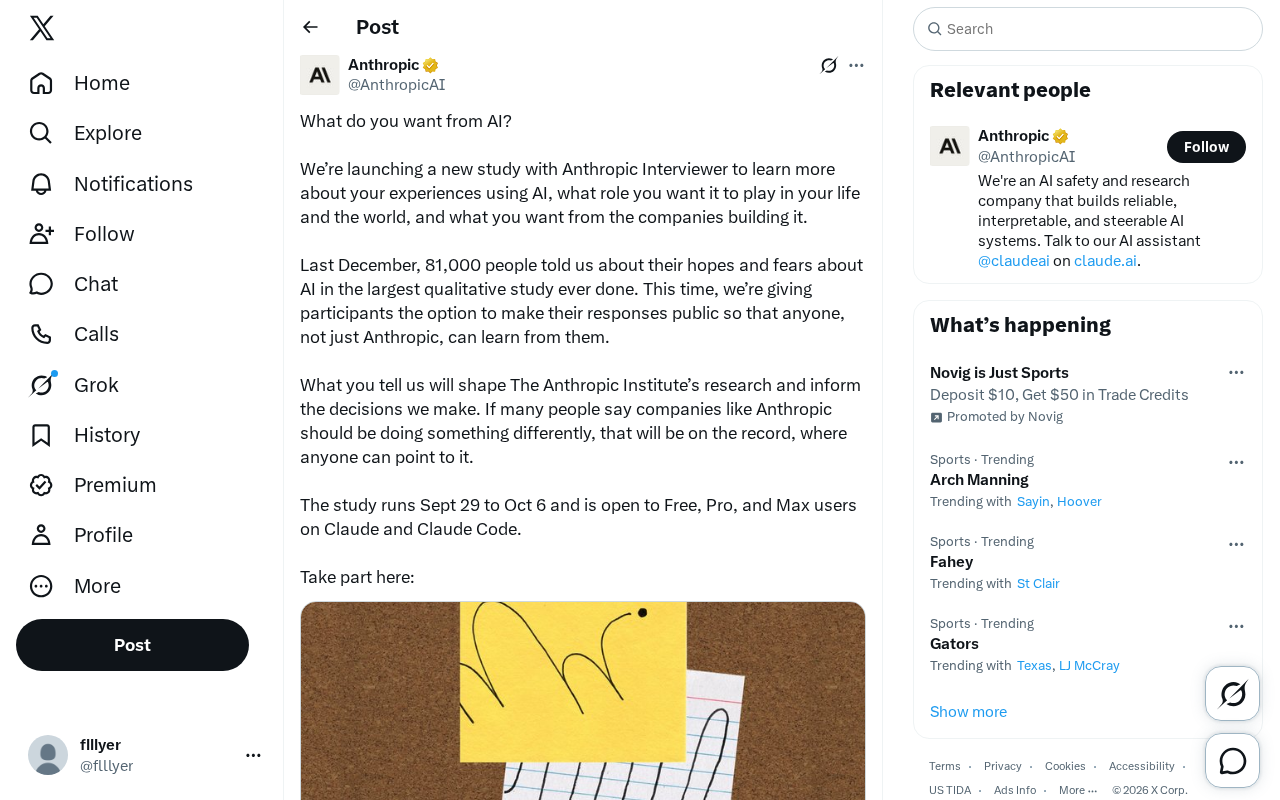
Anthropic is doing something rare: putting users' expectations of AI directly on the table and allowing those voices to be publicly documented. The company announced a new research initiative in collaboration with Anthropic Interviewer, centered on one core question—what do you actually want from AI?
What the research aims to answer
According to Anthropic's announcement on Twitter, the study seeks to understand three things: users' real experiences with AI, what role they hope AI will play in their personal lives and in the world, and what demands they have of the companies building AI.
This is not a generic user satisfaction survey. Anthropic explicitly states that participants can choose to make their responses public, allowing anyone—not just Anthropic—to learn from them. This design itself carries a degree of public oversight.
The Anthropic Institute is a research and public policy organization established by Anthropic, positioned similarly to an in-house "think tank": on one hand, it produces public research on AI's economic impact, safety governance, and social perception; on the other, it provides a basis for the company's decision-makers. Its distinction from the product team is that its outputs tend to be aimed at the public and policymakers rather than directly translated into feature updates. It is not uncommon in the tech industry for companies to establish such institutions (OpenAI and DeepMind have similar arrangements), but treating user feedback research as institutional research material means user expressions may enter a longer-term public agenda rather than merely serving as input to the product roadmap.
The precedent of 81,000 people and what's different this time
Last December, Anthropic conducted a large-scale qualitative study in which 81,000 people shared their hopes and fears about AI—the company called it "the largest qualitative study ever conducted."
The key change this time is the transparency mechanism. The announcement states: "If you tell us that a company like Anthropic should change, that will be on the record, and anyone can cite it." In other words, users' criticism will not be absorbed into internal reports and digested away; it may become a publicly verifiable record.
Anthropic also said the research results will shape The Anthropic Institute's research direction and influence the company's decisions.
Qualitative research is the counterpart to quantitative research: the latter relies on large-scale questionnaires and statistical sampling to quantify proportions and trends (e.g., "70% of users are worried about job loss"), while the former collects unstructured narratives through open-ended questions and in-depth interviews, with the goal of understanding "why people think this way and how they describe their experiences." Qualitative studies typically have smaller sample sizes but higher information density, and are often used to discover new dimensions of a problem. Anthropic's "largest qualitative study" claiming 81,000 participants last December was actually closer to large-scale open-ended text collection: the scale approached that of quantitative research, but the analysis method was qualitative. The limitation of such research is obvious self-selection bias—people willing to spend time writing long responses tend to already have strong views on AI issues, and the conclusions may not represent the silent majority.
Who can participate and when
The study is open from September 29 to October 6, for Free, Pro, and Max users of Claude and Claude Code. Participants sign up via the link in the announcement.
The window is only about a week long and covers users who are already using Claude products. This means the sample is inherently selective—it reflects the voices of existing users rather than the general public's overall attitude toward AI.
Why this matters
It is nothing new for AI companies to collect user feedback, but designing the feedback mechanism as "optionally public" is uncommon in the industry. Behind this lies a real problem: when companies say "we are listening to users," outsiders often cannot verify what was heard and what was ignored. The public option responds to this distrust to some extent.
Another notable signal is the involvement of The Anthropic Institute. The research is not just input for product iteration but is also positioned as a source of material for institutional research. If a large number of users express disagreement with how AI companies behave, those opinions will enter the public discussion space rather than remain internal to the company.
For ordinary users, this is a low-cost opportunity to speak up. For those observing the AI industry, the publicly released response data after the study may reveal more about the real tensions between users and AI companies than any corporate social responsibility report.
In user research, "optionally public" involves a whole set of data governance issues, the core of which are informed consent and anonymization. If original responses are made public, they may contain identifiable information such as personal experiences, career details, and evaluations of employers; simply replacing names is not enough to prevent identity inference from context. More rigorous approaches include: manual review of sensitive content before publication, paraphrasing quotes to blur them, publishing only aggregated conclusions rather than original text, or allowing participants to choose the scope of disclosure item by item. The article's mention that "the specific form of public responses and anonymization methods are unspecified" is precisely the key to assessing the credibility of such research—the vaguer the scope of disclosure, the harder it is for participants to estimate the risks they bear.
A sober reminder
The announcement does not specify the form public responses will take, how anonymization will be handled, or when the results will be released. Before choosing to go public, participants would do well to look closely at these details. After all, the scope and manner of "public" determine how much reference value this record actually has.
One-line Summary
Anthropic launches user research soliciting expectations of AI and allowing responses to be made public.
Paragraph Summary
Anthropic announced a new research initiative in collaboration with Anthropic Interviewer to understand users' real experiences with AI, the role they hope AI will play in their personal lives and the world, and their demands of AI companies. The study is open to Free, Pro, and Max users of Claude and Claude Code from September 29 to October 6. Compared with last December's large-scale qualitative study involving 81,000 participants, the key change this time is the transparency mechanism: participants can choose to make their responses public, allowing anyone—not just Anthropic—to learn from them, and users' criticism of the company may become a publicly verifiable record. The results will shape The Anthropic Institute's research direction and influence company decisions. The article also notes that the announcement does not specify the form of disclosure, anonymization methods, or when results will be released, and that the sample covers only existing users.
Related articles

AgentCore in Practice: Connecting Custom Tools and MCP Servers to Agents
DebuggerCafe tutorial shows how to connect custom tools and MCP servers to Amazon Bedrock AgentCore agents, covering tool contract design, MCP reuse, and production concerns.

816B Parameters Scores Only 39? The Real Cost-Effectiveness of the Open-Source LLM Parameter Race
Meta's 816B Muse Spark Open scores just 39 on Artificial Analysis, while 180B Qwen3.8-Flash-Next scores 40. This article analyzes 11 open-weight models' parameters vs. scores, exploring the real impact of activated parameters, quantized size, and deployment cost.

Aerial Manipulators: The Next Step for Drones from 'Seeing' to 'Changing'
Starting from a Reddit discussion, this article analyzes the technical challenges, potential applications, and deployment bottlenecks of aerial manipulators, exploring the key challenges for drones moving from environmental perception to physical manipulation.