Anthropic Launches Claude Duet: A Key Step in Its Agent Strategy

Anthropic launches Claude Duet, a standalone agent app available to Pro and Max users via waitlist, betting on the agent space.
Anthropic has launched a standalone application called Claude Duet, positioned as an agent product and currently available to Pro and Max subscribers through a waitlist. The article analyzes this as a major strategic bet by Anthropic in the agent space, aimed at integrating capabilities previously scattered across API and chat scenarios into a standalone end-user product. The waitlist mechanism reflects both the product's early stage and capacity control considerations. Prioritizing Pro and Max users reveals the commercial logic: agent tasks consume more tokens and compute resources, and tying them to high-value subscriptions helps validate willingness to pay. In an increasingly competitive agent space, Anthropic needs to differentiate by balancing autonomy with controllability. Feature details, pricing, and launch timing remain unclear.
Anthropic is turning its ambitions around AI agents into a standalone product. According to an RSS source, Anthropic has launched a new app called Claude Duet, currently available to Pro and Max subscribers through a waitlist. This is widely interpreted as a major bet by Anthropic in the agent space.
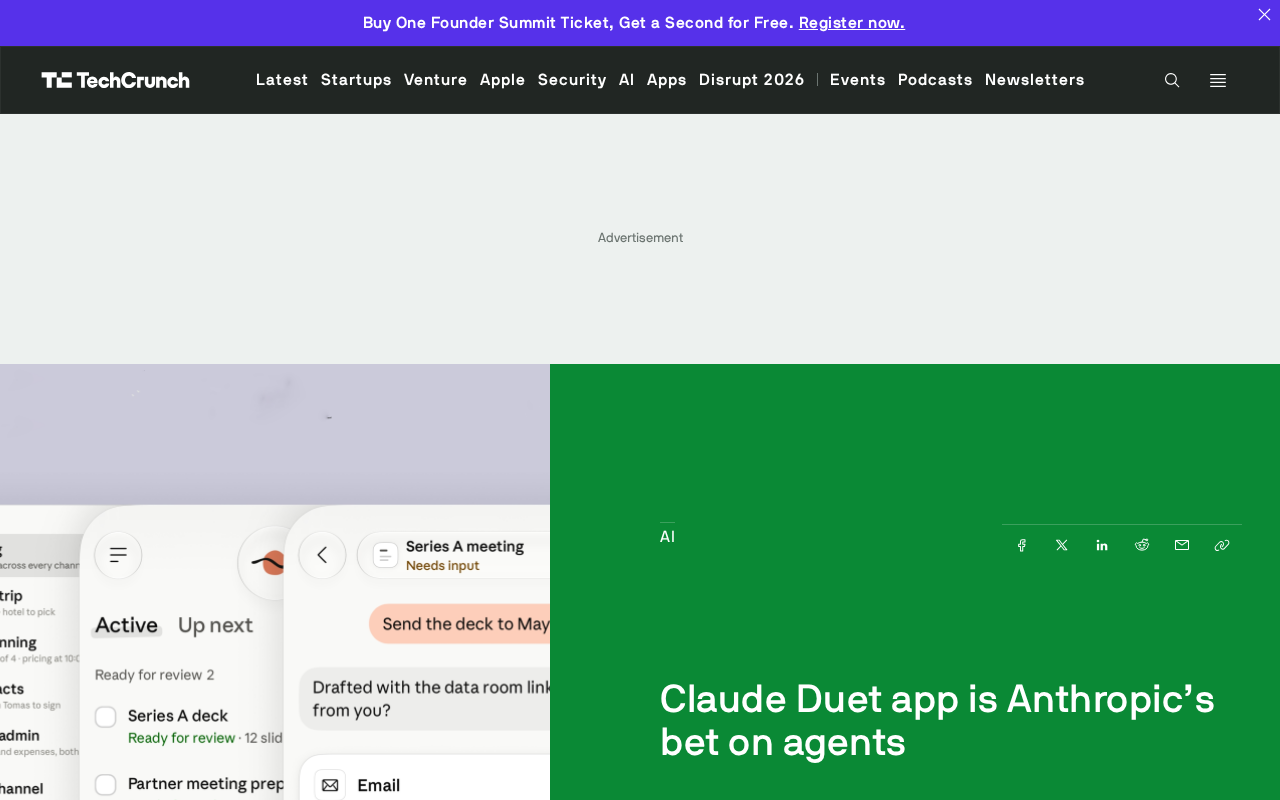
What Is Claude Duet?
Based on the available information, Claude Duet is a standalone application rather than a simple feature update to Claude's existing chat interface. Its core positioning revolves around "agents"—which suggests it may be capable of autonomous task execution, multi-step planning, and tool calling, rather than just conversational Q&A.
Public details are currently limited: the app is in a waitlist phase and is only available to paying Pro and Max users. This phased rollout strategy is not uncommon in AI product launches—it helps control early experience quality while also collecting real user feedback.
Agent is the key concept for understanding this article. Unlike traditional conversational AI, an agent is designed to perceive its environment, formulate multi-step plans, call external tools (such as browsers, code executors, or APIs), and autonomously complete goal-oriented tasks. Its core characteristics include autonomous decision-making, task decomposition, tool use, and closed-loop feedback. Anthropic has previously demonstrated early agent capabilities in Claude through features like tool use and computer use, but these capabilities existed in API or chat-embedded forms rather than as a standalone product. The launch of Claude Duet marks Anthropic's attempt to consolidate these fragmented agent capabilities into a standalone application centered on task execution, thereby differentiating it from a simple conversational assistant.
Why Is This Called Anthropic's "Bet on Agents"?
The phrase "bet on agents" comes from the original headline and points to Anthropic's strategic judgment: agents are the competitive focus for the next product paradigm.
Looking at the industry backdrop, agents are moving from concept to productization. Anthropic has already demonstrated capabilities such as tool use and computer operation in Claude, but these capabilities are scattered across API and chat scenarios. The emergence of Claude Duet signals Anthropic's attempt to integrate these capabilities into a standalone, end-user-facing agent product.
Prioritizing access for Pro and Max users also reveals the commercial logic: agent tasks typically consume more tokens and compute resources, and tying them to higher-value subscription tiers helps validate willingness to pay and unit economics.
Waitlist mechanisms are often used as a gray-release testing method in AI product launches. They allow vendors to collect real-world usage data, identify capability boundaries and stability issues, and avoid backend capacity overload from large-scale open access—all while controlling user scale. For agent products, this mechanism is especially important: agent tasks often involve multiple rounds of tool calls and long-running execution, consuming far more compute resources than single-turn conversations, with higher error costs. Through a phased waitlist rollout, Anthropic can reliably validate unit economics from an engineering standpoint and gradually adjust its resource allocation strategy.
What the Waitlist Mechanism Tells Us
Choosing a waitlist over full open access signals at least two things.
First, the product is still in an early stage, and its capability boundaries and stability need real-world refinement. Agent products differ from chat products in that the cost of errors is higher—a failure in an executing task causes far greater user experience loss than a poor conversational reply.
Second, there are capacity constraints. The backend load patterns of agent applications are harder to predict, making a gray release the prudent engineering choice.
What It Means for Users and Developers
For Pro and Max users, the waitlist means early access to Anthropic's agent form factor, but the specific feature list has not yet been announced, and the actual experience remains to be seen.
For the developer community, what's more noteworthy is whether Claude Duet will integrate with Anthropic's API ecosystem—agent products often require tool ecosystems and third-party integrations, which will affect opportunities for developers to build adjacent applications.
Positioning in the Competitive Landscape
The agent space is already crowded: OpenAI, Google, and numerous startups are all advancing their own agent products. With Anthropic's brand labels of "safety" and "controllability," how Claude Duet balances autonomy with controllability will be key to differentiated competition.
At present, details about Claude Duet's features, pricing (whether it's included in existing subscriptions), and official launch timing are all unclear. The opening of the waitlist is only the starting point—the real test is whether the product can deliver on its "agent" promise.
This article is based on limited information provided by an RSS source. Claude Duet's specific features have not yet been made public, and future developments are worth continued attention.
One-line Summary
Anthropic launches Claude Duet, a standalone agent app available to Pro and Max users via waitlist, betting on the agent space.
Paragraph Summary
Anthropic has launched a standalone application called Claude Duet, positioned as an agent product and currently available to Pro and Max subscribers through a waitlist. The article analyzes this as a major strategic bet by Anthropic in the agent space, aimed at integrating capabilities previously scattered across API and chat scenarios—such as tool use and computer operation—into a standalone product for end users. The waitlist mechanism reflects both the product's early refinement stage and capacity control considerations. Prioritizing Pro and Max users reveals the commercial logic: agent tasks consume more tokens and compute resources, and tying them to high-value subscriptions helps validate willingness to pay. In an increasingly competitive agent space, Anthropic needs to find differentiation by balancing autonomy with controllability. Currently, feature details, pricing, and launch timing all remain unclear.
Related articles

Gemini 4 Argon Hands-On: AI Builds Board Games, Constructs Temples, and Trains Robots Autonomously
Gemini 4 Argon hands-on roundup: AI autonomously builds a desk racetrack and temple in Blender, writes a ray tracing engine, trains a humanoid robot to sink 7 shots, plus API pricing and developer access.

The Magic Octagonal Coin: Why Only 9% of People Can Predict Its Flip?
Only 9% of people can correctly predict the Magic Octagon coin flip. This article explains its spatial rotation mechanism, common cognitive pitfalls, and a new hypothesis based on Relevance Theory, exploring the limits of human spatial reasoning.

Sam Altman: AI Is Entering the Era of Scientific Discovery — Math Breakthroughs Will Replicate in Biology and Energy
Sam Altman says AI is entering the era of scientific discovery — math breakthroughs will replicate in biology, materials science, and energy to help develop new drugs and energy sources.