Anthropic Launches Claude Duet: How a Proactive AI Assistant Is Reshaping Workflows

Anthropic launches proactive AI assistant Claude Duet, shifting from passive responses to daily briefings and proactive alerts.
Anthropic releases Claude Duet, a personal AI assistant that shifts from Q&A to proactive task management. Each morning it sends a briefing summarizing key items across connected apps, monitors all day, and alerts only when needed, with Claude Opus 5.5 judging priorities and whether confirmation is required. On security: no password/token access, sensitive info sharing refused, user approval required before actions, and stock trades/transfers prohibited. Duet inherits Claude account memory, skills, and 6000+ connectors, launches as standalone iOS/Android apps, and is included in Pro and Max research preview (US waitlist only). Limitations include shared usage limits with Claude and a single continuous conversation thread, contrasting with Grokbot's multi-agent division of labor.
Anthropic has officially entered the personal AI assistant race with a new product called Claude Duet. Unlike previous interaction models that require users to ask questions proactively, Duet is positioned as an AI agent that can actively manage tasks and communicate like a real teammate. According to a breakdown by Bilibili creator Brock Mesarich in his video, this product targets professionals and small business owners who have "more on their plate than they can keep track of," rather than developers alone. It attempts to transform AI from a "you ask, I answer" tool into a collaborator that proactively reports to you each day and keeps an eye on what matters.
From Passive Response to Proactive Management: The Core Logic of Duet
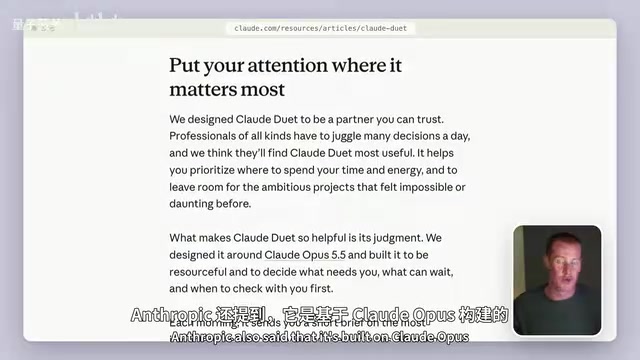
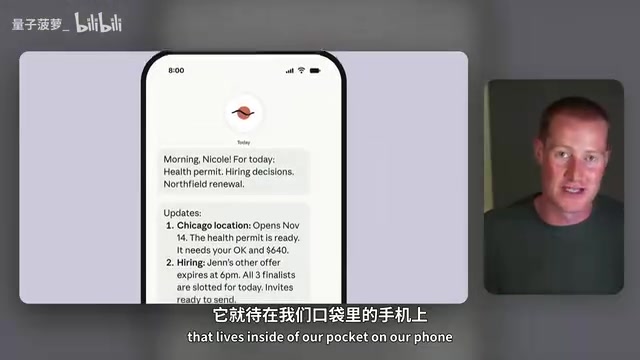
The most notable change in Duet is the interaction paradigm. Every morning, it sends users a brief summary of the most important items across their connected apps; then it continuously monitors those apps throughout the day, messaging only when something genuinely requires the user's attention. This design flips "people finding AI" into "AI finding people."
This capability is powered by the Claude Opus 5.5 model. According to the video, this model determines which items need user intervention, which can wait, and whether confirmation is needed before executing an action. Examples cited by Anthropic include: a coffee shop owner receives a reminder that her new store opens in 26 days but the health permit has not been submitted, and Duet drafts the application for her on the spot while informing her that a client renewal can wait until next Monday.
To be clear, larger tasks like building dashboards, sales forecasts, or even web apps have already been accomplished by products such as ChatGPT, Grokbot, and Metamuse. Duet's differentiator isn't an exclusive feature list but the fact that these capabilities are embedded directly within the Anthropic and Claude ecosystem, making migration costs minimal for users who already work deeply with products like Claude Code.
Proactive Agent is an interaction paradigm contrasted with traditional "request-response" chatbots. In the traditional model, AI only produces output after the user enters a prompt, and the system itself has no continuously running goals; a proactive assistant, by contrast, has long-term objectives, can trigger actions autonomously, and initiates interactions without immediate user instructions. Its technical prerequisites typically include: persistent memory, continuous access to multiple data sources, and a trigger mechanism (scheduled polling, event listening, or anomaly detection). The core design challenge for such systems is the "interruption budget"—if proactive notifications are too frequent, users perceive them as noise; if too infrequent, the system loses its reason to exist. The model must therefore judge the urgency and deferability of each item.
Security Boundaries and Permission Design
Letting an AI read your email and various apps inevitably raises security concerns. Anthropic's response: Duet never directly sees users' passwords or login tokens; new security checks reject the sharing of credit card numbers, government IDs, and similar information; sensitive data such as health and personal finances is only sent when the user explicitly instructs it. In addition, Anthropic has invited external firms to form a red team for penetration testing.
At the execution level, Duet displays the intended action and waits for user approval before sending messages, making payments, signing documents, or deleting anything. Stock trading and transfers between accounts are off-limits—not executed even with user approval. This "show first, execute later" mechanism effectively keeps final control in the user's hands.
Red Teaming originates from a military exercise term; in AI safety, it refers to the process by which an independent team actively seeks system vulnerabilities, privilege escalation paths, or inappropriate outputs from an attacker's perspective. Unlike routine internal testing, red team members are encouraged to use adversarial methods—such as crafting prompts that induce the model to leak sensitive information, attempting to bypass permission checks, or simulating malicious third-party apps injecting instructions. For an AI agent that can read email, calendars, and financial apps and perform write operations, red teaming typically focuses on: privilege escalation, prompt injection, and potential abuse within the scope of user authorization. Results are generally used to patch edge cases before launch, not to prove the system is absolutely secure.
Real-World Use Cases: From To-Do Lists to Real Estate Schedules
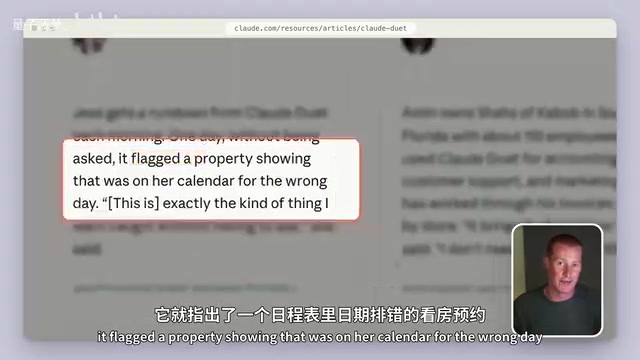
The video cites feedback from several early users. The creator of Boris used voice to sort through his to-do list with Duet while on a walk, rather than saving it all for when he sits down at his desk; a real estate agent said that one morning Duet flagged, without being asked, that a property showing on her calendar had the wrong date; a restaurant owner managing 110 employees uses it for accounting, customer support, and marketing.
What these cases share: Duet's value isn't in completing some isolated task for someone, but in continuously monitoring the state of multiple apps and proactively flagging anomalies. This is fundamentally different from the usage rhythm of traditional chatbots.
Deep Integration with the Claude Ecosystem
Duet inherits the user's memory, skills, and connected apps from Claude. For users who already have a Claude account, almost no additional setup is required. It supports over 6,000 connectors and plugins, with business scenarios cited by Anthropic including: checking unpaid invoices in QuickBooks or Stripe and drafting payment reminders, preparing payroll in Gusto, and preparing contracts for signature in DocuSign.
Duet appears as a standalone app on iPhone and Android, and is also accessible via Claude.ai. The current research preview is included in the Pro and Max subscription plans at no additional cost for paying users, but requires joining a waitlist and is currently limited to the United States.
Connectors and plugins are the integration layer that lets an AI assistant access external apps. Connectors typically work through APIs and OAuth authorization mechanisms provided by each service: after the user authorizes, the AI receives a time-limited, revocable access credential to read or write data in that app without directly touching the user's account password. Plugins wrap higher-level operational capabilities on top of connectors, such as "query unpaid invoices in Stripe" or "create a contract for signature in DocuSign." A large number of connectors means broad coverage, but each connector's permission granularity, stability, and data sync frequency vary widely—actual usability depends on the quality of specific integrations, not the count itself.
Limitations to Note: Shared Usage Limits and a Single Conversation Thread
The video's author specifically flags an easily overlooked pitfall: Duet shares usage limits with the rest of Claude's products, and background periodic checks also count toward them; larger tasks like building presentations or financial models consume more tokens. If users are already near Claude's usage cap, Duet may drain the limit faster. However, the author adds that Claude Opus 5.5 performs well on token efficiency, with complex workflows actually consuming less than before.
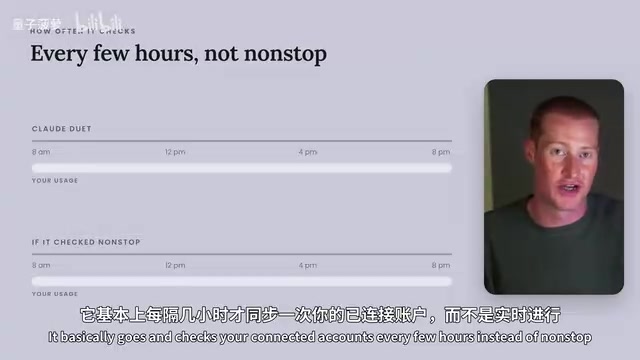
Another design difference is the conversation structure. Interaction with Duet happens in a single continuous thread—whether it's a one-off question during the week or a long-term project, everything starts from the same entry point. This contrasts with Grokbot, which supports creating multiple dedicated agents for different tasks and having them collaborate. The author considers multi-agent division of labor one reason he prefers Grokbot, as it prevents different conversations from interfering with each other. In addition, Duet has its own computer and browser in the cloud, so it can keep working without the user's phone or computer staying on; it checks connected accounts every few hours rather than polling continuously, to control usage consumption.
Multi-Agent architecture refers to a system that creates independent agent instances for different tasks, each with its own context, memory, and tool permissions, capable of calling one another or delegating subtasks. The advantage of this design is context isolation—a conversation handling finances won't be polluted by small talk about household matters, and long-term projects have dedicated continuous memory; the cost is architectural complexity, difficulty syncing state across agents, and the need for users to switch between multiple entry points. The counterpart is the single continuous thread model: simple to implement with naturally coherent context, but as conversations grow longer, early information may be pushed out of the context window, and tasks of different natures can interfere with each other. Each model has engineering and experiential trade-offs, and no consensus has emerged.
Competitive Landscape: The Personal AI Assistant Track Heats Up
Duet enters a rapidly crowding field. According to the video's overview, Grokbot launched in August, Meta released Muse in September, ChatGPT rolled out Dots a few weeks ago, and now with Claude Duet, all major platforms have staked out "proactive assistants that live in your pocket."
The author's personal choice is revealing: for the past two months he has used Grokbot as his daily workhorse, replying to nearly all his emails with it every day. He mentions a notable development—Elon has said Grokbot will select the most suitable model for different tasks, naming Claude Opus 5.5 among them. However, this is currently the only official source, and the specific model allocation remains unclear. This also raises an open question: whether Anthropic will allow other companies' models in Duet—the author is skeptical.
Currently Duet is not open to anyone; it can only be requested via the waitlist. For users already deeply invested in the Claude ecosystem, it's a nearly inevitable extension; for those accustomed to multi-agent division of labor, the single-thread design may be a trade-off to weigh. The real question may not be which assistant is smarter, but how much of your daily judgment you're willing to hand over to an always-on system.
Related articles

Will GitHub Die? Open Source Maintainer Burnout and the Collaboration Crisis in the AI Era
Lex Fridman podcast discussion on open source maintainer burnout and GitHub's predicament: massive pull requests overwhelm core maintainers, and AI worsens code bloat. Using math journal peer review and Poincaré conjecture verification as analogies, the article analyzes why verification in knowledge production must be deliberately slow, and how open source communities can avoid the failure mode of maintainers exiting.

Stop Building Cookie-Cutter AI Websites: 3 Tools That Transform Your Coding Agent
Three tools that boost AI coding agents: FFmpeg skill for local video editing in Claude Code and Cursor, Hallmark's 50 design themes to fix cookie-cutter AI sites, and Jailbreaks' 25+ model prompts.

How America's Gerontocracy Squeezes the Younger Generation
Americans over 55 hold nearly three-quarters of national wealth, alongside an 80-year-old president and elderly congressional leaders. The Atlantic's Idrees Kahloon explains how gerontocracy drives up housing costs, squeezes opportunities for the young, and explores zoning reform and child poverty reduction as practical fixes.