Anthropic Launches Cyber Mission: Using AI to Fortify Critical Infrastructure and Open-Source Software

Anthropic announces Cyber Mission to protect critical infrastructure and open-source software with AI.
Anthropic announced the Cyber Mission initiative via social media, aiming to protect critical infrastructure and open-source software, though the tweet disclosed no technical details. The article analyzes four dimensions: rising attack automation and supply chain complexity combined with persistent security talent shortages elevate the problem to systemic risk; critical infrastructure constraints around uptime and patch windows concentrate AI's value on anomaly detection and faster investigation; open-source security debt stems from misaligned incentives, and AI-assisted auditing could lower the barrier for small project maintainers; and security AI's dual-use nature makes authorization scope and anti-abuse mechanisms key variables. The article views the announcement as more signal than substance, with real value depending on Anthropic's engineering investment and ecosystem collaboration.
Anthropic Launches Cyber Mission: Using AI to Fortify Critical Infrastructure and Open-Source Software
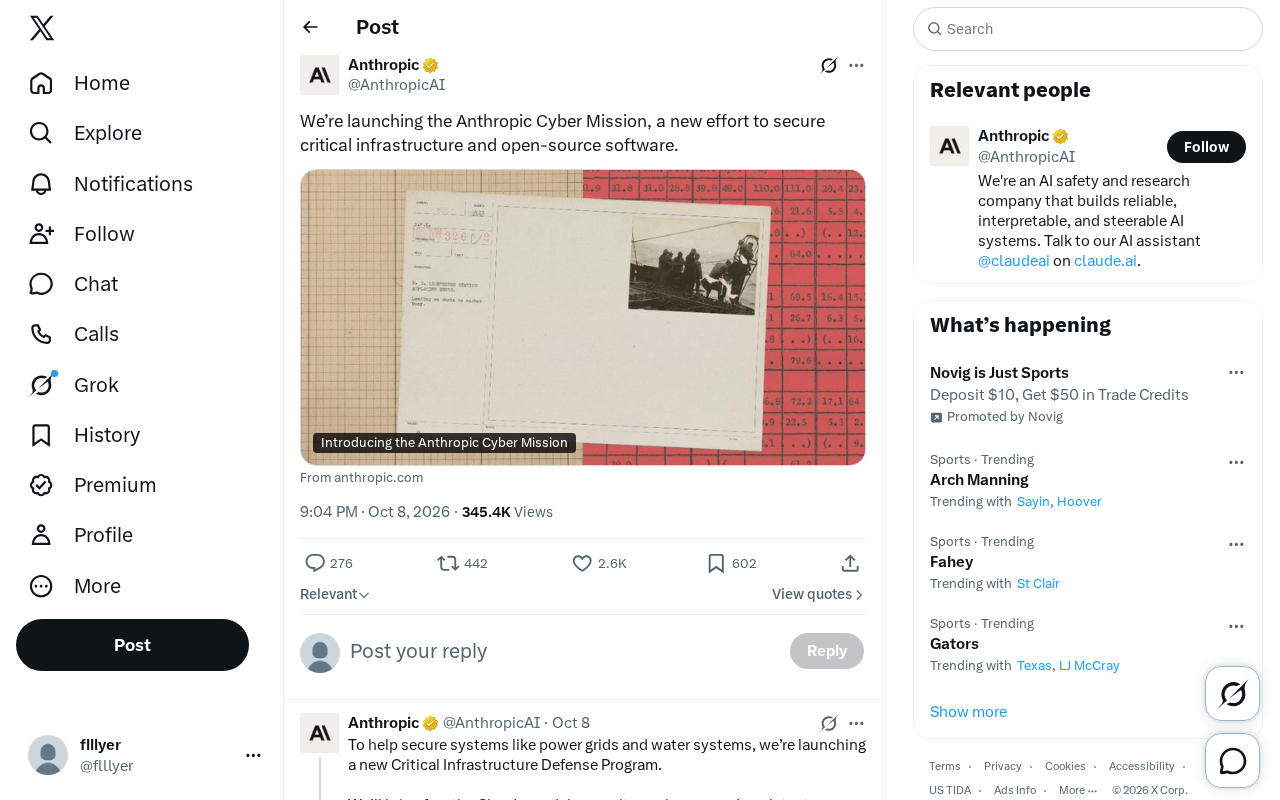
Anthropic announced on X (formerly Twitter) the launch of a new initiative called Cyber Mission, aimed at protecting critical infrastructure and open-source software. The brief tweet disclosed no technical details, but it points to an increasingly urgent industry challenge: as the attack surface expands from corporate intranets to power grids, water treatment plants, and open-source dependencies shared by developers worldwide, traditional manual auditing and security operations models can no longer keep pace.
Several dimensions worth examining emerge from this information: why Anthropic is entering the security space now, what risks critical infrastructure and open-source software each face, and what paths an AI company might take when doing cybersecurity.
Why Now: The Attack Surface Is Expanding While Defenders Are Stretched Thin
Security problems in critical infrastructure are nothing new, but what has changed in recent years is that both the degree of attack automation and the complexity of the supply chain have risen simultaneously. Attackers can use tools to mass-scan industrial control devices exposed on the public internet, or embed malicious code into open-source packages referenced by thousands of projects. Defenders, meanwhile, face a chronic shortage of security talent—many critical facility operations teams don't even have dedicated security engineers.
The situation with open-source software is similar but more insidious. Many core libraries are maintained part-time by a handful of volunteers and lack systematic security audit resources—when a widely depended-upon logging or cryptography library has a vulnerability, the impact cascades down the dependency chain to countless downstream products. By placing these two domains under the same initiative, Anthropic signals that it frames the problem as systemic risk rather than scattered, isolated vulnerabilities.
Software Bill of Materials (SBOM) is a key mechanism for understanding open-source supply chain risk. An SBOM is a machine-readable inventory that records, layer by layer, all components, versions, and dependency relationships contained in a software product—akin to an ingredient list on food packaging. After the Log4j vulnerability incident in 2021, the United States pushed SBOM into the regulatory spotlight, with an executive order requiring software vendors supplying the federal government to provide SBOMs. Its value lies in the fact that when a foundational library exposes a vulnerability, enterprises can quickly query whether they are affected and how extensive the impact is, rather than manually searching through code repositories. But SBOM only solves "knowing what you're using," not "whether what you're using is secure." This is why the industry has also proposed companion formats such as VEX (Vulnerability Exploitability eXchange), used to declare whether a known vulnerability is actually exploitable in a given product, helping downstream reduce ineffective incident response.
The AI Defense Gap in Critical Infrastructure
Critical infrastructure security has a unique constraint: systems cannot be arbitrarily shut down, nor can patches be easily applied. Power, water, and transportation control systems have limited update windows, and security teams rely more on monitoring and isolation measures. This means AI's value here lies not in automated remediation but in early anomaly detection and shortening investigation time.
Large models have a natural advantage in log analysis, threat intelligence correlation, and anomalous behavior identification—they can process unstructured data and weave fragmented alerts into attack chain narratives. Anthropic's accumulated work in model safety and alignment could theoretically transfer to this scenario: enabling models to reduce false positives and provide explainable judgment bases when assisting security operations, rather than throwing out black-box conclusions.
A commonly cited technical background in critical infrastructure security is the difference between OT (Operational Technology) and IT. OT refers to systems that directly control physical processes, such as PLCs (Programmable Logic Controllers), SCADA (Supervisory Control and Data Acquisition), and industrial control systems. These systems were designed with reliability and real-time performance as priorities rather than security; many devices run old firmware that cannot be upgraded, and communication protocols (such as Modbus) lack authentication mechanisms. IT-side measures like patch management and endpoint detection cannot be directly applied, because a single reboot could halt production lines or even cause physical accidents. This is the technical root of what the article describes as "cannot be arbitrarily shut down, nor can patches be easily applied," and it also explains why AI in OT scenarios is positioned more as passive monitoring and investigation assistance rather than active remediation.
Open-Source Security Debt Needs New Tools
The security problem in the open-source ecosystem is fundamentally an incentive problem: maintainers are not paid to conduct deep audits, and enterprise users are accustomed to using software for free. In the past two years, the industry has promoted mechanisms such as Software Bills of Materials (SBOM) and security scorecards, but the window from vulnerability disclosure to remediation remains long.
What AI can do in this area includes: assisting code auditing, identifying suspicious commit patterns, and assessing risk during dependency upgrades. If Anthropic opens this capability to open-source maintainers, it could create a kind of low-barrier democratization of security capabilities—allowing maintainers of small projects to access security analysis that previously only large companies could afford. This also aligns with the "open-source software" reference in the Cyber Mission title.
What Paths Might an AI Company Take in Security
From public information, Anthropic has not specified the concrete product form of Cyber Mission. Based on industry conventions and Anthropic's existing technical approach, several possible directions can be inferred: a model access program for critical infrastructure operators, collaborative audit projects with open-source foundations, or open security-related evaluation benchmarks and tools.
It is worth noting that Anthropic has consistently emphasized model safety and controllability. If Cyber Mission includes opening model capabilities to defenders, how to use them within authorized scope and how to prevent capability abuse will be unavoidable issues in the program's design. AI applications in security inherently have dual-use characteristics, and this is a question every company doing security AI must answer.
The dual-use nature of security AI requires specific elaboration. The same set of vulnerability discovery or code auditing capabilities that defenders use to find and fix problems can also be used by attackers to locate exploitable weaknesses; the ability of large models to generate phishing emails and obfuscate malicious code has been demonstrated multiple times. Therefore, the industry typically constrains this through terms of use, access approval, output monitoring, and abuse detection mechanisms, and some vendors set tiered access levels or customer identity verification for high-risk capabilities. For a company like Anthropic that emphasizes model alignment, if Cyber Mission opens model access, how to define "defensive use within authorized scope" and how to record and audit invocation behavior will directly determine the program's credibility and the difficulty of its promotion.
Signal Value Exceeds Details
A single tweet carries limited information, but the timing and wording reveal direction: Anthropic views cybersecurity as an important scenario for model capability deployment and has chosen the "critical infrastructure + open-source software" angle oriented toward public interest. For security practitioners, it is worth tracking whether applications will open and whether there will be a specific list of partner organizations; for open-source maintainers, if the program includes free auditing tools or model credits, the practical value would be direct.
At a time when AI companies are actively seeking enterprise-level deployment scenarios, choosing security as a direction is not surprising—it is one of the few domains that demands deep analysis, has low tolerance for hallucinations, and has clear willingness to pay. Whether Cyber Mission delivers depends on how much engineering resources and ecosystem collaboration Anthropic is willing to invest—not just a tweet.
Related articles

Why Does the Tesla Roadster Need to Fly? A Deep Dive into Musk's Wild Demo
Tesla's Roadster launch showed wall-climbing, upside-down driving, and flying stunts—but The Vergecast notes the demo car may lack a battery, the Rocket version is invite-only and not street-legal, and the website terms don't guarantee delivery. After nine years of delays, why does this car still need to exist?

AI Is Not a Replacement: Human-AI Collaboration Through the Lens of Factory Root Cause Analysis
Starting from factory root cause analysis, this article explains how AI accelerates evidence chain construction rather than replacing human experts, exploring the pragmatic implementation logic and business value of 'AI supporting people rather than replacing them.'

AI Agent Decision Auditing: Building an Evidence Chain in Regulated Workflows
Starting from a Reddit discussion, this article analyzes three core issues in AI agent decision auditing within regulated workflows: what fields audit records should contain, how to handle feedback latency for erroneous decisions, and how to continuously calibrate LLM judge consistency with human judgment.