Anthropic Loses $100 Billion Yet Valued at $1 Trillion? Unraveling the Financial Puzzle of Claude's Parent Company

Ninety percent of Anthropic's $100B loss is accounting; real operating loss is only ~$1B. Behind the high valuation: a compute gamble and control design.
Based on Bilibili creator "开盖"'s breakdown video, this article reconstructs Anthropic's journey from seven founders' departure to trillion-dollar valuation rumors. It finds that 90% of Anthropic's $100B on-paper loss stems from Amazon convertible bond accounting—higher valuation means larger conversion liability and deeper on-paper loss—while real operating loss was only ~$1B in the first three quarters. Claude Code hit $1B annualized revenue in six months, driving Q3 2025 revenue to nearly $17B. Anthropic uses four chip suppliers, signed ~$900B in compute bills, and forms "circular financing" with Amazon and Google. Founders hold over half voting power via one special share to hold the AI safety line. Rumored valuation: $1.5–2T.
Title
Anthropic Loses $100 Billion Yet Valued at $1 Trillion? Unraveling the Financial Puzzle of Claude's Parent Company
Meta Description
Anthropic reports over $100 billion in losses yet is rumored to be valued at $1 trillion. This article breaks down Claude's parent company's origin story, Claude Code's commercial explosion, its four-chip compute strategy, and the convertible bond accounting puzzle—explaining the real logic behind the high valuation and the IPO control risks.
Article Content
Introduction: On one side, over $100 billion in on-paper losses; on the other, market rumors of a $1.5–2 trillion valuation—Claude's parent company Anthropic's path to IPO is full of counterintuitive financial puzzles. Based on the in-depth breakdown video by Bilibili creator "开盖" (Kaigai), this article reconstructs the real logic behind this AI giant's high valuation, from team origins and product breakout to compute deployment and financial structure.
Starting with Seven Departures: A Safety-First Founding
In late 2020, then-OpenAI VP of Research Dario Amodei left along with his sister Daniela and five other colleagues. These seven had deep backgrounds—some had led GPT-3 development, others specialized in AI interpretability research. In January 2021, Anthropic was officially founded.
On a podcast, Dario explained the departure: rather than argue under someone else's vision, it was better to take trusted people and start fresh. They chose a more radical path—placing AI safety at the core of the company's mission and registering as a public benefit corporation (PBC), legally committing to balancing shareholder interests with humanity's long-term well-being.
Early fundraising was not smooth. The largest round in 2022—nearly $600 million—came from FTX founder SBF, but FTX then collapsed into bankruptcy, and its Anthropic shares were used to settle debts, sold for about $900 million. Looking back from today's valuation, that deal is widely seen as "sold too early."
Public Benefit Corporation (PBC) is a corporate form under U.S. law that requires the company to state one or more public benefit purposes in its charter and authorizes the board to weigh shareholder interests against the public benefit mission rather than treating shareholder financial return as the sole objective. A PBC differs from traditional B Corp certification: B Corp is a certification issued by a third-party organization, while PBC is a statutory corporate type at the state-law level. Anthropic's registration as a PBC means its board can legally reject certain highly profitable but high-risk businesses on "AI safety" grounds—an arrangement that in an ordinary company could trigger shareholder lawsuits.
From Claude to Claude Code: The Key Leap in Commercialization
In March 2023, the first-generation Claude was released. At the time ChatGPT was dominant, and Claude's full-year revenue was only just over $40 million. The turning point came in 2024—the Claude 3 series launched large, medium, and small models simultaneously, with the company claiming the largest version surpassed competitors on most tests.

The real commercialization trigger was Claude Code, released in February 2025. It goes beyond conversation, embedding directly into programmers' development environments to autonomously read code, modify code, and run tests. Officially disclosed: within just six months of launch, Claude Code's annualized revenue at then-current growth rates reached $1 billion. Prospectus data further confirms user stickiness: among enterprises, the groups that use Claude Code most pay 20 times more than non-users.
Financial data shows the same explosive curve: full-year 2024 revenue was under $400 million, while Q3 2025 alone approached $17 billion. Average annual spending by existing customers grew to 9 times the original. Model capability leaps also drew regulatory attention—according to the video, the Mythos model was selectively opened only to major clients like Apple, Microsoft, and Google for system vulnerability discovery; Fable 5 was ordered to be restricted by the U.S. Commerce Department three days after launch, and it took over half a month of global suspension before resuming.
The Compute Arms Race: Four Chip Suppliers and a $900 Billion Bill
Underpinning model capability is compute. Anthropic simultaneously uses chips from four suppliers: Amazon Trainium, Google TPU, Nvidia GPU, and AMD GPU. The scale disclosed in the video is staggering: over 1 million Amazon Trainium 2 chips deployed alone, Google committed to supply up to 1 million TPUs, and SpaceX even dedicated an entire data center to Anthropic containing over 220,000 Nvidia GPUs.

Chips share a similar structure when broken down: a central compute core surrounded by HBM memory responsible for data supply. Anthropic admitted in its prospectus that it had severely underestimated compute demand, causing supply tightness, and therefore aggressively stockpiled over the past two years. Signed compute bills total nearly $900 billion, with the SpaceX contract requiring about $3 billion per month once all equipment is in place.
HBM (High Bandwidth Memory) is a key supporting component of AI chips. No matter how powerful the GPU/TPU compute core is, it needs to continuously read model weights and intermediate data from memory at high speed; HBM vertically stacks multiple DRAM dies and interconnects them with through-silicon vias (TSVs), achieving several times the bandwidth of traditional GDDR memory in a tiny footprint. Current mainstream HBM3e has about 24–36GB per stack, and a high-end AI accelerator typically carries 6–8 HBM stacks. HBM production capacity and yield are highly concentrated among SK Hynix, Samsung, and Micron, making it—like advanced process nodes—a bottleneck constraining AI compute expansion.
The Truth Behind the Hundred-Billion Loss: Convertible Bond Accounting Magic
The massive compute bills are funded mainly in two ways. First, fundraising: cumulative funding since founding exceeds $140 billion, with valuation soaring from over $60 billion in March 2024 to over $960 billion in May 2025. Largest investor Amazon has invested $18 billion cumulatively, Google at least $13 billion. Interestingly, both are simultaneously shareholders and compute suppliers—according to the video's analysis, Anthropic has committed to purchasing over $230 billion in compute from the two combined, far exceeding their invested capital, which foreign media calls "circular financing." The prospectus also acknowledges that these institutions simultaneously play multiple roles as shareholders, suppliers, customers, and competitors.

Second, operating cash flow turning positive: in the first three quarters of 2025, operating cash inflows exceeded outflows by over $6 billion. So where does the hundred-billion loss mentioned at the start come from? Breaking down the prospectus reveals that 90% stems from on-paper figures. In early years, Amazon provided Anthropic with over $6 billion in convertible bonds whose conversion terms are tied to valuation—the higher the company's valuation, the greater the conversion value and the higher the corresponding liability. As of end-September 2025, on-book liabilities had accumulated to over $130 billion, and liability growth is directly recorded as loss. In other words, the more valuable the company, the larger the on-paper loss. The real operating loss for the first three quarters was only just over $1 billion, with the second quarter even achieving profitability for the first time and the third quarter showing a slight return to loss. After IPO, convertible bonds convert to equity, and such on-paper losses will no longer appear.
Convertible bonds are a hybrid financial instrument: investors first put in funds as debt, and under agreed conditions (such as the company's valuation reaching a threshold, or the company going public) can convert to company stock at a specified price. For issuers, convertible bonds carry lower interest than ordinary debt but dilute equity upon conversion; for investors, they combine the downside protection of debt with the upside of equity. In accounting, if conversion terms are tied to company valuation, rising valuation increases the fair value of the conversion obligation, and this increment is recognized in the statements as a liability and corresponding fair value change loss—creating the counterintuitive phenomenon where "the more valuable the company, the larger the on-paper loss." This is precisely the main source of Anthropic's hundred-billion on-paper loss.
The Trillion-Dollar Valuation Question: Balancing Control and Risk
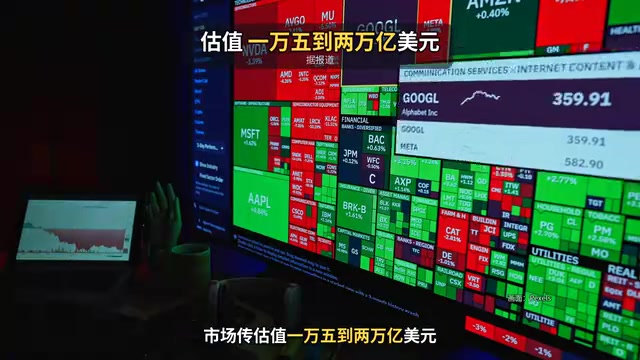
According to reports, Anthropic published its prospectus on October 26, planning to list on Nasdaq under the ticker ANT. Market rumors put the valuation range at $1.5–2 trillion, which if realized would approach the record for the largest IPO in history set by SpaceX.
But ordinary investors should note the control structure: the seven founders jointly hold one special share, and this single share carries over half the voting power, plus a non-salaried trust that can elect a majority of the board. Ordinary shareholders have extremely limited say in corporate governance. The founding team says this design is intended to ensure the company doesn't purely chase profit and to hold the safety bottom line.
This bottom line has real examples. In February 2025, the U.S. Department of Defense asked Anthropic to lift two restrictions—allowing mass surveillance of American citizens and allowing development of fully autonomous weapons. After Anthropic refused, the President ordered federal agencies to stop using its services, and the DoD listed it as a supply chain risk. Anthropic then sued the government, and the case remains unresolved. Fortunately, government business accounts for less than 2% of its revenue, so the impact is limited.
Dual-class share structure is a common arrangement for founders to maintain control, typically like Google's Class A/B/C shares or Meta's Class B super-voting shares. Anthropic's approach is more extreme: the seven founders jointly hold one special share carrying over half the voting power, paired with a non-salaried trust that can elect a majority of the board. Such structures are not uncommon in tech IPOs but usually include "sunset clauses" (e.g., super-voting rights automatically lapse when founders leave or holdings fall below a certain percentage). Investors should watch whether the prospectus discloses such clauses and whether ordinary shareholders retain veto rights over related-party transactions, executive compensation, and similar matters.
Bulls vs. Bears: The Next Nvidia or an AI Bubble?
Bulls argue that with revenue growing more than tenfold in a year, Anthropic is the next Nvidia; bears worry that the nearly $900 billion compute bill could become an crushing burden when growth slows. As of the video's release, this debate remains unresolved.
It's worth adding that the financial and operational data above are all cited from Bilibili creator "开盖"'s breakdown video and the prospectus information it references; some market rumors (such as valuation range and IPO timing) have not been officially confirmed, and readers should verify for themselves.
This article is compiled and analyzed based on content from the Bilibili "开盖" channel and does not constitute investment advice.
One-line Summary
Ninety percent of Anthropic's hundred-billion loss is accounting figures; real operating loss is only just over $1 billion. Behind the high valuation lies a compute gamble and control structure design.
Paragraph Summary
Based on Bilibili creator "开盖"'s breakdown video, this article reconstructs Anthropic's journey from seven founders' departure to trillion-dollar valuation rumors. It points out that 90% of Anthropic's hundred-billion on-paper loss comes from accounting treatment of Amazon convertible bonds—the higher the valuation, the larger the conversion liability and the deeper the on-paper loss—while the real operating loss for the first three quarters was only just over $1 billion. On commercialization, Claude Code reached $1 billion annualized revenue within six months of launch, driving Q3 2025 quarterly revenue to nearly $17 billion. On compute, Anthropic uses four chip suppliers simultaneously, has signed bills nearing $900 billion, and forms "circular financing" relationships with Amazon and Google. Founders hold over half the voting power through one special share, which the company says is designed to hold the AI safety bottom line. Market rumors put the valuation at $1.5–2 trillion, with bulls and bears split on whether high revenue growth can cover massive compute commitments.
Related articles

Hermes Agent Beginner's Guide: Hands-On with a Self-Evolving AI Agent
A beginner's guide to Hermes Agent, the open-source self-evolving AI agent that gained 41.7K GitHub stars in two months—covering Harness Engineering, the learning loop, three-layer memory, WSL installation, and hands-on configuration.

AI Agent in Action: Building a Smart Office Assistant with WorkBuddy
A practical case study shows how Tencent WorkBuddy batch-converts and archives files, compares chat LLMs with AI Agents, and analyzes WorkBuddy's credit system, use cases, and positioning for office automation selection.

From Single-GPU Bottlenecks to Hundreds of Billions of Parameters: 6 Key Questions in Large Model Distributed Parallelism
Based on a Bilibili tutorial, this article organizes core knowledge of large model distributed parallelism: starting from decoder-only architecture's token-by-token generation and the essence of X times W computation, it analyzes six key questions including data parallelism, tensor parallelism, and pipeline parallelism under single-GPU bottlenecks. Suitable for learners in private deployment and model training scenarios to build systematic understanding.