Anthropic Lost $80.7B in Six Months but Is Valued at $2 Trillion: Is Its IPO a Bubble?
Anthropic seeks a $1.5–2T IPO with an $80.7B paper loss, 30x revenue growth in five quarters, a 5-point lead, and control in one Class F share.
Anthropic's prospectus shows a $1.5–2 trillion valuation range and an $80.7 billion first-half loss, of which $70 billion is a paper loss from remeasuring convertible bonds at the new valuation, not operating cash burn. Claude Code has over $2.5 billion annualized revenue and about 40 million paying customers, with revenue growing over 30x in five quarters. But the top five AI companies differ by only 5 points on intelligence rankings. A supply chain risk designation was upheld 2-1 in the Washington appeals court. Seven co-founders jointly hold one Class F share with 50.1% voting power. The IPO could raise over $100 billion, the largest in history.
Title
Anthropic Lost $80.7B in Six Months but Is Valued at $2 Trillion: Is Its IPO a Bubble?
Meta Description
Anthropic's prospectus shows a $80.7 billion loss in the first half, while reported valuations reach $1.5–2 trillion. This article breaks down key facts—Claude Code's annualized revenue exceeding $2.5 billion, 30x revenue growth over five quarters, the source of the $70 billion paper loss, and the Class F share's 50.1% voting power—to analyze the bubble debate around the largest IPO in history.
Article Content
Anthropic is going public. Reported valuations range from $1.5 trillion to $2 trillion, while the prospectus shows a loss of $80.7 billion in the first half of this year. How can it be worth so much while losing so much? I read the entire prospectus and will lay out both the good and the bad.
A Company Whose Imagination Is Powered by Claude Code
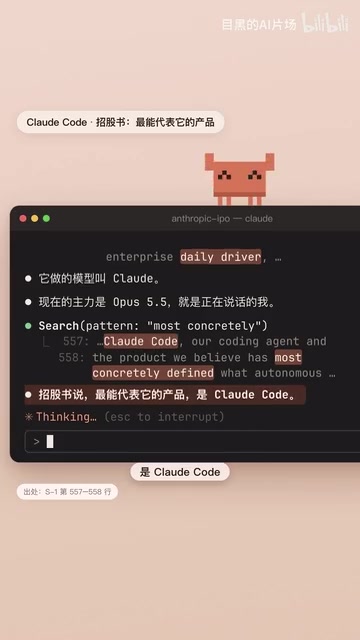
Founded in 2021, Anthropic's flagship model is Claude, with the current main model being Opus 5.5. The product that best represents its form in the prospectus is Claude Code—you state a requirement, and it plans, writes code, runs tests, and fixes bugs on its own in the command line.
NASA engineers used it to plan routes for the Perseverance Mars rover; the prospectus claims that was the first AI-planned driving path on Mars. In February this year, the company disclosed that Claude Code's annualized revenue exceeded $2.5 billion, with about 40 million paying customers, including more than 11,900 spending over $100,000 annually.
This business isn't unique to Anthropic. The prospectus names only two main competitors: Google and OpenAI. On Artificial Analysis's intelligence ranking (by company), Anthropic scores 58, Meta 56, China's Kimi 55, and both OpenAI and Google 53—the top five differ by only 5 points.

A $2 trillion valuation converted to RMB would be enough to give nearly 10,000 yuan to every person in the country. What's being bet on is whether this few-point lead can be maintained.
Revenue Soars, Losses Soar Even More
Revenue is growing rapidly: $376 million in Q1 last year to $11.555 billion in Q2 this year—more than 30 times over five quarters, averaging over $120 million per day.
But the company has lost money every year since its founding. In the first half of this year, it posted a $80.7 billion loss, of which $70 billion is a paper loss from remeasuring $2.4 billion in convertible bonds at the new valuation—the more valuable the company, the more expensive the debt, with the excess fully recorded as a loss. Hence the odd phenomenon: the more valuable the company, the more it loses on paper.
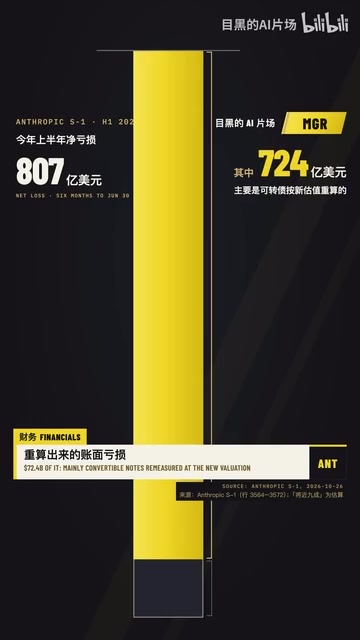
This is also key to understanding the prospectus: the $80.7 billion loss figure does not equate to operating cash burn; it is largely an accounting consequence of rising valuation. But conversely, the higher the valuation, the uglier this paper loss, which also shows that the market's pricing has run far ahead of revenue.
Accounting treatment of convertible bonds is key to understanding this $70 billion loss. Convertible bonds are initially measured as liabilities, but when the company's valuation rises sharply, the value of the conversion option swells, and accounting rules require recognizing that increase as a fair value loss. Anthropic's $2.4 billion convertible bonds triggered a massive remeasurement because the new valuation is far above the issuance point. This loss consumes no cash and does not affect operating cash flow, yet it creates a glaring number on the income statement. Investors need to distinguish between "paper loss" and "operating loss": the former is a byproduct of rising valuation, while the latter reflects the true burn rate. Only if the prospectus also discloses operating cash flow and adjusted EBITDA can the company's actual financial condition be judged more accurately.
Its Safety Stance Has Put It in the Crosshairs
In the risk section, there is an issue directly related to its own positioning. Anthropic has publicly stated that its technology should not be used for mass surveillance within the United States or for fully autonomous weapons. In February this year, the U.S. President ordered federal agencies to stop using its models, and the Department of Defense designated it as a national security supply chain risk.
The prospectus only records the government's decision, not its reasoning. Anthropic filed lawsuits in two courts simultaneously: the Northern District of California found this to be retaliation against its speech and largely ruled in its favor; the Washington appeals court ruled 2-1 on September 25 that one supply chain risk designation stands. The litigation is ongoing, and the cause is precisely "what I can be used for."
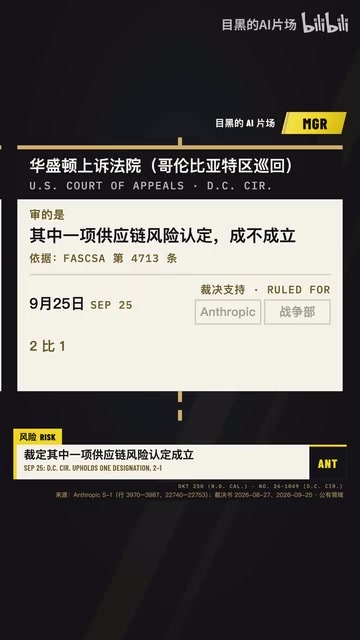
For a company whose core narrative is "safety," this is an unavoidable hurdle: the more it insists on constraining the boundaries of model use, the more likely it is to friction with one of its largest customers—the government.
Supply chain risk designation is an administrative measure by the U.S. Department of Defense against contractors, typically meaning the supplier is deemed to pose a risk that could affect national security, and federal agencies must assess and may restrict cooperation with it. Being listed is not equivalent to illegality or sanctions, but it materially affects the company's ability to obtain government contracts. Anthropic faces different rulings from two courts simultaneously, reflecting the complexity of such administrative designations in judicial review: the Northern California court focused on the constitutional issue of retaliation against speech, while the Washington appeals court focused on the legality of administrative procedure. For AI companies, the government is both regulator and major customer, and the tension between safety stance and commercial interests is particularly acute at Anthropic.
The Largest IPO in History, and a Class F Share That Decides Everything
Reports suggest this IPO could raise over $100 billion. If true, it would surpass SpaceX's $75 billion in June this year to become the largest IPO in history.
The most unusual line in the prospectus is a special share held jointly by the seven co-founders—a Class F share. This single share pays no dividends but controls voting, accounting for 50.1% of total voting power. Anyone can buy the stock, but where the company goes is essentially decided by these seven people.
As for how much one share sells for, that column in the prospectus is still blank. Reports say listing could happen as early as the week of November 16. The answer will only truly be revealed once that column is filled in.
Class F shares and dual-class structures are not uncommon in tech IPOs, but Anthropic's design is more extreme. In typical AB share structures, founders usually hold high-voting shares, but other shareholders still share voting power. The Class F share concentrates 50.1% of voting power in a single share held jointly by seven co-founders, meaning public shareholders cannot form effective checks on major decisions even if they hold large stakes. The benefit is that management can adhere to long-term strategy and resist short-term market pressure—especially relevant given Anthropic's emphasis on safety, which may cause friction with the government or major customers; concentrated control helps maintain strategic resolve. The downside is weak corporate governance checks: public investors have almost no leverage over management, and if strategic mistakes or conflicts of interest arise, external shareholders struggle to correct course.
The Core Question in the Bubble Debate
Stringing the clues together: a 5-point lead on the intelligence ranking, 30x revenue growth over five quarters, an $80.7 billion paper loss, a $2 trillion valuation, and 50.1% of voting power concentrated in a single Class F share.
Supporters would say revenue growth proves demand is real, and products like Claude Code have already proven a commercialization path; skeptics would say the lead is too thin, competitors too close, and the valuation has already透支 future years of growth in one go.
This may not be a question that can be answered with "yes" or "no." But the blank price column in the prospectus and the unfinished litigation mean the answer will not settle any time soon.
One-line Summary
Anthropic plans to IPO at a $1.5–2 trillion valuation, with an $80.7 billion paper loss in the first half, 30x revenue growth over five quarters, but only a 5-point lead and control concentrated in one Class F share.
Paragraph Summary
Anthropic's prospectus shows a valuation range of $1.5–2 trillion and an $80.7 billion loss in the first half, of which $70 billion is a paper loss from remeasuring convertible bonds at the new valuation, not operating cash burn. Core product Claude Code has annualized revenue over $2.5 billion, about 40 million paying customers, and revenue grew over 30x in five quarters. But the top five companies on the intelligence ranking differ by only 5 points, so the lead is not secure. Due to friction with the government over its safety stance, one supply chain risk designation was upheld 2-1 in the Washington appeals court. Seven co-founders jointly hold one Class F share representing 50.1% of voting power, highly concentrated control. The IPO could raise over $100 billion, making it the largest IPO in history.
Related articles

Hermes Agent Beginner's Guide: Hands-On with a Self-Evolving AI Agent
A beginner's guide to Hermes Agent, the open-source self-evolving AI agent that gained 41.7K GitHub stars in two months—covering Harness Engineering, the learning loop, three-layer memory, WSL installation, and hands-on configuration.

AI Agent in Action: Building a Smart Office Assistant with WorkBuddy
A practical case study shows how Tencent WorkBuddy batch-converts and archives files, compares chat LLMs with AI Agents, and analyzes WorkBuddy's credit system, use cases, and positioning for office automation selection.

From Single-GPU Bottlenecks to Hundreds of Billions of Parameters: 6 Key Questions in Large Model Distributed Parallelism
Based on a Bilibili tutorial, this article organizes core knowledge of large model distributed parallelism: starting from decoder-only architecture's token-by-token generation and the essence of X times W computation, it analyzes six key questions including data parallelism, tensor parallelism, and pipeline parallelism under single-GPU bottlenecks. Suitable for learners in private deployment and model training scenarios to build systematic understanding.