Anthropic Mysterious Model Leak? A 14-Trillion-Parameter Behemoth Appears on Hugging Face

A Hugging Face repository claims to leak an Anthropic 14-trillion-parameter model, but authenticity is doubtful.
The article centers on the Reddit-discussed Hugging Face repository burner22/numbat, which claims to contain an Anthropic internal "Mythos-class" training checkpoint with 14 trillion parameters, 1224 MoE experts, 7.72 TB of weights, 772 shards, and a hybrid GDN+MLA architecture. It analyzes the technical implications of these numbers, notes the engineering challenges of ultra-large sparse MoE and efficient attention architectures, and lists authenticity concerns: unknown uploader, lack of digital signatures or official endorsement, questionable training cost and technical plausibility, and precedents of forgery. It further discusses multi-faceted impacts if true—AI safety and compliance questions, competitive disruption, architectural research value—and advises developers to be cautious with weights of unknown origin. The conclusion emphasizes that everything is speculation until independent verification.
Incident Recap: A "Mythos-Class" Model Repository on Hugging Face
Recently, a post on the Reddit community sparked heated discussion: a Hugging Face repository named burner22/numbat claims to contain an Anthropic internal "Mythos-class" training checkpoint. The post listed staggering specifications: 14 trillion parameters, 1224 MoE experts, 7.72 TB of weights, 772 weight shards, and a hybrid GDN+MLA architecture. The repository also provides model architecture code, configuration files, and training metadata.
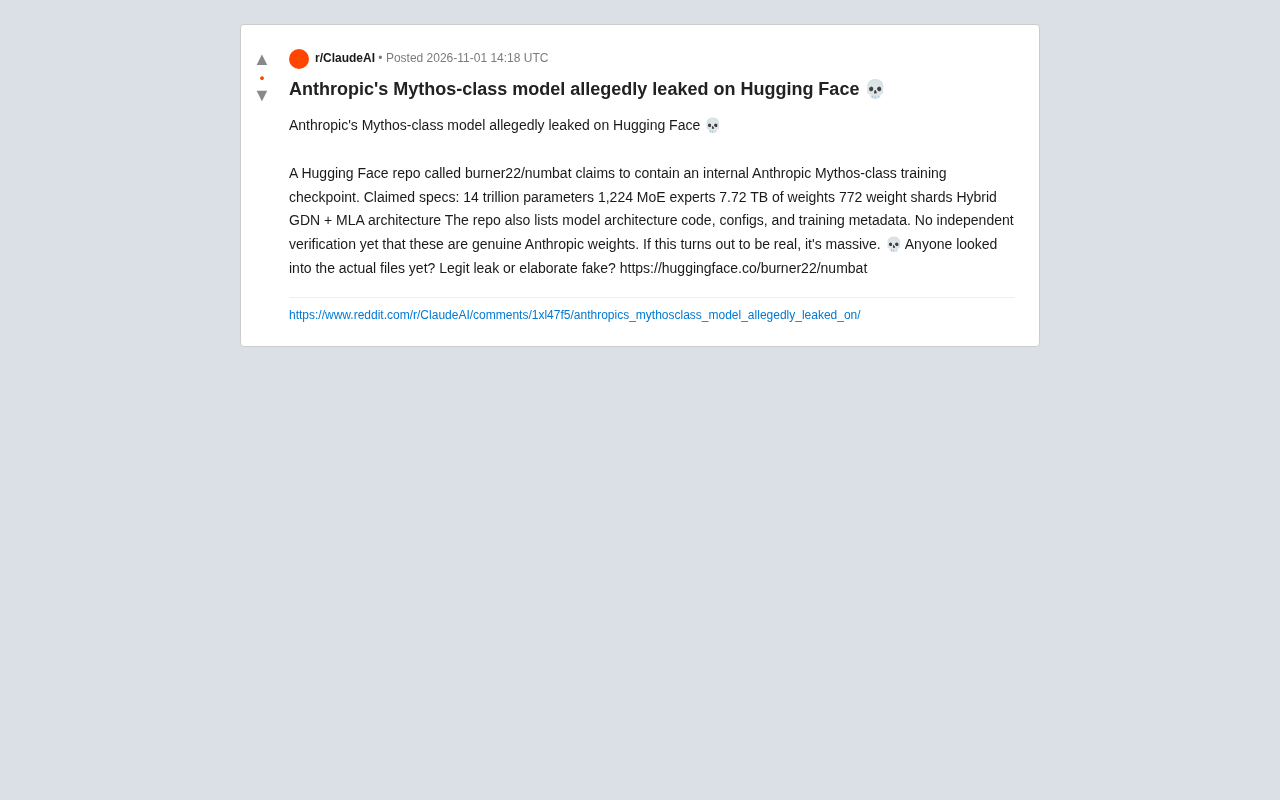
The poster stated bluntly: "If this is real, it would be explosive news." But as of now, no independent verification can prove these weights actually come from Anthropic. Community users have been asking: Has anyone checked the actual files? Is this a real leak or an elaborate fake?
Technical Specification Analysis: The Ambition Behind the Numbers
What Does 14 Trillion Parameters Mean?
Current mainstream public large models typically range from hundreds of billions to trillions of parameters, while 14 trillion parameters means an order of magnitude larger than known models like GPT-4. Such a massive parameter count, combined with 1224 MoE (Mixture of Experts) experts, suggests the model may employ an extreme sparsification design—activating only a small subset of experts per inference to balance computational efficiency and model capacity.
Mixture of Experts (MoE) is an architecture that splits the model's feed-forward layers into multiple parallel "expert" subnetworks and, through a learnable router, activates only a few experts for each token. Its core value lies in decoupling "parameter scale" from "computation": the total parameter count can be very large, but each forward inference only computes the activated experts, so training and inference FLOPs are far lower than an equivalent dense model. Common designs like GShard and Switch Transformer select top-1 or top-2 experts per token, along with load-balancing losses to prevent expert collapse. The "1224 MoE experts" mentioned here belong to this paradigm—the more experts and the lower the activation ratio, the higher the model's sparsity. It should be noted that MoE's engineering challenges lie in the communication overhead of expert parallelism, routing instability, and memory footprint—the total parameters still need to be stored in a distributed manner, just scheduled on demand during computation.
7.72 TB of Weights and 772 Shards
The 7.72 TB weight files require 772 shards for storage, reflecting the engineering challenges of distributing and loading ultra-large-scale models. The hybrid GDN+MLA architecture (GDN likely refers to Gated Delta Networks, MLA to Multi-head Latent Attention) is a popular direction in recent years for improving long-context efficiency. If true, this would be an important disclosure of Anthropic's architectural innovation.
GDN (Gated Delta Networks) belongs to the efficient sequence modeling route of linear attention/state space methods. Its approach uses a gated Delta rule to maintain a compact recurrent state, making the per-step computation approximately independent of sequence length during inference, thereby significantly reducing complexity in long-context scenarios. MLA (Multi-head Latent Attention), proposed by DeepSeekAd-V2, compresses the Key/Value cache into a low-rank latent vector, greatly reducing KV cache memory usage while maintaining the expressiveness of multi-head attention. The combination of the two (GDN handling linear efficient global state, MLA handling compressed attention for precise retrieval) is a popular exploration direction for reducing long-context inference costs: the former excels at streaming state for ultra-long sequences, while the latter provides supplementation when precise recall is needed. If the architecture description in the article is accurate, it indicates the model attempts to control inference costs at the extreme scale of 14 trillion parameters—a key factor in whether such ultra-large models can be practically deployed.
Doubts About Authenticity: The Possibility and Motives of Forgery
Despite the astonishing specifications, several doubts cannot be ignored:
- Lack of verification: Hugging Face repositories can be freely created, the uploader's identity is unknown (
burner22appears to be a throwaway account), and there is no digital signature or official endorsement. - Technical plausibility: Training a 14-trillion-parameter model is extremely costly—would Anthropic need to upload such a confidential checkpoint to a public platform? More likely, the code and configuration in the repository are pieced together, and the weight files may be random data or old models.
- Historical precedent: There have been multiple "leak" incidents that were ultimately proven to be pranks or marketing stunts.
Some community users have attempted to download portions of the shards, but no analysis results have been published yet. Discussion under the Reddit post is polarized: some believe this is an intentional "teaser" from Anthropic, while others mock it as "fake again."
When judging the authenticity of such "leaks," there is a practical technical checklist: First, check the checksums and file headers of the shard files—real weights are typically stored in safetensors format with metadata, while random data often fails deserialization; second, verify the consistency between configuration files and architecture code—forgers often stitch together multiple open-source repositories, causing tensor shapes and layer counts to mismatch config.json; third, check the timestamps, log formats, and distributed training traces in training metadata—real checkpoints leave traces like optimizer state and learning rate schedules; fourth, check the uploader account's historical behavior and registration time—throwaway accounts like burner22 are themselves an important signal. Additionally, Hugging Face repositories by default provide no source authentication—anyone can name a repository in the style of any organization, so "existing on Hugging Face" absolutely does not equal "from Anthropic."
Industry Impact: What Would It Mean If True?
Assuming the leak is authentic, its impact would be multi-faceted:
- Security and compliance: Anthropic has always emphasized AI safety; an internal model leak would raise questions about its data governance capabilities.
- Competitive landscape: If a 14-trillion-parameter model were open-sourced or semi-open-sourced, it could disrupt the existing open-source model ecosystem, forcing OpenAI, Google, and others to adjust their strategies.
- Research value: Details of the hybrid GDN+MLA architecture would provide valuable reference for academia, advancing efficient inference research.
But before independent verification, all of this is speculation. Developers are advised to remain cautious and not blindly download or run weight files of unknown origin to avoid introducing security risks.
Conclusion: Let the Dust Settle
Currently, the authenticity of this repository remains a mystery. The question in the original Reddit post—"Legit leak or elaborate fake?"—is exactly the question on the entire AI community's mind. We will continue to follow subsequent verification progress. Until then, it may be worth viewing this as a stimulus to our imagination about model scale: if 14 trillion parameters become reality, where will the boundaries of AI capability be pushed next?
(This article is based on public Reddit discussion and has not independently verified the repository's contents.)
Related articles

VERS: Editing Activation Explanations to Halve Reasoning Model Tokens
VERS guides reasoning models by editing activation explanations, cutting 45.8% of tokens on GSM8K with only a 0.82 pp accuracy drop and transferring to larger models, but losing accuracy on competition problems.

Finding Errors Is Not Enough: Selective Model Escalation for Entity-Targeted Sentiment Analysis
This study explores selective model escalation for entity-targeted sentiment analysis, comparing data collection ordering, uncertainty-driven re-examination, and model routing—finding that minority-class priority only helps at very small data volumes, the oracle upper bound far exceeds actual gains, and escalation must be tailored to each dataset.

WAS-PO: Using Whitened Advantages to Solve the Correlation Trap in Multi-Reward Reinforcement Learning
WAS-PO paper proposes whitening advantages to correct correlation bias in multi-reward RL: when rewards are correlated, naive weighted summation effectively applies Σ^{1/2}w instead of w. Experiments show training reward improves steadily, but held-out accuracy does not improve in sync, and under two rewards it actually falls behind.