Anthropic Pays $1.25 Billion Per Month to Rent xAI's Compute — The Staggering Deal Behind the AI Race

Anthropic pays $1.25B/month to lease compute from competitor xAI, revealing AI's extreme compute scarcity.
SpaceX's S-1 prospectus reveals that Anthropic signed a cloud services agreement with xAI, paying $1.25 billion per month to rent COLOSSUS supercomputing cluster capacity through May 2029, totaling approximately $45 billion. This massive compute deal between direct competitors reflects the structural mismatch between GPU supply bottlenecks and exploding demand, demonstrating that the AI race is fundamentally a compute race and that capital consumption in frontier AI R&D has reached unprecedented levels.
SpaceX S-1 Filing Reveals a Massive Compute Deal
A seemingly inconspicuous disclosure in SpaceX's recently filed S-1 prospectus has sent shockwaves through the entire AI industry: Anthropic has signed a cloud services agreement with xAI, paying $1.25 billion per month to rent compute resources from xAI's COLOSSUS and COLOSSUS II supercomputing clusters. The agreement runs through May 2029, with a total value potentially reaching approximately $45 billion.
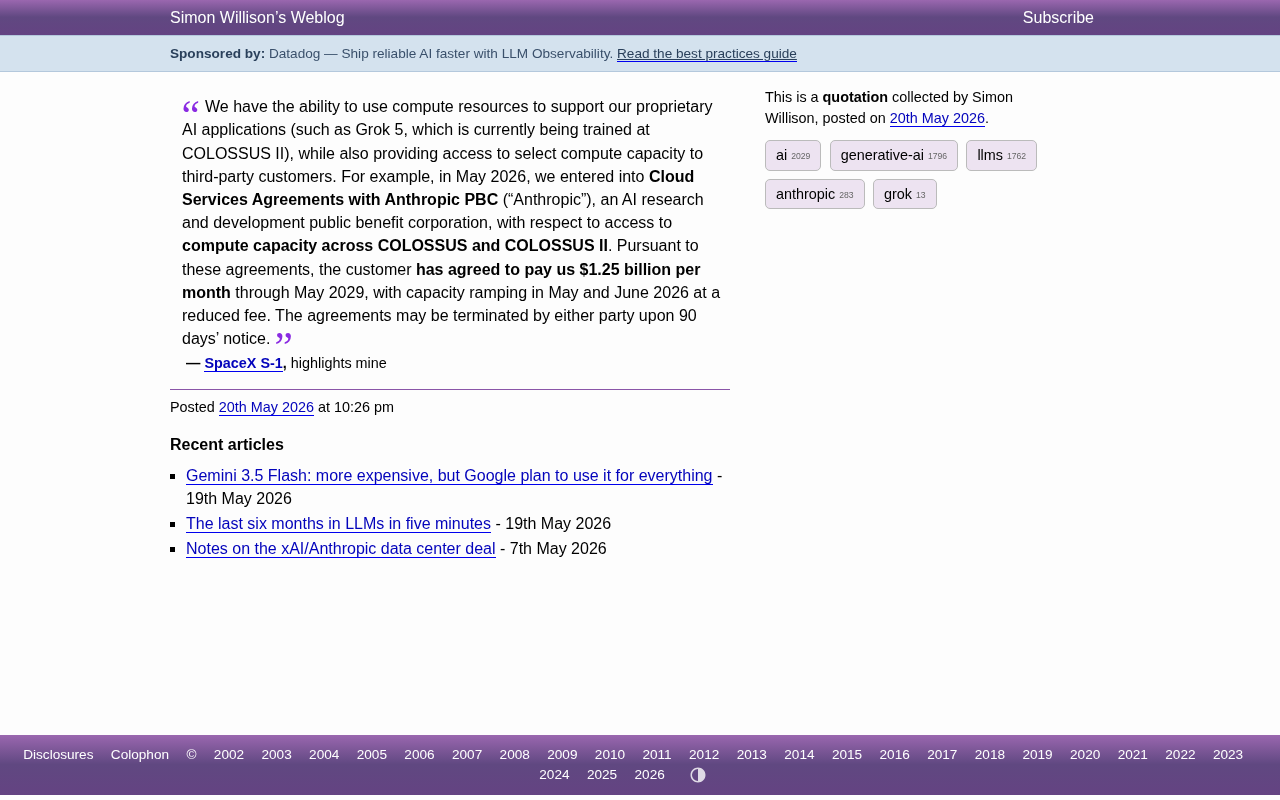
This is not only one of the largest compute leasing deals in AI history — it also reveals an unexpected dynamic in the current AI race: compute collaboration between direct competitors.
Deal Details: An Unprecedented Compute Agreement
According to the original disclosure in the SpaceX S-1 filing, the key terms of this compute deal between Anthropic and xAI include:
- Signing date: May 2026
- Monthly payment: $1.25 billion
- Contract duration: Through May 2029 (approximately 3 years)
- Compute source: COLOSSUS and COLOSSUS II supercomputing clusters
- Ramp-up arrangement: May–June 2026 is a capacity ramp-up period with reduced fees
- Exit mechanism: Either party may terminate with 90 days' notice
Notably, this information appeared in SpaceX's S-1 filing rather than an independent xAI disclosure. The S-1 is a registration statement required by the U.S. Securities and Exchange Commission (SEC) before an initial public offering (IPO), which must detail a company's business operations, financial condition, risk factors, and material contractual relationships. Since Elon Musk controls both SpaceX and xAI, xAI's material commercial contracts must be disclosed in SpaceX's S-1 as related-party transactions — which is why this compute deal first surfaced through SpaceX's filing rather than a voluntary xAI announcement. The filing also mentions that COLOSSUS II is currently training the Grok 5 model, indicating that xAI still has surplus compute capacity available for external customers even while meeting its own training needs.
COLOSSUS: From Zero to World's Largest Supercomputer in 122 Days
xAI's COLOSSUS cluster is one of the world's largest AI training infrastructures. In September 2024, xAI completed the first phase of the COLOSSUS cluster in Memphis, deploying 100,000 NVIDIA H100 GPUs in just approximately 122 days — setting an industry record for supercomputer construction speed. COLOSSUS II is its expanded version, reportedly scaling to over 200,000 GPUs, primarily used for training the Grok series of large models. It is precisely this massive infrastructure reserve that enables xAI to sell surplus compute to external customers while meeting its own needs.
Why Would Competitors Buy Compute From Each Other?
Compute Hunger Is Universal Across the AI Industry
As the developer of the Claude model series, Anthropic is one of the most competitive companies in the AI space, directly competing with xAI's Grok series. However, in an era of extreme GPU compute scarcity, competitive relationships don't preclude commercial cooperation.
The compute required to train frontier large models is growing exponentially. The core of today's AI compute shortage lies in the structural mismatch between NVIDIA GPU supply bottlenecks and exploding demand. Training a GPT-4-class model requires thousands to tens of thousands of A100/H100 GPUs running continuously for months, and inference deployment also consumes massive compute. A single NVIDIA H100 card costs $30,000–$40,000, and global annual supply is limited by TSMC's advanced process capacity constraints. This gives companies capable of building large-scale supercomputing clusters (such as xAI, Microsoft, and Google) enormous bargaining power.
Anthropic previously relied primarily on Amazon AWS and Google Cloud compute resources — the company has received over $4 billion in strategic investment from Amazon and signed a long-term cloud services agreement with AWS, while also receiving billions in funding from Google and using GCP compute. Even so, a multi-cloud strategy still cannot fully meet its ever-expanding needs, which directly led to the decision to lease compute from xAI. xAI's COLOSSUS cluster offers a highly attractive supplementary option.
Business Logic Overrides Competitive Concerns
$1.25 billion per month in revenue represents substantial cash flow for xAI. These funds help xAI amortize the enormous construction costs of its supercomputing infrastructure while providing capital for future expansion. For Anthropic, although paying a competitor for compute may seem contradictory, the strategic value of securing scarce GPU resources far outweighs such concerns.
The 90-day termination notice clause also indicates that both parties have maintained sufficient flexibility — if the competitive landscape shifts, either party can exit the agreement relatively quickly.
Deeper Signals for the AI Industry Landscape
Compute Is Power: Whoever Owns the GPUs Calls the Shots
This deal once again proves that in the current AI race, the party that owns compute infrastructure holds tremendous strategic advantage. By building the COLOSSUS supercomputing cluster at massive scale, xAI not only serves its own Grok model training but has also successfully converted surplus compute into commercial revenue, forming a "Compute-as-a-Service" business model.
Capital Consumption by AI Companies Has Reached Staggering Levels
$1.25 billion per month is only a portion of Anthropic's compute spending. Combined with its existing investments in AWS and GCP, Anthropic's total annual expenditure on computational resources likely far exceeds $10 billion. This also explains why Anthropic needs continuous large-scale fundraising — since 2025, the company has raised tens of billions of dollars in cumulative investment. Anthropic's move also demonstrates that even the best-funded AI companies face a compute supply ceiling.
A New Paradigm of Coexisting Cooperation and Competition
This kind of "coopetition" relationship is not new in the tech industry. Classic examples include: Samsung has long manufactured A-series chips for Apple while fiercely competing in the smartphone market; TSMC simultaneously provides foundry services to competing clients like AMD, Intel, and Apple; Microsoft Azure is both OpenAI's exclusive cloud provider and competes with it through its own Phi series models. The core logic of this model is: the economies of scale at the infrastructure layer far outweigh the strategic risk of serving competitors. However, such direct compute transactions in the AI space are still rare, signaling that the AI industry may develop more complex cooperation networks in the future, further blurring the boundaries between compute providers and model developers.
Conclusion: The Compute Race Is the Essence of the AI Race
This disclosure hidden within SpaceX's prospectus opens a window into how the AI industry truly operates. When a competitor is willing to pay $1.25 billion per month for your compute, it speaks both to the extreme scarcity of GPU compute and to the fact that the capital intensity of frontier AI research has reached an entirely new order of magnitude. The AI race, at its core, is ultimately a race for compute.
Key Takeaways
- Anthropic signed a cloud services agreement with xAI, paying $1.25 billion per month to rent compute from the COLOSSUS and COLOSSUS II supercomputing clusters, with the contract running through May 2029
- This information was disclosed through SpaceX's S-1 prospectus as a mandatory related-party transaction disclosure, with total deal value potentially reaching approximately $45 billion
- xAI's COLOSSUS cluster contains over 100,000 NVIDIA H100 GPUs, was built in just 122 days, and is one of the world's largest AI training infrastructures
- Compute transactions between direct competitors reflect the extreme scarcity of compute resources in today's AI industry, rooted in the structural mismatch between GPU supply bottlenecks and exploding demand
- xAI still has surplus compute to sell externally while training Grok 5, forming a "Compute-as-a-Service" business model
- This deal reveals that capital consumption in frontier AI R&D has reached unprecedented levels — even the wealthiest AI companies face a compute ceiling
Related articles
 Tech Frontiers
A Rare Quiet Day in AI: Recursive Self-Improvement Stirs Beneath the Surface
A rare quiet day in AI sees multiple sources go silent simultaneously. Behind the calm, Recursive Self-Improvement (RSI) research continues. What this means for the industry.
 Tech Frontiers
Reve 2 vs. Ideogram 4: A Deep Dive into Layout Control in AI Image Generation
A deep comparison of Reve 2 and Ideogram 4's layout control capabilities, covering technical approaches, real-world use cases, and industry trends for designers and creators.
 Tech Frontiers
In the Weights: Check Your Influence Score in the AI World
In the Weights is an AI influence search engine that quantifies your presence in the AI world with a score. Explore how it evaluates practitioners and what it means for digital identity.