Anthropic Posts $80.7B Loss in Push for $2T IPO: The Battle for AI's Valuation Anchor

Anthropic's $80.7B loss is an accounting cost of valuation gains; the $2T valuation is the necessary anchor for AI supply chain compute commitments.
Anthropic has filed for an IPO, with Wall Street expecting a raise of up to $100 billion and a valuation of $2 trillion, yet the prospectus shows a first-half net loss of $80.7 billion. The article explains that this loss mainly stems from the book appreciation of convertible-like rights granted in early fundraising—an accounting cost of rising valuation, not a cash outflow. What really matters is the operating data: Q2 and Q3 operating profit has turned positive, Q3 single-quarter revenue was $16.8 billion, and first-half revenue was about $16.3 billion, nearly 15 times the same period last year. Pushing for a $2 trillion valuation isn't just about one company—US AI infrastructure depends on long-term compute contracts signed by leading firms. Anthropic carries roughly $800 billion in compute commitments; after deducting available funds, $569 billion still needs to be covered by future revenue, which under optimistic estimates would take 17 years. The IPO's pricing thus becomes the public-market valuation anchor for the entire AI industry chain, directly affecting whether the giants' $3 trillion-plus AI spending commitments can continue.
A "Contradictory" Prospectus
One of the most closely watched prospectuses in Silicon Valley lately comes from Anthropic. It has officially filed for an IPO, with Wall Street estimating the raise could reach as high as $100 billion and the valuation could hit $2 trillion. Yet the same document plainly states: a net loss of $80.7 billion for the first half of this year.
Many people's first reaction is: losing that much, how can it be worth $2 trillion? The answer to this question lies in the composition of the loss—and in the entire AI infrastructure chain in which Anthropic sits.
The $80.7B Loss: An Accounting Cost, Not Cash Bleed
Most of this $80.7 billion is not what we ordinarily understand as "the business lost money."
During early fundraising, Anthropic granted investors a right similar to convertible bonds—if the company's valuation rose in the future, they could convert into shares at a low price. Now that Anthropic's valuation has soared, the book value of these rights has risen accordingly, and accounting rules require the appreciation to be recorded as a loss.
Put simply, this is an accounting cost driven by rising valuation, not a cash outflow problem. The more valuable the company becomes, the larger this paper "loss" grows—a rather ironic logic.
What's really worth examining is the operating data: Anthropic's Q2 and Q3 operating profit has already turned positive, Q3 single-quarter revenue reached $16.8 billion, and overall first-half revenue was about $16.3 billion—nearly 15 times the same period last year. The combination of rapid growth and an inflection point in profitability is what gives it the confidence to push for a high valuation.

This kind of rights arrangement, common in early-stage fundraising, typically involves fair value remeasurement of financial liabilities under accounting rules. Under US GAAP, when a company grants investors the right to subscribe for future shares at a fixed price, and that right is settled in cash or shares, it may be classified as a liability rather than equity; at each reporting date it must be remeasured at fair value, with the appreciation recorded directly in current-period profit or loss. This is similar to the stock appreciation rights common in equity incentive plans—the higher the company's valuation, the larger the carrying amount of the liability, and the more exaggerated the paper loss. By contrast, real cash outflows appear only in operating cash flow, which is why investors analyzing such companies tend to focus on operating cash flow, free cash flow, and adjusted EBITDA rather than GAAP net income.
Why Must It Push for $2 Trillion?
Since operations are already improving, why insist on listing at an astronomical valuation? Because this isn't just about Anthropic.
This wave of AI infrastructure in the US is sustained by long-term compute deals signed by leading companies like Anthropic and OpenAI. Contracts are signed for 10 or 15 years, and upstream investment in chips, data centers, and power all rests on these long-term commitments. If Anthropic, as a first-tier player, can't secure a super valuation, it becomes very hard for the rest of the chain to keep telling the story.
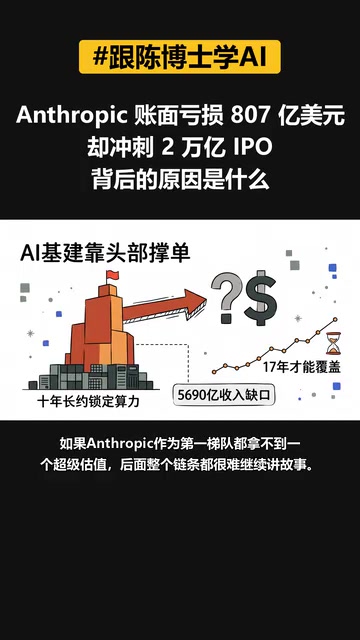
Estimates suggest Anthropic carries roughly $800 billion in compute commitments; after deducting some funding, $569 billion still needs to be covered by future revenue. Even under fairly optimistic profitability assumptions, it would take 17 years to cover. That number alone explains why it urgently needs a super valuation recognized by public markets—only with a high enough valuation can the future revenue story support today's procurement commitments.
The key to understanding compute commitments is distinguishing "total contract value" from "current-period cash spending." Long-term agreements between hyperscale cloud providers and AI companies typically use a "take-or-pay" structure: regardless of whether the full amount is used in the future, the signing party must pay a minimum amount as agreed. Such commitments exist in accounting as off-balance-sheet or note-disclosed "purchase obligations"; they don't go directly onto the balance sheet but constitute real rigid spending. Therefore, when a company's compute commitments far exceed its current revenue, the core of market assessment is whether it can cover these obligations with future revenue growth. This also explains why valuation is so critical for such companies—a high valuation means lower financing costs and stronger credit endorsement, supporting continued signing and execution of long-term procurement contracts.
An IPO That Prices the Entire Industry Chain
The pricing of this IPO is not just a matter of whether the market gives Anthropic face—it's more like providing a publicly recognized valuation anchor for the entire AI industry chain.
Giants like Google, Meta, Microsoft, Oracle, and Amazon have combined AI spending commitments exceeding $3 trillion over the coming years. Whether this money can keep flowing depends largely on whether leading AI companies can deliver on expectations in public markets.
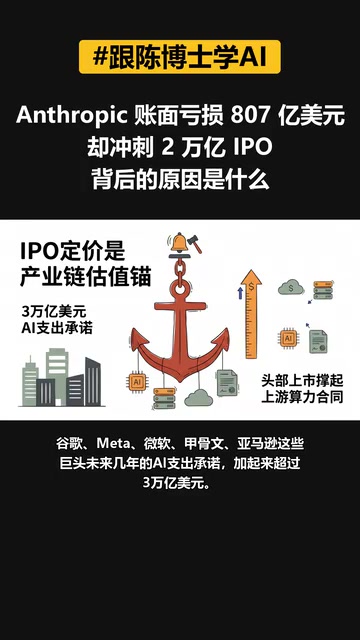
If even the leading AI companies can't support expectations when they go public, how will upstream long-term compute contracts be honored? This is an unavoidable question for the entire industry chain.
"Valuation anchor" is a common concept in capital markets: when the first or most representative company in a sector goes public, its pricing becomes the reference benchmark for valuing similar assets in both primary and secondary markets. For the AI industry chain, Anthropic's IPO pricing will directly affect other AI companies' private fundraising valuations, the collateral value of upstream chip and data center assets, and institutional investors' allocation to the sector. If pricing falls short of expectations, it could trigger a reassessment of the sustainability of AI capital expenditure as a whole; if pricing is strong, it can reinforce the investment narrative that "compute is infrastructure," driving valuation linkage up and down the chain. Thus, the significance of this IPO's pricing goes beyond any single company's fundraising size.
Judgment: $2 Trillion Is, in a Sense, "Necessary"
From an industry logic perspective, Anthropic's push for $2 trillion is necessary in a sense. It needs this valuation to convert its compute procurement commitments for the next decade-plus into a revenue story the market is willing to believe.
So where this IPO ultimately prices may be more worth watching than whether it itself makes money—it directly determines whether the expansion of US AI infrastructure can continue. For those watching the AI industry, this prospectus is not just one company's financial disclosure, but a key window into the entire AI capital cycle.
Related articles

Hermes Agent Beginner's Guide: Hands-On with a Self-Evolving AI Agent
A beginner's guide to Hermes Agent, the open-source self-evolving AI agent that gained 41.7K GitHub stars in two months—covering Harness Engineering, the learning loop, three-layer memory, WSL installation, and hands-on configuration.

AI Agent in Action: Building a Smart Office Assistant with WorkBuddy
A practical case study shows how Tencent WorkBuddy batch-converts and archives files, compares chat LLMs with AI Agents, and analyzes WorkBuddy's credit system, use cases, and positioning for office automation selection.

From Single-GPU Bottlenecks to Hundreds of Billions of Parameters: 6 Key Questions in Large Model Distributed Parallelism
Based on a Bilibili tutorial, this article organizes core knowledge of large model distributed parallelism: starting from decoder-only architecture's token-by-token generation and the essence of X times W computation, it analyzes six key questions including data parallelism, tensor parallelism, and pipeline parallelism under single-GPU bottlenecks. Suitable for learners in private deployment and model training scenarios to build systematic understanding.