Anthropic Quarterly Revenue Soars Nearly 50% to $16.8 Billion, Discloses Distillation Revenue Share Ahead of IPO

Anthropic disclosed $16.8 billion in Q3 revenue ahead of its IPO, up nearly 50% quarter-over-quarter, and is proactively reducing distillation revenue.
At a pre-IPO investor meeting, Anthropic disclosed Q3 revenue of $16.8 billion, up nearly 50% from $11.5 billion in the previous quarter, expanding its revenue scale 3.5-fold within three quarters. Unit economics improved in tandem: every $1 of compute cost generates $1.70 in revenue, and the adjusted operating margin reached 11%. The most notable disclosure is that distillation contributes 5% to 7% of total revenue, yet Anthropic has proactively reduced it substantially in Q3. Overall, Anthropic is building a financial narrative of a disciplined, scaling enterprise ahead of its IPO.
Anthropic disclosed a striking report card to investors ahead of its IPO. According to the Financial Times, the AI company announced at an investor meeting last Wednesday that its third-quarter revenue reached $16.8 billion, up nearly 50% from $11.5 billion in the previous quarter.
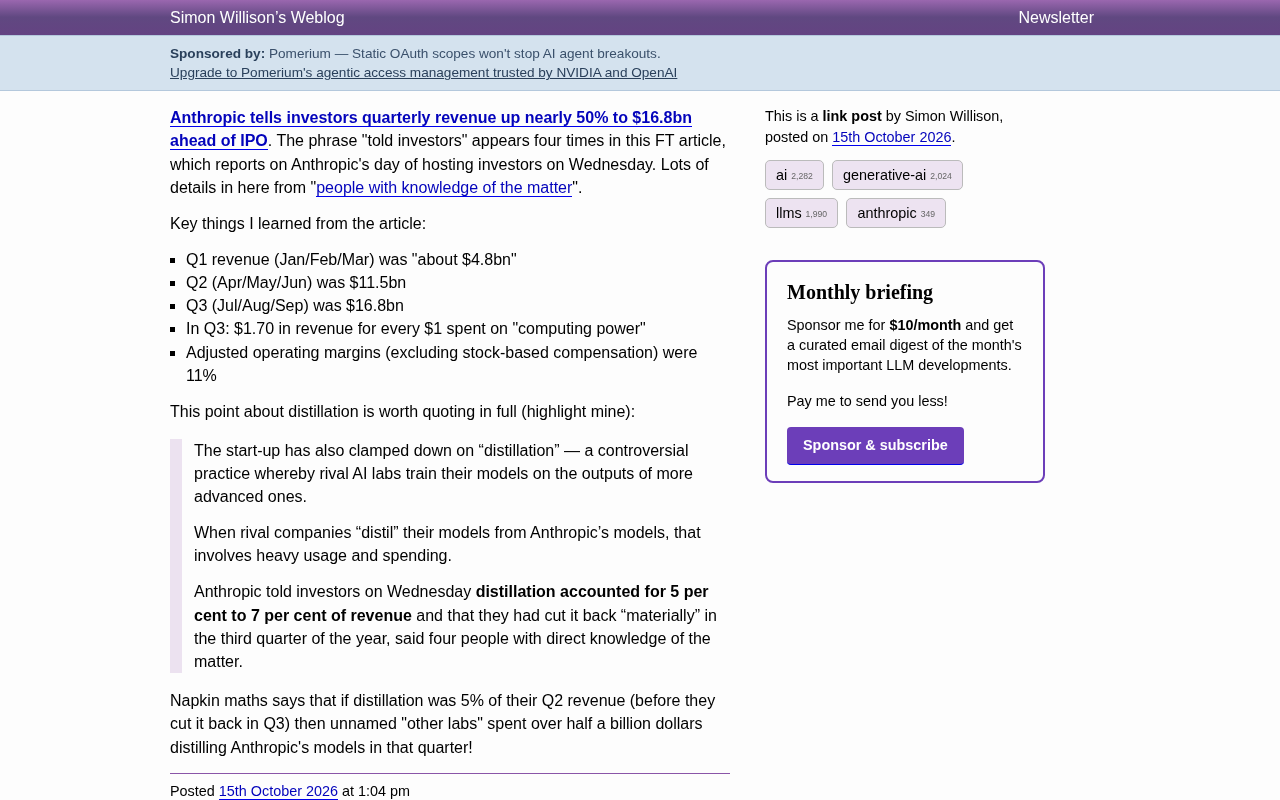
These figures reveal the accelerating pace of commercialization in the AI large-model industry. From approximately $4.8 billion in Q1 to $11.5 billion in Q2, and then to $16.8 billion in Q3, Anthropic expanded its revenue scale 3.5-fold within three quarters.
The Growth Logic Behind the Triple Jump in Revenue
Three quarters, three sets of numbers, tracing a steep growth curve. Q1 (January to March) revenue was approximately $4.8 billion, Q2 (April to June) jumped to $11.5 billion, and Q3 (July to September) climbed further to $16.8 billion. Quarter-over-quarter growth rates were 140% and 46% respectively. Although the growth rate has slowed somewhat, the absolute increment remains substantial.
More noteworthy is the improvement in unit economics. According to disclosures, Anthropic generated $1.70 in revenue for every $1 spent on compute costs in Q3. This ratio reflects the company's optimization room in inference efficiency and pricing strategy.
The adjusted operating margin (excluding stock-based compensation expenses) reached 11%, indicating that Anthropic has initially achieved positive operating cash flow capability. For an AI company still making massive investments in model training, this figure carries significant signal value.
Adjusted Operating Margin is a metric commonly used by pre-IPO companies to demonstrate operational quality to investors. Its biggest difference from the GAAP operating margin is that it excludes items such as Stock-Based Compensation (SBC). For AI companies, SBC tends to be extremely large, because companies need to use substantial options and restricted stock to compete for scarce top researchers.
Therefore, "adjusted operating margin turning positive" does not equate to the company having achieved true accounting profitability. It indicates more that: without considering equity dilution costs, revenue from core operations can already cover cash expenses such as compute, bandwidth, and labor. When interpreting this figure, investors typically need to consider the company's total SBC scale, free cash flow, and future equity dilution pace together. This is also why Anthropic emphasizes the word "adjusted"—it is both a signal of genuine improvement and a carefully chosen narrative framing.
Distillation: The Overlooked Revenue Variable and Industry Undercurrent
The most industry-discussion-worthy aspect of this disclosure is that Anthropic quantified for the first time the revenue contribution from "distillation."
Distillation refers to the practice of competitors using the outputs of more advanced models to train their own models. When other AI labs distill Anthropic's models, it means large volumes of API calls and compute consumption, which directly translates into revenue for Anthropic.
Anthropic revealed to investors that distillation contributed 5% to 7% of total revenue, and that in Q3 it had already "substantially" reduced this revenue source. According to four people with direct knowledge, the company proactively scaled back its distillation business.
Using simple math: if distillation accounted for 5% of total revenue in Q2, and Q2 revenue was $11.5 billion, then spending by "other labs" alone on distilling Anthropic's models exceeded $575 million. This figure reflects a subtle industry reality—the dual relationship between frontier AI companies as both competitors and customers of each other.
Anthropic's proactive reduction of distillation revenue may dampen revenue growth in the short term, but in the long term it may be sending investors a signal: the company values sustainable end-user value more than relying on one-time training expenditures from competitors.
Knowledge Distillation was originally a model compression technique proposed by Hinton et al. in 2015. The core idea is to have a smaller "student model" imitate the output distribution (soft labels) of a large "teacher model," thereby achieving performance close to the large model at lower cost. However, in the current large-model race, the usage of this concept has shifted: when an AI lab makes large-scale API calls to a competitor's frontier model and uses its generated outputs to train its own model, it is essentially "distilling" the competitor's capabilities.
This practice has become an industry undercurrent because it simultaneously touches on technical, commercial, and compliance issues. Technically, it can significantly shorten the catch-up cycle; commercially, the distilled party gains substantial API revenue but may also be cultivating a future competitor; on compliance, most mainstream models' terms of service explicitly prohibit using their outputs to train competing models, so such calls are often conducted in a dispersed and covert manner. Anthropic's willingness to quantify this revenue and proactively reduce it itself indicates that it has recognized that while this money is real, it is difficult to sustain long-term.
The Pre-IPO Financial Narrative: The Balancing Act of Growth and Restraint
In the Financial Times article, "told investors" appears four times, highlighting Anthropic's posture of actively constructing a financial narrative ahead of its IPO. The message conveyed to investors is layered: rapid revenue growth, improving unit economics, positive profit margins, and proactive optimization of revenue structure.
This narrative logic implies a judgment—Anthropic hopes the capital markets will position it as a disciplined, scaling enterprise rather than merely an AI lab burning money for growth. The 11% adjusted operating margin figure, combined with the proactive reduction of distillation revenue, both serve this positioning.
Against the backdrop of the AI industry broadly facing skepticism about "revenue growth coexisting with widening losses," Anthropic's choice to present a combination of positive profit metrics and revenue quality optimization ahead of its IPO makes the timing particularly intriguing.
Pre-IPO investor meetings have a specific function in Silicon Valley and Wall Street parlance: testing the waters. Under the U.S. JOBS Act, companies planning to go public can communicate with institutional investors before formally filing their S-1 to gauge market acceptance of valuation and business model. Disclosures at such meetings are typically carefully designed to both demonstrate growth momentum and preemptively address investor concerns about losses, compliance, and growth sustainability.
The repeated appearance of "told investors" in the Financial Times article is precisely because every word at such occasions may be recorded and revisited. For an AI company that has not yet formally filed its prospectus, proactively disclosing the scale of distillation revenue and explaining that it is being reduced is a typical form of expectation management: rather than letting the market discover on its own after listing that part of the revenue structure is difficult to sustain, it is better to explain it clearly in advance and keep the narrative initiative in one's own hands.
One-line Summary
Anthropic disclosed $16.8 billion in Q3 revenue ahead of its IPO, up nearly 50% quarter-over-quarter, and is proactively reducing distillation revenue.
Paragraph Summary
At a pre-IPO investor meeting, Anthropic disclosed that third-quarter revenue reached $16.8 billion, up nearly 50% from $11.5 billion in the previous quarter, expanding its revenue scale 3.5-fold within three quarters. Unit economics improved in tandem: every $1 of compute cost generates $1.70 in revenue, and the adjusted operating margin reached 11%, indicating the company has initially achieved positive operating cash flow capability. The most industry-discussion-worthy aspect of the disclosure is the quantification of the distillation business—it contributes 5% to 7% of total revenue, but Anthropic has proactively and substantially reduced it in Q3. Based on Q2 data, other AI labs' single-quarter spending on distilling Anthropic's models may exceed $575 million, reflecting the dual relationship between frontier AI companies as both competitors and customers of each other. Overall, Anthropic is attempting to build a financial narrative of a "disciplined, scaling enterprise" ahead of its IPO.
Related articles

NVIDIA's 30,000 Developers Use Cursor, Code Commit Volume Triples
Cursor engineer Chris Diaz breaks down five organizational gaps blocking enterprise AI coding scale—strategy, risk tiering, governance, metrics, and operating model. NVIDIA's 30,000 developers use Cursor daily, tripling code commits while defect rates stay flat. The key: rewrite the SDLC, not add tools.

Ponytail: Giving AI Coding Agents a Senior Engineer's Mindset
Ponytail is a free GitHub tool that injects a senior engineer's mindset into AI coding agents, making them ask whether code is even necessary first. According to TamilDeck, it can compress 200 lines of AI-generated code to 30, cutting token costs, with support for Cursor rules and Claude Code skill integration—though security review still requires human oversight.

Complete Guide to Connecting Cursor AI to the GitHub MCP Server
A step-by-step guide to connecting Cursor AI to the GitHub MCP server: create a personal access token, configure mcp.json, store the token in the ENV block, and verify with a PR query.