Anthropic Releases Claude Opus 5.5: Faster, Cheaper, and Record-Breaking Alignment

Anthropic's Claude Opus 5.5 cuts costs 40%, boosts speed 30%, and sets a new alignment benchmark.
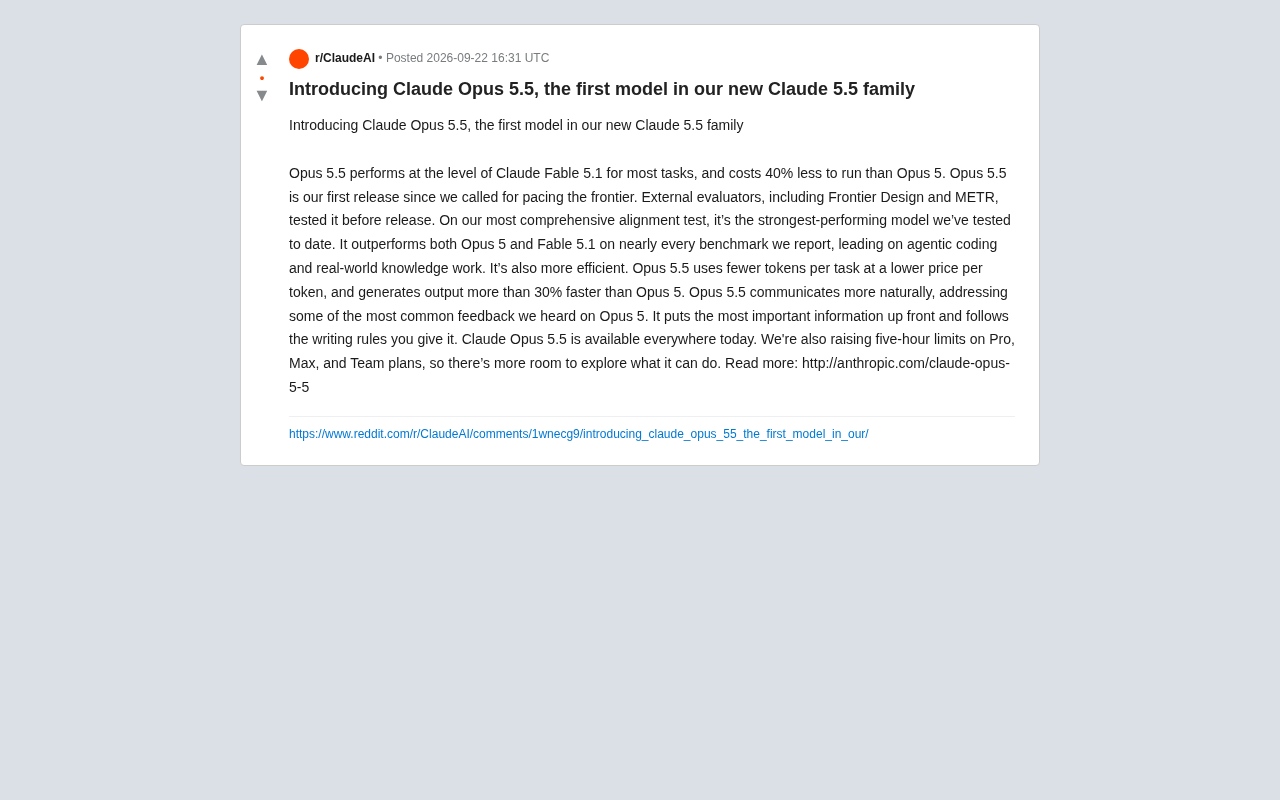
Anthropic has launched Claude Opus 5.5, the first model in the Claude 5.5 family, delivering across-the-board performance gains at significantly lower cost. Compared to Opus 5, it runs 40% cheaper, generates output 30% faster, and consumes fewer tokens per task. It leads on nearly all reported benchmarks, especially in agentic coding and real-world knowledge work. On safety, Opus 5.5 achieved Anthropic's strongest-ever alignment test results and passed external evaluations by METR and Frontier Design. Interaction improvements include more natural communication, front-loaded key information, and stricter adherence to user instructions. Available now on all platforms, with expanded usage limits for Pro, Max, and Team plans.
Anthropic has officially launched Claude Opus 5.5, the first model in the new Claude 5.5 family. What makes this release stand out isn't just the performance gains — it's also the fact that this is Anthropic's first product following its public advocacy for "pacing the frontier." In many ways, it serves as a real-world test of the company's safety commitments.
Performance and Cost: Doing More with Less
The most immediate selling point of Opus 5.5 is efficiency. According to official data, it matches Claude Fable 5.1 performance on most tasks while costing 40% less to run than Opus 5. For enterprises and developers who rely on large models for batch processing, the same budget now goes significantly further.
The efficiency gains play out across three dimensions: fewer tokens consumed per task, a lower per-token price, and generation speeds more than 30% faster than Opus 5. Combined, these improvements deliver cost and latency reductions that are far more impactful than any single metric suggests. For agentic applications, speed and cost are often the critical bottlenecks that determine whether a product can scale — Opus 5.5's improvements in both areas carry real practical weight.
"Pacing the frontier" is a policy position Anthropic began advocating around 2024. The core idea is that leading AI labs should ensure safety evaluations and alignment research can keep pace with capability advances before deploying their most powerful models — slowing releases when necessary. This stance contrasts with the more aggressive release strategies of competitors like OpenAI and Google, and is an extension of Anthropic's Responsible Scaling Policy (RSP). The RSP stipulates that once a model crosses certain dangerous capability thresholds, it must meet corresponding safety standards before training or deployment can continue. Opus 5.5, released after passing external evaluations under this framework, is a live example of this system in action.
Benchmarks: Leading Across the Board
Anthropic states that Opus 5.5 surpasses both Opus 5 and Fable 5.1 on nearly every reported benchmark, with particular leadership in agentic coding and real-world knowledge work.
These two focus areas aren't arbitrary. Agentic coding is currently the hottest commercial frontier for large models, involving complex capabilities like code generation, debugging, and multi-step autonomous execution. "Real-world knowledge work" points toward high-value use cases in office productivity, research, and analysis. Anthropic has invested heavily in programming tools like Claude Code in recent years, and Opus 5.5's coding leadership continues that strategic focus.
Agentic coding is fundamentally different from traditional code completion. Rather than simply generating a snippet, it requires the model to autonomously plan multi-step tasks, invoke tools, process execution results, and iterate based on feedback — operating more like an independent junior engineer. Common benchmarks for evaluating this capability include SWE-bench (which simulates real GitHub issue fixes) and various multi-step tool-use tests. Anthropic's Claude Code product is the commercial embodiment of this direction. Opus 5.5's leadership here means greater practical utility as a coding assistant for complex tasks, well beyond simple snippet generation.
Alignment Testing: The Strongest Performance Yet
The safety and alignment progress deserves its own discussion. Anthropic reports that Opus 5.5 achieved the strongest performance ever recorded in its most comprehensive alignment testing. Prior to release, the model was also evaluated by external assessment organizations including Frontier Design and METR.
Bringing in third-party evaluators is a practice Anthropic has consistently emphasized, and it directly echoes its "pacing the frontier" stance — advancing capability without sacrificing the rigor of safety review. Positioning "strongest alignment performance" and "across-the-board capability leadership" as co-equal selling points is itself a reflection of Anthropic's differentiated positioning: it's trying to demonstrate that safety and capability are not zero-sum.
METR (Model Evaluation & Threat Research) is an independent research organization focused on assessing the potential risks of frontier AI models, with particular attention to autonomy, deceptive behavior, and dangerous capabilities such as cyberattack assistance or bioweapon-related knowledge. Frontier Design is similarly a third-party firm specializing in AI safety evaluation. The value of involving such organizations lies in addressing the credibility problem of self-assessment — conclusions drawn solely by the developer are inherently subject to scrutiny. The industry currently lacks a unified standard for "alignment testing," and the frameworks and disclosure levels vary significantly across companies. External evaluator participation is therefore an important mechanism for improving transparency, and one that distinguishes Anthropic from some of its competitors.
Experience Improvements: Responding to Real User Feedback
Opus 5.5 also includes targeted improvements to the interaction experience. Anthropic is candid that these changes directly address the most common user complaints about Opus 5.
Specifically, the new model communicates more naturally, leads with the most important information, and more strictly follows user-defined writing rules. For users who regularly use Claude for writing and summarization tasks, "front-loading key information" and "following instructions" are two changes that will meaningfully improve the experience — verbose preambles and models that ignore explicit instructions have been persistent pain points.
Availability and Expanded Usage Limits
Claude Opus 5.5 is available today across all platforms. At the same time, Anthropic has loosened the five-hour usage cap for Pro, Max, and Team plans, giving users more room to explore the model's capabilities.
Raising usage limits is a pragmatic signal. Paired with the 40% cost reduction mentioned earlier, Anthropic has the headroom to let more users engage with the new model at higher frequency without worrying about runaway compute costs. This simultaneous push of "lower costs" and "higher limits" typically signals that the company has strong confidence in the new model's commercial prospects.
Summary
Opus 5.5's highlights can be summarized as: across-the-board performance gains, significantly lower costs, faster speeds, record-setting alignment test results, and an interaction experience that better matches how users actually work. As the opening act of the Claude 5.5 family, it represents both a routine capability iteration and a public statement from Anthropic about responsibly advancing the frontier. For developers and enterprise users, the lower costs and expanded usage limits are the most tangible benefits — well worth putting to the test in real workflows.
Related articles

AI Is Not a Replacement: Human-AI Collaboration Through the Lens of Factory Root Cause Analysis
Starting from factory root cause analysis, this article explains how AI accelerates evidence chain construction rather than replacing human experts, exploring the pragmatic implementation logic and business value of 'AI supporting people rather than replacing them.'

AI Agent Decision Auditing: Building an Evidence Chain in Regulated Workflows
Starting from a Reddit discussion, this article analyzes three core issues in AI agent decision auditing within regulated workflows: what fields audit records should contain, how to handle feedback latency for erroneous decisions, and how to continuously calibrate LLM judge consistency with human judgment.

Apple Opens Multiseat Subscription Purchasing: App Subscriptions Can Now Be Sold in Bulk to Businesses and Schools
Apple opens multiseat purchasing for auto-renewable subscriptions: businesses and schools can bulk-buy via Apple Business and Apple School Manager, adding or removing seats anytime. Enabled by default in App Store Connect—developers should verify settings; group purchasing sandbox testing opens October 2026.