Anthropic's $80.7 Billion "Loss": Accounting Magic or Real Crisis?

Most of Anthropic's $80.7 billion loss is a convertible note accounting adjustment, not cash outflow, with operations trending healthy.
The Reddit community analyzed Anthropic's $80.7 billion SEC-reported loss, concluding about $72 billion stems from convertible note value changes—a non-cash accounting adjustment reflecting rising valuation. Users highlighted the healthy gross margin of $16 billion revenue vs. $9 billion compute costs, while debating $86 billion chip leases and SPV debt opacity. Most agreed Anthropic is in a high-growth R&D phase where net profit isn't the goal, and understanding GAAP vs. Non-GAAP matters more than the loss figure.
Anthropic's recent SEC filing shows an $80.7 billion loss, a figure that quickly went viral on social media. But after an in-depth discussion spanning hundreds of comments, the Reddit community reached a very different conclusion: most of this "loss" is a paper game.
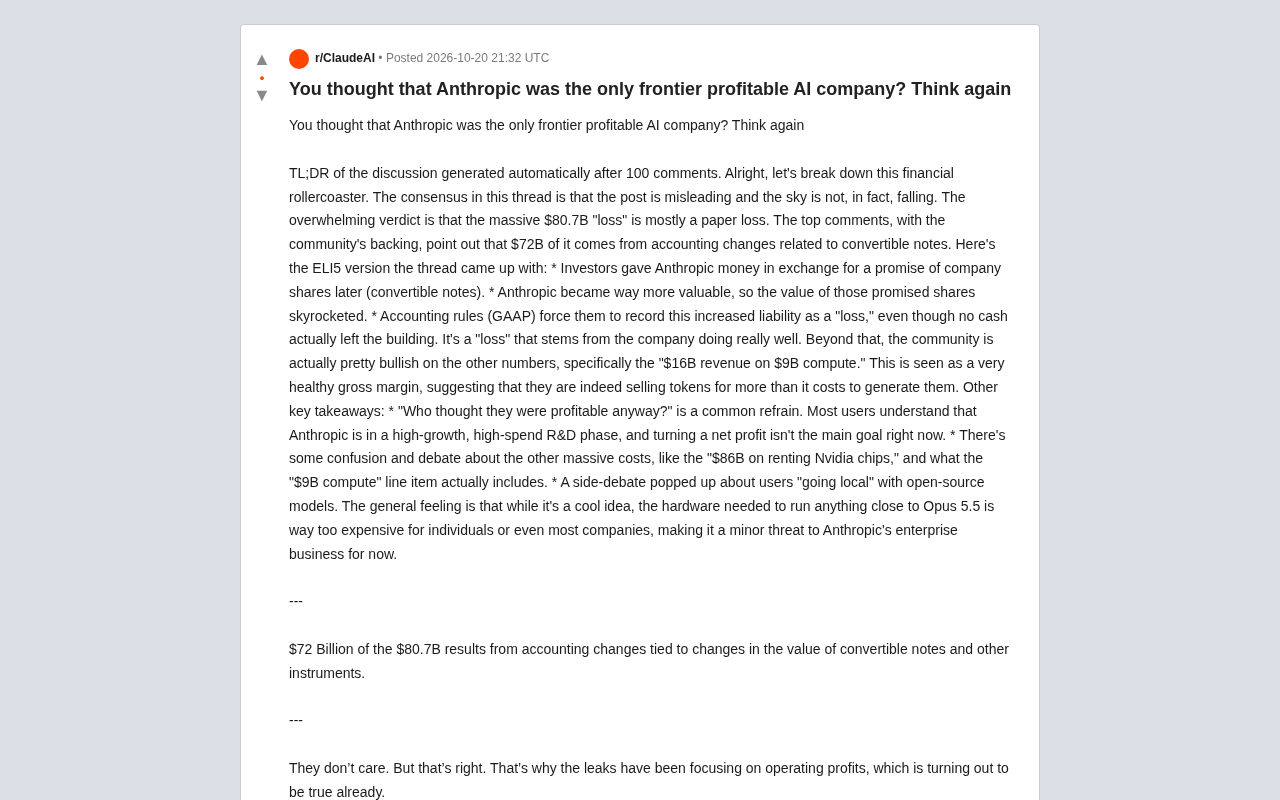
The Truth Behind the $80.7 Billion "Loss": The Accounting Effect of Convertible Notes
According to the community consensus in the Reddit discussion, about $72 billion of the $80.7 billion loss comes from accounting adjustments related to changes in the value of convertible notes and related financial instruments. This is not a cash outflow, but rather a bookkeeping result under GAAP accounting standards.
A highly upvoted comment offered a plain-language explanation: investors injected capital into Anthropic in the form of convertible notes, agreeing to convert them into company shares in the future. As Anthropic's valuation climbed sharply, the value of these promised shares soared accordingly. Accounting standards require the company to record this increase in liabilities as a "loss," even though no cash left the company's accounts.
In other words, this "loss" stems precisely from the company performing too well. One user in the community put it bluntly: "They don't care about this number at all. That's also why the leaked information has consistently focused on operating profit, which has actually started to turn positive."
Convertible Notes are a financing instrument that sits between debt and equity. Investors inject capital in the form of a loan, agreeing to convert it into company shares at a predetermined price at some future point (or when specific conditions are triggered). For startups, the advantage of this instrument is that it delays valuation pricing and reduces financing friction. The key accounting point is this: when the company's valuation rises, the value of the shares to be issued upon conversion also rises, and GAAP requires the company to recognize this incremental amount as a change in the fair value of a liability, recorded in current-period profit and loss. As a result, a fast-growing company may show a massive "loss" on paper, even though no cash has flowed out. This is similar in logic to paper losses caused by stock-based compensation—both are non-cash items that analysts typically exclude in Non-GAAP figures.
The difference between GAAP and Non-GAAP is key to understanding this type of reporting. GAAP (US Generally Accepted Accounting Principles) requires that non-cash items such as changes in the fair value of convertible notes, stock-based compensation, and asset impairments be included in net income, with the goal of presenting investors with the full set of economic obligations. Non-GAAP figures, by contrast, allow companies to exclude these items, bringing the numbers closer to the true cash performance at the "operating level." The SEC has clear rules on this: companies may use Non-GAAP metrics, but they must disclose them alongside GAAP metrics with reconciliation explanations, and must not give them greater prominence than GAAP metrics. It is industry practice for tech companies to present both sets of numbers in their financial reports. If media outlets cite only GAAP net income, they can easily magnify the impact of paper losses while ignoring the real trends at the operating level.
$16 Billion in Revenue vs. $9 Billion in Compute Costs: A Healthy Signal
Setting aside the paper losses, the community was more excited about another set of numbers: $16 billion in revenue against $9 billion in compute spending. By this calculation, Anthropic's gross margin is quite respectable, meaning they are indeed selling tokens at a price above the cost of generating them.
One comment noted: "It's still a deficit of more than half of revenue, but if you factor in the hardware debt hidden in the SPV, the situation is much better than I expected." Another user added that this kind of paper revenue shows up in Amazon's and Google's financial reports, but the media prefers the impact of big numbers.
Gross margin has its own particularities in the context of AI model companies. Traditional SaaS companies often have gross margins above 70%–80%, because the marginal cost of replication is extremely low; large model companies, however, require continuous GPU compute for inference, and token generation has a real marginal cost. Therefore, when measuring gross margin as "revenue minus compute costs," it is important to note that compute spending may include both training (capitalized, one-time model R&D investment) and inference (recurring operating costs that grow with usage). If training accounts for a high share of the $9 billion in compute spending, the actual inference gross margin would be higher; otherwise, it would be lower. This is precisely the substance of the community debate over "what exactly the $9 billion covers."
Community Divisions: Compute Costs and the Murky Territory of SPVs
The discussion was not monolithic. Some users raised a question: if Anthropic pays cloud providers such as Microsoft for compute in the form of convertible notes, would its profitability look worse? This question sparked debate over exactly what the $9 billion in compute spending covers.
The community was similarly confused about the $86 billion spent on renting NVIDIA chips. Some users argued that the SPV (special purpose vehicle) structure makes it difficult to judge the true scale of the hardware debt. Other comments reminded that this SEC filing cannot be handled as flexibly as Anthropic's previous "creative accounting," because "you can't just play tricks on an SEC filing." But someone immediately countered: "Companies make Non-GAAP reports in SEC filings all the time."
SPV (Special Purpose Vehicle) is a legal entity independent of the parent company's balance sheet, commonly used for structured finance, asset securitization, or large-scale equipment leasing. In the AI compute sector, companies may lease chips from suppliers such as NVIDIA through an SPV, with the SPV holding the hardware assets and bearing the debt while the parent company pays usage costs in the form of lease fees. The advantage is that the hardware debt does not appear directly on the parent company's statements, but the cost is that the true scale of debt and rigid spending obligations becomes difficult to judge from the outside. Investors need to combine footnotes, lease commitment disclosures, and related-party transaction information to reconstruct the full financial picture. This is the fundamental reason the community is confused about the "$86 billion chip lease."
Can Local Open-Source Models Threaten Anthropic?
The discussion also spawned a side topic: whether users running open-source models "locally" would disrupt Anthropic's enterprise business. The community's overall judgment was that while the idea is cool, the hardware cost required to reach a level close to Opus 5.5 would be too expensive for individuals and even most companies. In the short term, this can only be considered a secondary threat.
Most users have a clear understanding of Anthropic's positioning: it is in a high-growth, high-investment R&D phase, and net profit is not its current priority. The rhetorical question "Who thinks it's already profitable?" appeared repeatedly in the discussion, suggesting that outside interpretations of AI companies' financial data often ignore the basic facts of their stage of development.
The value of this discussion lies in revealing a more general phenomenon: when AI companies' financial data is reduced to headlines about "massive losses," key context such as accounting rules, stage of development, and business structure is often overlooked. For those following the AI industry, understanding the difference between GAAP and Non-GAAP may be more important than remembering a loss figure.
One-line Summary
Most of Anthropic's $80.7 billion loss is a convertible note accounting adjustment, not a cash outflow, and the operating level is already trending healthy.
Paragraph Summary
The Reddit community held an in-depth discussion about the $80.7 billion loss in Anthropic's SEC filing. The conclusion is that about $72 billion of it comes from accounting adjustments for changes in the value of convertible notes, not an actual cash outflow—and it actually reflects the company's rising valuation. The community focused more on the healthy gross margin implied by $16 billion in revenue against $9 billion in compute costs, believing that Anthropic sells tokens above the cost of generation. The discussion also exposed divisions: the $86 billion chip lease spending and the SPV structure make the true scale of debt hard to judge, and there is disagreement over whether SEC filings can be "manipulated." In a side topic, the community believed local open-source models are unlikely to threaten Anthropic's enterprise business in the short term. Most users emphasized that Anthropic is in a high-growth, high-investment R&D phase, that net profit is not its current goal, and that understanding the difference between GAAP and Non-GAAP is more important than remembering the loss figure.
Related articles

Gemini 4 Argon Hands-On: AI Builds Board Games, Constructs Temples, and Trains Robots Autonomously
Gemini 4 Argon hands-on roundup: AI autonomously builds a desk racetrack and temple in Blender, writes a ray tracing engine, trains a humanoid robot to sink 7 shots, plus API pricing and developer access.

The Magic Octagonal Coin: Why Only 9% of People Can Predict Its Flip?
Only 9% of people can correctly predict the Magic Octagon coin flip. This article explains its spatial rotation mechanism, common cognitive pitfalls, and a new hypothesis based on Relevance Theory, exploring the limits of human spatial reasoning.

Sam Altman: AI Is Entering the Era of Scientific Discovery — Math Breakthroughs Will Replicate in Biology and Energy
Sam Altman says AI is entering the era of scientific discovery — math breakthroughs will replicate in biology, materials science, and energy to help develop new drugs and energy sources.