Anthropic's Ban Backfires as Unexpected Free Ad for GLM? The Story Behind an Open-Source Model's Viral Moment

Anthropic's move against GLM accidentally went viral, turning the Chinese open-source LLM into a trending topic on Reddit.
A sarcastic Reddit post revealed a fascinating industry dynamic: Anthropic's restrictive action against GLM, the open-source LLM from Zhipu AI, backfired spectacularly — generating massive unexpected exposure for the model instead. In open-source communities, being "blocked by a big player" is often read as a badge of credibility, creating a classic reverse amplification effect. The post reflects a deeper industry trend: as closed-source models pile on more restrictions around pricing, access, and usage terms, developer interest in open-source alternatives keeps climbing. GLM's appeal — local deployment, data sovereignty, cost control — is only growing stronger.
A Ban That Became an Accidental Marketing Campaign
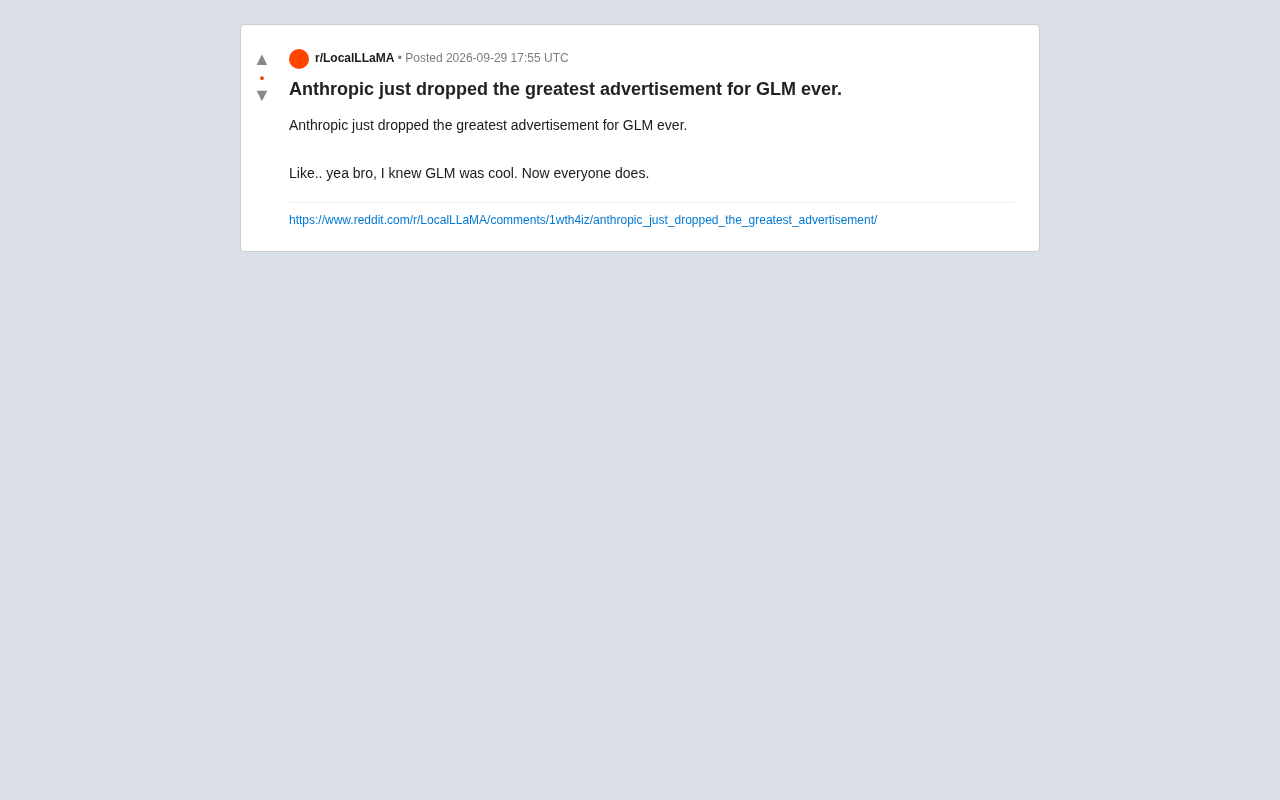
Recently, a post in Reddit's AI community sparked quite a bit of discussion. The author wrote in a sardonic tone: "Anthropic just dropped the greatest advertisement for GLM ever."
The implication was delightfully ironic — GLM, a Chinese open-source LLM previously known mainly within niche developer circles, suddenly gained widespread attention overnight, all because of something Anthropic did. The poster added, half-jokingly: "Yeah man, I already knew GLM was cool, now everyone knows."
The post was brief, but it captured an interesting phenomenon playing out across the AI industry: restrictive moves by top-tier players can sometimes give competitors or alternative solutions unexpected exposure.
Why Call It "the Greatest Advertisement"?
In internet culture, being "targeted by a big company" often reads as being "validated by a big company." When a leading AI firm like Anthropic takes restrictive action against a third-party model or use case, the community's first instinct is rarely "that model must be bad" — it's more like "that model must be good enough to make the big players nervous."
This dynamic is especially pronounced in open-source communities. GLM, the large language model series developed by Zhipu AI, already had a solid reputation among open-source developers. Once it got pulled into a conversation involving Anthropic, the discussion naturally amplified, effectively delivering low-cost brand exposure.
The tone of the original poster reflects a sentiment shared by many developers: they didn't need convincing that GLM was good, but they were happy to see more people finally noticing this previously under-the-radar option.
GLM (General Language Model) is a large language model series jointly developed by Tsinghua University and Zhipu AI, encompassing multiple versions including GLM-4 and ChatGLM. Unlike purely closed-source models such as GPT or Claude, the GLM series offers open-weight downloads, allowing developers to self-deploy on local machines or private servers. This makes it popular among developers who prioritize data privacy and cost control. The series performs particularly well on Chinese language understanding and generation tasks, while also offering strong support for English and coding tasks — making it one of the most internationally visible Chinese open-source LLMs.
The Rising Value of Open-Source Models Is Being Reassessed
Behind this Reddit post lies a larger industry trend that's been building for some time. As closed-source commercial models increasingly impose restrictions on pricing, access permissions, and terms of use, developer communities are paying more and more attention to open-source and semi-open-source alternatives.
The reason GLM could ride this wave of discussion comes down to something fundamental: it offers a path that diverges from the purely closed-source route. For teams that care about cost control, data sovereignty, or deployment flexibility, models like GLM are becoming increasingly attractive.
When leading companies raise barriers through terms of service or technical restrictions, they inadvertently push more users to actively explore and evaluate alternatives — and that's precisely what Reddit users meant by "the greatest advertisement."
"Semi-open-source" models typically refer to models whose weights are public but come with commercial use restrictions (such as non-commercial use only, or requiring a license application) — sitting somewhere between fully closed commercial APIs and permissive open-source licenses like Apache or MIT. Anthropic's Claude series is a classic example of a closed-source commercial model: users can only access it via API, cannot obtain model weights, and are subject to terms of service that restrict access by region, use case, and daily call volume. This fundamental difference in access models is precisely the structural driver pushing developers toward open-source alternatives like GLM — when a closed-source service hits access barriers due to policy or business decisions, locally deployable open-source models naturally become the fallback.
An Industry Signal Worth Watching
It's worth noting that the Reddit post itself carries limited factual detail — it's largely an expression of community sentiment, without providing specific context about what exactly Anthropic did. So the following observations are better treated as lenses for interpretation rather than firm conclusions:
- Bans or restrictions by major players can easily trigger a reverse amplification effect on social media;
- Community recognition for open-source LLMs often reaches a broader audience precisely through these kinds of "accidental events";
- AI competition is no longer purely a technical race — the battle over openness, accessibility, and user trust matters just as much.
For readers tracking the AI ecosystem, these kinds of organically forming community discussions are themselves a window into shifting market sentiment and evolving model reputations. As more and more people begin weighing the trade-offs between closed-source and open-source options, any move by a top-tier player can become a footnote in the subtle reshaping of competitive dynamics.
Related articles

OpenAI Partners with Shield: How the Astra Agent Revolutionizes IT Troubleshooting
OpenAI and Shield launch the Astra agent, which autonomously logs into computers and legacy systems to fix IT issues in real time, 35-40% faster than traditional models, with humans involved only when judgment is needed.

iPhone Duo Battery Life Tested: One Charge a Day Is Unavoidable, and the Large Screen Is the Culprit
iPhone Duo battery test: heavy use needs at least one charge a day, and about 30% remains after 6.5 hours of screen-on time. How often the large screen is unfolded is key; a MagSafe battery pack helps, and long-term degradation is also worth watching.

Kimi K3.1 Pro Open-Sourced: 2.8 Trillion Parameters Close In on Opus
Moonshot releases the open-source MoE model Kimi K3.1 Pro, with 2.8T total parameters and 104B activated, trailing Opus 5.5 by under 1 point on Terminal Bench 4.0.