Anthropic's Business Plan: Betting Big on Compute—Building a God or Selling IT?

Anthropic's S-1 filing is seen as a bold compute bet on AGI, packaged for Wall Street as an IT services company.
After Anthropic's S-1 filing surfaced, the tech world interpreted it as an ultimate gamble: 'either build a god or die trying.' The article notes that this pre-IPO disclosure essentially justifies unlimited compute investment, signaling the company 'will spend as much money as possible on computing resources.' Meanwhile, Anthropic faces a fundamental narrative tension: its long-term vision points to AGI, but going public requires a predictable revenue model and enterprise customers, creating a dual narrative of 'building a god' and 'selling IT services.' If this logic holds, it could reinforce the 'compute as a moat' competition among frontier labs, and investors must distinguish whether they're buying a high-growth software company or a cash-devouring compute machine. Specific financial figures and risk factors remain incomplete.
Title
Anthropic's Business Plan: Betting Big on Compute—Building a God or Selling IT?
Meta Description
Anthropic's S-1 filing reveals the core contradiction of its business plan: telling Wall Street an IT services story while providing financial justification for maximum compute investment. This article analyzes this dual narrative of "building a god or selling IT" and its implications for the industry.
Article Content
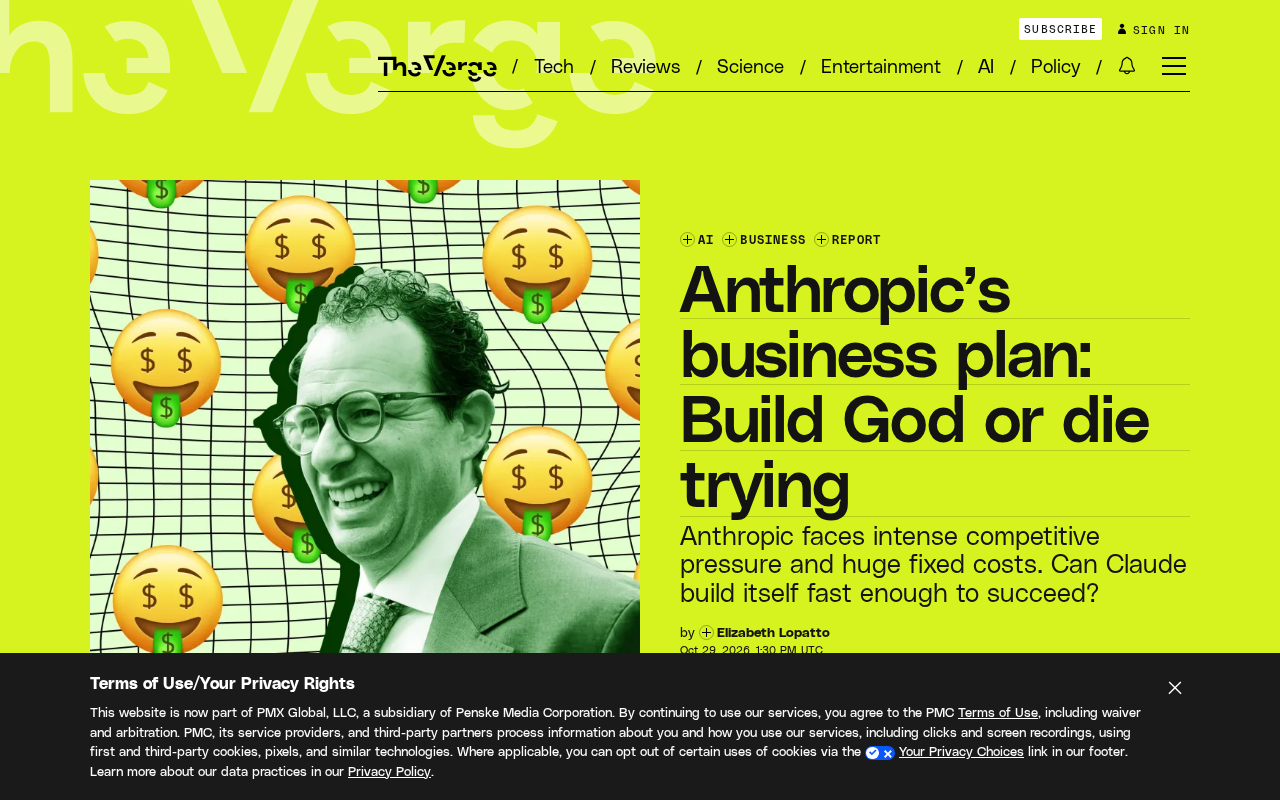
After Anthropic's S-1 filing surfaced, the tech world began re-examining the company's ambitions. What appears to be a routine pre-IPO disclosure has been interpreted as an ultimate gamble: "either build a god or die trying."
A Compute Arms Race Exposed by an S-1 Filing
According to analysis of the original report, Anthropic's S-1 filing essentially provides financial justification for its unlimited investment in compute. In other words, the company is sending a signal to capital markets: we will spend as much money as possible on computing resources.
This is not without precedent. Anthropic has always treated safety and scale as two sides of the same coin, and large-scale pre-training and inference require astronomical compute support. The S-1 disclosure gives the outside world its first opportunity to understand, from a financial perspective, just how many chips this company has placed on "bigger models."
An S-1 filing is a registration statement that companies must submit to the U.S. Securities and Exchange Commission (SEC) before an initial public offering (IPO), typically containing core disclosures such as business model, financial data, risk factors, and management discussion. It is both a regulatory compliance document and the primary vehicle through which a company tells its growth story and valuation logic to potential investors. For AI companies, the "use of proceeds" and "risk factors" sections in an S-1 are particularly critical, because large-scale compute procurement, data center construction, and long-term R&D investment often require advance explanation to capital markets of their necessity and sustainability. For this reason, an S-1 filing not only reflects a company's current financial situation but also exposes its strategic bets on the future.
The Dual Narrative of "Building a God" and "Selling IT"
The original report raises a sharp observation: if you're curious whether Anthropic is going all out to build a "machine god" while simultaneously trying to convince Wall Street that it's just an IT services company, this filing perfectly demonstrates that delicate balancing act.
There is a fundamental tension here. On one hand, Anthropic's long-term vision points toward artificial general intelligence, and its safety research is built on the premise of being "powerful enough to change the world." On the other hand, going public requires a predictable revenue model, enterprise customers, and a clear commercialization path. Telling investors "we're building a god" is clearly less reassuring than saying "we're selling APIs."
This dual narrative is not unique to Anthropic, but its S-1 puts this contradiction on the table in the most blunt way possible: the financial data supports compute investment, while the business story is packaged as IT services.
Artificial general intelligence (AGI) generally refers to AI systems that match or exceed human-level performance across a broad range of cognitive tasks. Frontier AI labs often set AGI as their long-term goal, but their safety research is also built on a premise: future models may become powerful enough to have systemic impact. Meanwhile, the enterprise AI market currently primarily sells API calls, model hosting, and customized services, with revenue models closer to cloud computing or software as a service (SaaS). This gap between "long-term vision" and "short-term commercialization" is the key background for understanding AI companies' IPO narratives—capital markets demand both predictable revenue growth and proof that a company's technological leadership can continuously translate into commercial advantage.
What It Means for the Industry
If Anthropic's S-1 does provide justification for maximum compute spending, this could reinforce the competitive logic of the entire frontier lab ecosystem—compute is the moat, and insufficient investment means falling behind. For secondary market investors, what needs to be distinguished is: are you buying a high-growth software company, or a cash-devouring compute machine?
Currently, publicly available information remains limited, and the specific financial figures and risk factors in the S-1 have not been fully elaborated. But a clear signal has already been sent: in Anthropic's blueprint, compute is not a cost item—it is the bet itself.
(This article analyzes based on limited information from the original report; specific financial details are subject to official documents.)
"Compute as a moat" refers to the logic by which frontier AI labs treat large-scale computing resources as their core competitive barrier. Training and running large models requires massive GPU clusters, high-speed interconnect networks, and supporting power infrastructure—investments with extremely high fixed costs and long construction cycles. Once a lab leads in compute scale, it may iterate models faster, attract more users, and dilute per-unit inference costs, forming a positive feedback loop. Conversely, insufficient investment may cause it to fall behind in the next-generation model race. Therefore, the "maximum compute spending" implied by the S-1 filing is not merely a financial choice but a competitive strategic signal that may force peers to follow suit, further raising the capital expenditure threshold for the entire industry.
One-line Summary
Anthropic's S-1 filing is interpreted as a bold compute bet on AGI, packaged for Wall Street as an IT services company.
Paragraph Summary
After Anthropic's S-1 filing surfaced, the tech world interpreted it as an ultimate gamble: "either build a god or die trying." The article points out that this pre-IPO disclosure essentially provides financial justification for the company's unlimited compute investment, sending a signal that it "will spend as much money as possible on computing resources." Meanwhile, Anthropic faces a fundamental narrative tension: its long-term vision points toward artificial general intelligence, but going public requires a predictable revenue model and enterprise customers, creating a dual narrative of "building a god" and "selling IT services." If this logic holds, it could reinforce the frontier lab competitive logic of "compute as a moat," and investors need to distinguish whether they're buying a high-growth software company or a cash-devouring compute machine. Currently, specific financial figures and risk factors have not been fully elaborated.
Related articles
OpenAI Math Breakthrough, Anthropic IPO, and Reasoning Model Tutorial
OpenAI unveils math, CS, and physics results, claiming proof that ETH is false; Anthropic files for IPO, disclosing revenue and customer data; SpaceX gets $40B GPU financing; open-source model tool-calling accuracy issues and constrained decoding; 8-video reasoning model tutorial.

14 Core Concepts of Reasoning Models: From Chain of Thought to GRPO Explained
A systematic breakdown of 14 core concepts of reasoning models: chain of thought, test-time compute, verifiers, RLVR and GRPO, distillation, and reward hacking, plus rules for controlling thinking-token costs to help you decide when reasoning is worth paying for.

OpenAI's Claimed Refutation of ETH Sparks Debate, Meta Bets Big on AI Infrastructure
OpenAI claims an AI-assisted discovery that challenges the Exponential Time Hypothesis (ETH) and launches the mid-tier GPT-6.1 Tera. Cloudflare discloses a cross-customer data leak postmortem, and Meta plans $95B in AI infrastructure financing.