Anthropic's Conceptual Reasoning Index (CRI): A New Standard for Evaluating AI Reasoning Capabilities

Anthropic's CRI redefines AI evaluation by measuring conceptual reasoning over mere answer correctness.
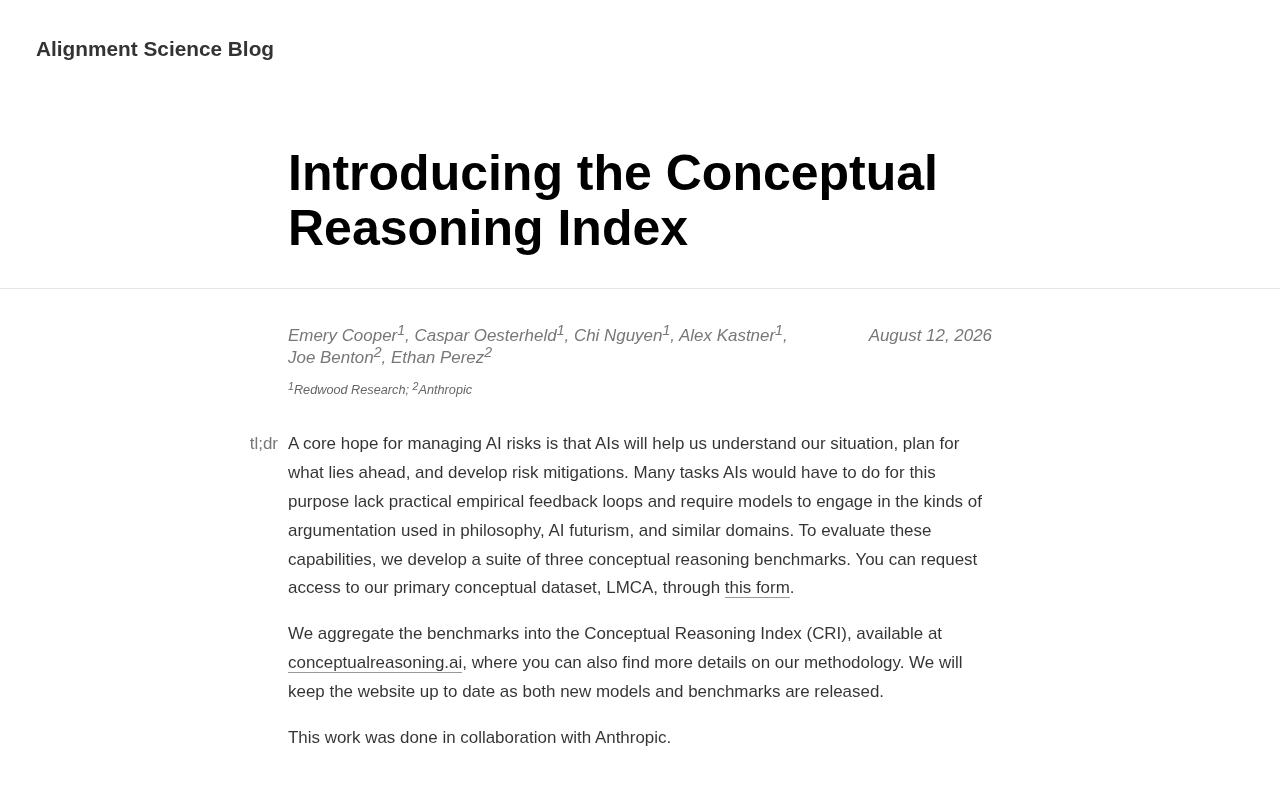
Anthropic's Conceptual Reasoning Index (CRI) represents a paradigm shift in AI evaluation, moving beyond saturated traditional benchmarks like MMLU and GSM8K to assess whether models truly reason through concepts rather than pattern-match answers. The framework evaluates concept transfer, logical structure recognition, and multi-step reasoning consistency, sparking Hacker News debate about benchmark neutrality, data contamination, and whether reasoning can be captured in a single index.
Introduction: Why We Need a New Reasoning Benchmark
Anthropic recently introduced an evaluation framework called the "Conceptual Reasoning Index" (CRI), aiming to provide a more rigorous measure of large language models' reasoning capabilities. This topic sparked discussion on Hacker News—while not explosively popular (32 points, 22 comments), the industry trends it reflects are worth a deep dive.
As GPT, Claude, Gemini, and other models achieve near-saturated scores on traditional benchmarks (such as MMLU and GSM8K), the industry increasingly recognizes that these metrics can no longer truly reflect a model's "thinking" ability. MMLU (Massive Multitask Language Understanding) is a multiple-choice test covering 57 subjects, ranging from humanities and social sciences to STEM fields; GSM8K is a dataset containing 8,500 elementary school math word problems. In early 2023, GPT-4's 86.4% score on MMLU was considered a breakthrough, but by late 2024, multiple models had surpassed 90% and were approaching 95%. This "ceiling effect" means the benchmark has lost its discriminative power—when all top models score near-perfect, score differences reflect statistical noise rather than genuine capability gaps. When scores approach the ceiling, are we measuring a model's reasoning ability or its memorization of training data? The introduction of CRI is a direct response to this question.
What Is the Conceptual Reasoning Index (CRI)
From "Getting the Right Answer" to "Understanding Concepts"
Traditional benchmarks typically focus on the correctness of final answers—whether the model's output is right or wrong. But a correct answer doesn't necessarily come from correct reasoning. A model might "guess right" through pattern matching or memorized answers without truly understanding the conceptual structure behind the problem.
The core philosophy of CRI shifts the evaluation focus from "results" to "process" and "conceptual generalization." It examines whether a model can:
- Transfer known concepts to unfamiliar contexts
- Identify the underlying logical structure of problems rather than surface features
- Maintain conceptual consistency across multi-step reasoning
- Resist distractors that are superficially similar but fundamentally different
This approach aligns with recent academic discussions on "compositional generalization" and "systematic reasoning." Compositional generalization is a core concept in cognitive science and AI, referring to the ability to recombine finite known components according to rules to understand and generate novel structures never seen before. For example, after learning "cat chases dog" and "dog chases bird," humans can immediately understand "bird chases cat"—even if they've never encountered this combination. Google's SCAN benchmark (2019) and the COGS dataset (2020) revealed systematic failures of neural networks in this regard. Researchers like Lake and Baroni have pointed out that while Transformer models perform excellently within distribution, their performance drops dramatically in out-of-distribution scenarios requiring systematic compositional rules. CRI's emphasis on "concept transfer" attempts to capture this capability dimension overlooked by traditional benchmarks.
Why Anthropic Is Leading This Initiative
As a company with "AI safety" and "interpretability" at its core mission, Anthropic has long been dedicated to understanding the internal workings of models. Their interpretability research focuses primarily on "mechanistic interpretability"—reverse-engineering the internal computational processes of neural networks to understand what specific computations each neuron, attention head, and layer performs. Milestone achievements include the 2023 discovery of "superposition"—where models use limited neurons to represent far more features than their dimensional count—and the 2024 work using sparse autoencoders (SAE) to successfully decompose millions of interpretable features in Claude models. These studies have given Anthropic deep insight into how internal computational paths may differ drastically from human intuitions about "reasoning."
Compared to purely pursuing benchmark scores, Anthropic cares more about whether models reason in the ways we expect. CRI can be seen as an extension of their interpretability research into the evaluation domain—it doesn't just want to know if a model answers correctly, but "why" it answers that way, verifying from external behavior whether the model has formed conceptual structures consistent with human reasoning.
Key Discussion Points on Hacker News
Skepticism About Benchmark Credibility
In the Hacker News comments, a recurring voice expressed caution toward "yet another benchmark." Some developers pointed out that whenever a new benchmark is released, it's often accompanied by the publisher's own model performing well on that benchmark. This potential conflict of interest—"whoever sets the questions has the advantage"—is a long-standing trust challenge in the evaluation space.
Consequently, the community's primary concerns are whether CRI can be independently reproduced by third parties, whether evaluation data is publicly available, and whether data contamination exists (where models have seen test questions during training). Data contamination (or benchmark leakage) refers to training corpora containing original questions or highly similar variants from evaluation datasets. Since modern LLM training data typically comes from large-scale web crawling (such as Common Crawl), and popular benchmark questions are widely scattered across the internet (forums, academic papers, tutorial blogs), contamination is nearly unavoidable. Multiple studies in 2023 showed that even minimal contamination rates can significantly inflate evaluation scores. Detection methods include n-gram overlap analysis, anomalous perplexity detection on test questions, and observing whether scores drop significantly after making minimal but semantically equivalent rewrites to questions. If CRI is to address this problem, it needs to continuously update questions or adopt programmatic generation strategies so each evaluation uses unique question instances. A truly valuable benchmark must withstand external scrutiny.
Can Conceptual Reasoning Be Quantified as a Single Index
Another strand of discussion touches on a more fundamental philosophical question: can "conceptual reasoning" itself be quantified as a single index? Commenters argued that reasoning is a multidimensional, context-dependent capability, and summarizing it with a single number may lose important information or even mislead people about model capabilities. This is quite similar to the controversies surrounding IQ tests—the convenience of a single score often comes at the cost of sacrificing complexity.
Practical Implications of CRI for the AI Evaluation Industry
Addressing Traditional Benchmark Saturation
The shrinking gaps between mainstream models on traditional evaluations make it increasingly difficult for enterprises and developers to make effective selection decisions. If CRI can provide greater discriminative power—especially by revealing model differences on high-difficulty reasoning tasks—it will offer practical reference value for model evaluation and procurement.
Driving a Paradigm Shift in AI Evaluation
At a deeper level, CRI represents the trend of AI evaluation evolving from "static question banks" to "capability probes." Traditional AI evaluation follows standardized testing logic: fixed question banks, fixed scoring criteria, models take tests and receive scores. But this paradigm has fundamental limitations—it measures model performance on specific distributions rather than underlying capabilities themselves. "Capability probing" borrows from cognitive science's experimental methodology for studying human mental abilities: isolating and measuring specific cognitive functions through carefully controlled minimal-contrast experiments. For example, by systematically varying surface-level problem phrasing while keeping logical structure unchanged, one can test whether a model truly captures abstract structure; by introducing specific types of distractors, one can probe the robustness boundaries of model reasoning. BIG-Bench, ARC (AI2 Reasoning Challenge), and Chollet's ARC-AGI (Abstraction and Reasoning Corpus) are all early explorations in this direction.
Future evaluations may look less like exams and more like cognitive science experiments—using carefully designed tasks to probe specific capability boundaries of models. This has methodological implications for how the entire industry understands and compares AI models.
Several Concerns Worth Watching
Despite the promising direction of CRI, several issues remain to be observed:
First, interest neutrality. As a benchmark introduced by a model vendor, its objectivity requires time and third-party verification to establish.
Second, long-term validity. Any public benchmark faces the fate of being "targeted for optimization once it becomes popular." This is a classic manifestation of Goodhart's Law in AI evaluation—"when a measure becomes a target, it ceases to be a good measure." Model development teams will incorporate popular benchmarks into their optimization objectives, gaming scores through adjusting training data ratios, directionally collecting similar question types, or even using benchmark-style feedback during RLHF. Historically, benchmarks like ImageNet and SQuAD have undergone similar degradation. Countermeasures include keeping test sets private, regularly rotating questions, using adversarial design to make targeted optimization difficult, and adopting multi-dimensional evaluation systems to avoid single-point gaming. When teams start specifically tuning for CRI scores, will it still reflect genuine reasoning ability? One of CRI's core challenges is striking a balance between transparency and resistance to gaming.
Third, the balance between interpretability and actionability. An overly complex evaluation system, while rigorous, may be difficult to widely adopt; oversimplification brings us back to the single-index approach.
Conclusion
Anthropic's Conceptual Reasoning Index is a meaningful attempt in the AI evaluation space, pushing the conversation from "how many questions does a model get right" to the more fundamental question of "is the model truly reasoning." Regardless of whether CRI ultimately becomes an industry standard, the methodological reflections it sparks—how to measure intelligence, how to avoid benchmark contamination, how to balance quantification with complexity—will continue to shape the future direction of AI capability evaluation.
For developers and enterprises, a rational stance might be: welcome more rigorous evaluation tools while maintaining independent judgment, and never treat any single score as the final verdict on model capabilities.
Related articles

Why Does the Tesla Roadster Need to Fly? A Deep Dive into Musk's Wild Demo
Tesla's Roadster launch showed wall-climbing, upside-down driving, and flying stunts—but The Vergecast notes the demo car may lack a battery, the Rocket version is invite-only and not street-legal, and the website terms don't guarantee delivery. After nine years of delays, why does this car still need to exist?

AI Is Not a Replacement: Human-AI Collaboration Through the Lens of Factory Root Cause Analysis
Starting from factory root cause analysis, this article explains how AI accelerates evidence chain construction rather than replacing human experts, exploring the pragmatic implementation logic and business value of 'AI supporting people rather than replacing them.'

AI Agent Decision Auditing: Building an Evidence Chain in Regulated Workflows
Starting from a Reddit discussion, this article analyzes three core issues in AI agent decision auditing within regulated workflows: what fields audit records should contain, how to handle feedback latency for erroneous decisions, and how to continuously calibrate LLM judge consistency with human judgment.