Anthropic's Five-Point Cybersecurity Action Plan: How AI Defenders Can Outpace Attackers

Anthropic releases cybersecurity action plan, advocating accelerated arming of defenders over restricting AI use.
Anthropic released a five-point cybersecurity action plan whose core argument is to responsibly accelerate providing AI capabilities to trusted defenders, rather than restricting defensive AI use due to risk concerns. AI is reshaping the cyber offense-defense landscape—attackers freely leverage AI to lower attack barriers, and excessive conservatism on the defensive side only widens the capability gap. The plan emphasizes speed first, ensuring defenders evolve faster than attackers, marking a paradigm shift in AI safety from "passive constraint" to "proactive empowerment."
Core Thesis: Arm Defenders, Don't Restrict AI
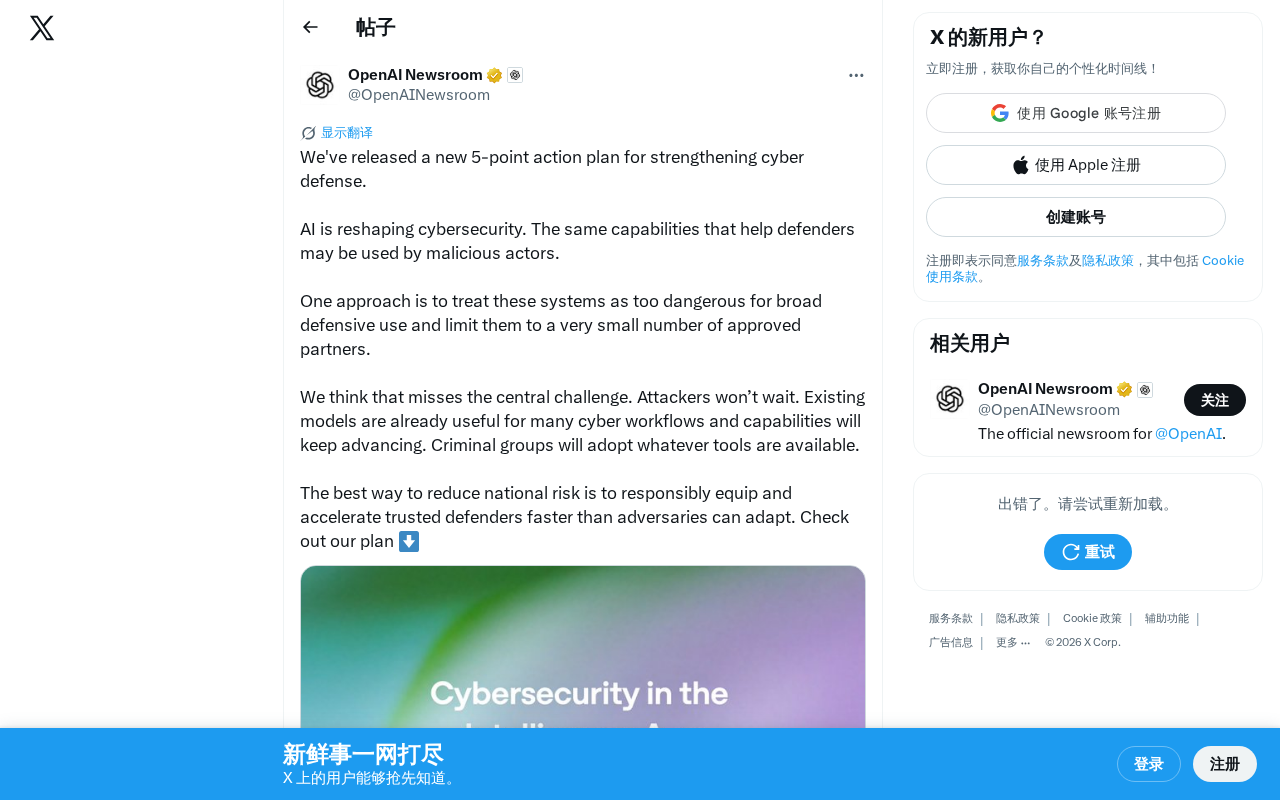
Anthropic recently released a five-point action plan to strengthen cyber defense, with a clear core argument: Rather than viewing AI as too dangerous and restricting its use in defense, we should responsibly accelerate the arming of trusted defenders, enabling them to adapt and evolve faster than attackers.
Anthropic was co-founded in 2021 by former OpenAI Research VP Dario Amodei and his sister Daniela Amodei, with a core team largely from OpenAI's safety research division. The company's mission centers on "responsible AI development," having introduced safety frameworks such as Constitutional AI and interpretability research. Its flagship Claude model series is renowned for safety alignment. This cybersecurity action plan marks Anthropic's first systematic extension of its AI safety philosophy to the national cybersecurity strategy level, signaling a strategic expansion from "model safety" to "ecosystem security."
This stance directly responds to a common conservative view in the industry—that AI systems are too risky and should be limited to a very small number of approved partners. Anthropic argues that this approach overlooks the real core challenge.
AI Is Reshaping the Cybersecurity Landscape
The Asymmetric Game Between Offense and Defense
In its statement, Anthropic highlighted a key reality: AI is fundamentally changing the offensive-defensive landscape of cybersecurity. The same AI capabilities that help defenders can equally be exploited by malicious actors. Existing AI models can already support many cybersecurity workflows, and these capabilities continue to evolve.
From a technical perspective, large language models (LLMs) can automate malicious code analysis, generate exploit scripts, and simulate social engineering attack scripts—compressing tasks that would take skilled hackers hours down to minutes. Meanwhile, defensive AI applications including anomaly traffic detection, threat intelligence correlation analysis, and automated vulnerability remediation recommendations rely on the same underlying model capabilities. This "double-edged sword" characteristic makes cybersecurity one of the most complex domains in AI governance.
Cybersecurity has long suffered from an "offense-defense asymmetry" dilemma: attackers only need to find one vulnerability to succeed, while defenders must patch every single one. This structural inequality is further amplified in the AI era. Attackers can use AI to lower technical barriers, enabling "democratized" Advanced Persistent Threat (APT) attacks; meanwhile, if defenders face restrictions on AI usage, they fall even further behind in an already unequal contest. The "first-mover advantage" in game theory means in this context: whichever side first deploys AI capabilities at scale for defense will gain a strategic advantage that's difficult to reverse.
More alarmingly, criminal organizations won't wait for regulations to land—they will adopt every available tool. Attackers won't stop because defenders impose limitations on themselves. If the defensive side is overly conservative with AI applications, they are effectively widening the capability gap with attackers.
Why Restricting Defensive AI Use Won't Work
Restricting defensive AI use to a very small number of partners may appear prudent on the surface, but this approach has fundamental flaws:
- Attackers face no restrictions: Criminal organizations and nation-state hackers can freely obtain and deploy open-source models and various AI tools
- Defense needs broad coverage: Cybersecurity defense isn't just the concern of a few institutions—it's a shared need across the entire digital ecosystem
- Technological evolution is irreversible: AI capabilities continue to advance; restricting use only causes defenders to fall behind attackers
Core Strategy of Anthropic's Five-Point Action Plan
From Anthropic's public statement, several core strategic directions can be distilled:
First, accelerate rather than restrict. The best way to reduce national-level cyber risk is to responsibly equip trusted defenders with AI and accelerate their capability building.
Second, responsible empowerment. The keyword is "responsibly," meaning AI capabilities shouldn't be opened indiscriminately, but rather targeted empowerment should occur on the basis of established trust mechanisms. Defining "trusted defenders" is the core challenge in implementing this strategy. Existing frameworks typically rely on identity verification (such as government agency credentials, security vendor certifications), purpose-of-use reviews (defensive vs. offensive), and behavioral monitoring mechanisms. However, the dual-use nature of AI capabilities makes technical-level distinctions extremely difficult—the same vulnerability scanning tool can be used for defensive auditing or offensive reconnaissance. This requires that institutional design cannot rely solely on technical means but must also incorporate legal liability tracing, usage log auditing, and industry self-regulation to build a multi-layered trust verification system.
Third, speed first. The core objective is to ensure defenders evolve faster than attackers adapt—this is fundamentally a race against time.
Industry Impact and Future Outlook
The Evolving Role of AI Safety Companies
As a company known for "AI safety," Anthropic's release of this cybersecurity action plan carries special significance. It demonstrates that AI safety isn't just about restrictions and constraints—it should also include proactive defensive empowerment. This shift in thinking from "passive defense" to "active arming" may redefine the entire industry's understanding of AI safety.
Implications for the Global AI Security Ecosystem
At the geopolitical level, AI cybersecurity capabilities have become a new dimension of national strategic competition. The U.S. CISA (Cybersecurity and Infrastructure Security Agency), the EU's ENISA (European Union Agency for Cybersecurity), and China's cybersecurity authorities are all exploring policy frameworks for AI-assisted defense. Notably, there are significant divergences among nations in their policy orientations between "open empowerment" and "strict control": the U.S. tends to pursue technological advantage through rapid deployment led by the private sector, while the EU emphasizes compliance review and risk prevention. Anthropic's action plan essentially provides industry endorsement for the "speed-first" path, and this stance itself is part of the global AI governance competition.
This approach holds reference value for the global AI security field. Against the backdrop of increasingly AI-driven cybersecurity offense and defense, how to balance the openness and control of AI capabilities, and how to ensure defenders don't fall behind in the technology race, are strategic questions every nation and organization must face.
The key lies in establishing a comprehensive mechanism: one that allows trusted defenders to rapidly acquire and deploy AI capabilities while preventing abuse. This requires multiple safeguards across technical means, institutional design, and ecosystem collaboration.
Conclusion
The AI arms race in cybersecurity has already begun. Anthropic's five-point action plan sends a clear signal: In the AI era, the greatest risk is not that defenders have too much AI capability, but too little. Facing constantly evolving cyber threats, only by enabling defenders to run faster can we truly reduce overall security risk.
Key Takeaways
- Anthropic released a five-point action plan advocating for responsibly accelerating the arming of trusted cyber defenders, rather than restricting AI's defensive use
- AI is reshaping the cybersecurity landscape; existing models can support multiple cybersecurity workflows, and criminal organizations will adopt every available tool
- The conservative strategy of limiting AI defensive capabilities to a few partners has fundamental flaws and widens the capability gap with attackers
- The core strategy is ensuring defenders evolve faster than attackers adapt—this is a race against time
- AI safety isn't just about restrictions and constraints; it should include proactive defensive empowerment, representing an important shift in industry thinking
Related articles
 Tech Frontiers
A Rare Quiet Day in AI: Recursive Self-Improvement Stirs Beneath the Surface
A rare quiet day in AI sees multiple sources go silent simultaneously. Behind the calm, Recursive Self-Improvement (RSI) research continues. What this means for the industry.
 Tech Frontiers
Reve 2 vs. Ideogram 4: A Deep Dive into Layout Control in AI Image Generation
A deep comparison of Reve 2 and Ideogram 4's layout control capabilities, covering technical approaches, real-world use cases, and industry trends for designers and creators.
 Tech Frontiers
In the Weights: Check Your Influence Score in the AI World
In the Weights is an AI influence search engine that quantifies your presence in the AI world with a score. Explore how it evaluates practitioners and what it means for digital identity.